Results by title
179 books match the query 'Past' and 7 start with m
Making Senses of the Past
Toward a Sensory ArchaeologyEdited by Jo Day
Southern Illinois University Press, 2013
Since the nineteenth century, museums have kept their artifacts in glass cases to better preserve them, and drawings and photographs have become standard ways of presenting the past. These practices have led to an archaeology dominated by visual description, even though human interaction with the surrounding world involves the whole body and all of its senses. In the past few years, sensory archaeology has become more prominent, and Making Senses of the Past is one of the first collected volumes on this subject. This book presents cutting-edge research on new theoretical issues. The essays presented here take readers on a multisensory journey around the world and across time.
In ancient Peru, a site provides sensory surprises as voices resound beneath the ground and hidden carvings slowly reveal their secrets. In Canada and New Zealand, the flicker of reflected light from a lake dances on the faces of painted rocks and may have influenced when and why the pigment was applied. In Mesopotamia, vessels for foodstuffs build a picture of a past cuisine that encompasses taste and social activity in the building of communities. While perfume and flowers are examined in various cultures, in the chamber tombs of ancient Roman Palestine, we are reminded that not all smells are pleasant. Making Senses of the Past explores alternative ways to perceive past societies and offers a new way of wiring archaeology that incorporates the senses.
In ancient Peru, a site provides sensory surprises as voices resound beneath the ground and hidden carvings slowly reveal their secrets. In Canada and New Zealand, the flicker of reflected light from a lake dances on the faces of painted rocks and may have influenced when and why the pigment was applied. In Mesopotamia, vessels for foodstuffs build a picture of a past cuisine that encompasses taste and social activity in the building of communities. While perfume and flowers are examined in various cultures, in the chamber tombs of ancient Roman Palestine, we are reminded that not all smells are pleasant. Making Senses of the Past explores alternative ways to perceive past societies and offers a new way of wiring archaeology that incorporates the senses.
[more]
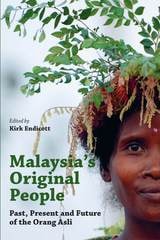
Malaysia's Original People
Past, Present and Future of the Orang AsliEdited by Kirk Endicott
National University of Singapore Press, 2015
The Malay-language term used for indigenous minority peoples of Peninsular Malaysia, “Orang Asli”, covers at least 19 culturally and linguistically distinct subgroups. Until about 1960 most Orang Asli lived in small camps and villages in the coastal and interior forests, or in isolated rural areas, and made their living by various combinations of hunting, gathering, fishing, agriculture, and trading forest products. By the end of the century, logging, economic development projects such as oil palm plantations, and resettlement programmes have displaced many Orang Asli communities and disrupted long-established social and cultural practices.
The chapters in the present volume provide a comprehensive survey of current understandings of Malaysia’s Orang Asli communities, covering their origins and history, cultural similarities and differences, and they ways they are responding to the challenges posed by a rapidly changing world. The authors, a distinguished group of Malaysian (including Orang Asli) and international scholars with expertise in anthropology, archaeology, biology, education, therapy, geography and law, also show the importance of Orang Asli studies for the anthropological understanding of small-scale indigenous societies in general.
The chapters in the present volume provide a comprehensive survey of current understandings of Malaysia’s Orang Asli communities, covering their origins and history, cultural similarities and differences, and they ways they are responding to the challenges posed by a rapidly changing world. The authors, a distinguished group of Malaysian (including Orang Asli) and international scholars with expertise in anthropology, archaeology, biology, education, therapy, geography and law, also show the importance of Orang Asli studies for the anthropological understanding of small-scale indigenous societies in general.
[more]
Managing Crises in the Academic Library
Past, Present, and FutureDoris Van Kampen-Breit
Assoc of College & Research Libraries, 2023
When a crisis occurs, it is the employees who determine an organization’s resiliency and effectiveness. It is their response, ability to plan for contingencies, and capacity for creating solutions that means the difference between organizational success and failure.
In 29 chapters from authors in all institution types and sizes, Managing Crises in the Academic Library can help library workers learn from the crises of the past and prepare for the next unexpected event. Chapters cover lessons from the COVID-19 pandemic, perpetual budget uncertainty, dealing with downsizing, merging departments, mold mitigation, and mental health issues, but also offer strategies applicable during any crisis, including:
Libraries and library workers are deeply sustaining lifelines for many students and faculty. Managing Crises in the Academic Library collects stories that demonstrate the tenacity, creativity, and ingenuity of academic library workers as they maintain this vital community lifeline and offers actionable ideas and approaches for planning for and sustaining the resources, services, and people in the library during difficult times.
In 29 chapters from authors in all institution types and sizes, Managing Crises in the Academic Library can help library workers learn from the crises of the past and prepare for the next unexpected event. Chapters cover lessons from the COVID-19 pandemic, perpetual budget uncertainty, dealing with downsizing, merging departments, mold mitigation, and mental health issues, but also offer strategies applicable during any crisis, including:
- Responsive decision-making in academic library collections
- Managing stakeholder expectations
- Effective communication strategies
- Continuity of operations planning
- Utilizing library storage facilities
- Documentation and cross-training
- Mediating student technology needs
- Setting boundaries
Libraries and library workers are deeply sustaining lifelines for many students and faculty. Managing Crises in the Academic Library collects stories that demonstrate the tenacity, creativity, and ingenuity of academic library workers as they maintain this vital community lifeline and offers actionable ideas and approaches for planning for and sustaining the resources, services, and people in the library during difficult times.
[more]
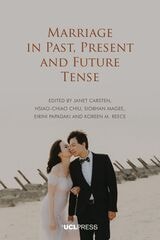
Marriage in Past, Present and Future Tense
Edited by Janet Carsten, Hsiao-Chiao Chiu, Siobhan Magee, Eirini Papadaki, and Koreen M. Reece
University College London, 2021
A wide-ranging survey of how marriage relates to social change.
A series of global case studies, Marriage in Past, Present and Future Tense unravels the ever-changing intimate and institutional questions united by marriage. Traversing politics, economics, and religion, the authors explore how marital practices both react to and produce broader social transformation. In particular, the authors contend that contexts marked by violent sociopolitical ruptures such as civil war or colonization illuminate the links between the personal and political. What emerges is a complex portrait of marriage as a site of cultural memory, embodied experience, and active imagination.
A series of global case studies, Marriage in Past, Present and Future Tense unravels the ever-changing intimate and institutional questions united by marriage. Traversing politics, economics, and religion, the authors explore how marital practices both react to and produce broader social transformation. In particular, the authors contend that contexts marked by violent sociopolitical ruptures such as civil war or colonization illuminate the links between the personal and political. What emerges is a complex portrait of marriage as a site of cultural memory, embodied experience, and active imagination.
[more]
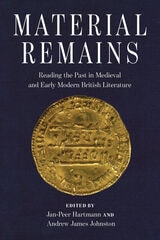
Material Remains
Reading the Past in Medieval and Early Modern British LiteratureEdited by Jan-Peer Hartmann and Andrew James Johnston
The Ohio State University Press, 2021
Medieval and early modern literature was fascinated with the material remains of the past. Scenes involving the discovery, description, circulation, or contemplation of archaeological objects can be found in texts ranging from hagiography to elegiac poetry, from historiography to romance—across regions and periods. This volume gathers voices to explore the ways in which these texts employ descriptions of objects from the past to produce aesthetic and literary responses to questions of historicity and the epistemological conditions of historical knowledge. The contributions to Material Remains: Reading the Past in Medieval and Early Modern British Literature examine the understanding and experience of temporality as registered through the representation of found objects. From Beowulf and King Arthur to Richard III, Roger de Norton, and more, these essays reproduce the thrill of the archaeological find and generate new forms of historical understanding beyond the established narratives that reinforce modern forms of periodizing the Middle Ages. List of Contributors Neil Cartlidge, Roberta Frank, Lori Ann Garner, Jonathan Gil Harris, Jan-Peer Hartmann, John Hines, Naomi Howell, Andrew Hui, Andrew James Johnston, Sarah Salih, Philip Schwyzer
[more]
More than a Moment
Contextualizing the Past, Present, and FutureSteven D. Krause
Utah State University Press, 2019
As recently as 2012, massive open online courses (MOOCs) looked poised to revolutionize higher education, but in just a few years their flaws and problems have made them into a less relevant model. In More than a Moment, Steven D. Krause explores MOOCs and their continuing impact on distance learning in higher education, putting them in the context of technical innovations that have come before and those that will be part of the educational future.
Krause writes about his own experiences as a participant in several MOOCs and the experiences of faculty who developed and taught MOOCs. Contrary to many early claims from educational entrepreneurs, they were never entirely “new,” and MOOCs and their aftermath are still at the heart of the tensions between nonprofit universities and for-profit entities, particularly online program management firms, in delivering distance education.
While MOOCs are no longer a threat to education in the United States, they are part of the ongoing corporatization of education and remain part of conversations about experienced-based credit, corporate training, and open education. Presenting historical, student, teacher, and administrative perspectives, More than a Moment is a well-rounded treatment that will be of interest to academics and entrepreneurs interested in distance education, online pedagogy, online program management, and public-private partnerships in higher education.
[more]
Music Theory and the Exploration of the Past
Edited by Christopher Hatch and David W. Bernstein
University of Chicago Press, 1993
In recent decades, increased specialization has sharply separated music theory from historical musicology. Music Theory and the Exploration of the Past brings together a group of essays—written by theorists and musicologists—that seek to bridge this gap. This collection shows that music theory can join forces with historical musicology to produce a more humanistic form of musical scholarship.
In nineteen essays dealing with musical theories from the twelfth to the twentieth century, two recurring themes emerge. One is the need to understand the historical circumstances of the writing and reception of theory, a humanistic approach that gives theory a place within social and intellectual history. The other is the advantages of applying contemporaneous theory to the music of a given period, thus linking theory to the history of musical styles and structures. The periods given principal attention in these essays are the Renaissance, the years around 1800, and the twentieth century.
Abundantly illustrated with musical examples, Music Theory and the Exploration of the Past offers models of new practical applications of theory to the analysis of music. At the same time, it raises the broader question of how historical knowledge can deepen the understanding of an art and of systematic writings about that art.
[more]