Results by title
137 books match the query 'Patients' and 7 start with m

Making Uncertainty
Tuberculosis, Substance Use, and Pathways to Health in South AfricaAnna Versfeld
Rutgers University Press, 2023
In Cape Town, South Africa, many people with tuberculosis also use substances. This sets up a seemingly impossible problem: People who use substances are at increased risk of tuberculosis disease; and substance use seems to result in erratic behavior that makes successful treatment of people affected by tuberculosis extremely difficult. People affected don’t get healthy, healthcare providers are frustrated, and families seek to balance love and care for those who are ill with self-protection. How are we to understand this? Where does the responsibility for poor health and healing lie? What are the possibilities for an effective healthcare response? Through a close look at lives and care, Making Uncertainty: Tuberculosis, Substance Use, and Pathways to Health shows how patterns of substance use, tuberculosis disease, and their interaction are shaped by history, social context, and political economy. This, in turn, generates new perspectives on what makes poor health, and what good care might look like.
[more]
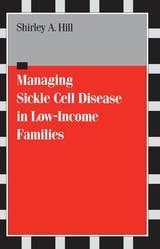
Managing Sickle Cell Disease
In Low-Income FamiliesShirley A. Hill
Temple University Press, 2003
As many as 30,000 African Americans have sickle cell disease (SCD). Though the political activism of the 1960s and a major 1970s health campaign spurred demands for testing, treatment, and education programs, little attention has been given to how families cope with SCD. This first study to give SCD a social, economic, and cultural context documents the daily lives of families living with this threatening illness. Specifically, Shirley A. Hill examines how low-income African American mothers with children suffering from this hereditary, incurable, and chronically painful disease, react to the diagnosis and manage their family's health care.The 23 mostly single mothers Hill studies survive in an inner-city world of social inequality. Despite limited means, they actively participate, create, and define the social world they live in, their reality shaped by day-to-day caregiving. These women overcome obstacles by utilizing such viable alternatives as sharing child care with relatives within established kinship networks.Highlighting the role of class, race, and gender in the illness experience, Hill interprets how these women reject, redefine, or modify the objective scientific facts about SCD. She acknowledges and explains the relevance of child-bearing and motherhood to African American women's identity, revealing how the revelation of the SCD trait or the diagnosis of one child often does not affect a woman's interpretation of her reproductive rights.
[more]
Meaning Of A Disability
The Lived Experience of ParalysisAlbert Robillard
Temple University Press, 1999
When ethnomethodologist Albert Robillard began to suffer the symptoms of motor-neuron disease, he realized he was a living laboratory for revealing the countless taken-for-granted methods people use to produce being together. Meaning of a Disability is a detailed autobiography of the experiences and trained observations of a university professor who became paralyzed in mid-life.
With his loss of speech, Robillard was forced to communicate through a lip-reading system developed by his wife and student assistants. Restricted by this form of communication and his paralysis, he soon learned the frustrations of making his meaning known. Hospital nurses wrongly anticipated his words. Those who translated for him inevitably distorted his meaning. Most of all, the casual pace of conversational give-and-take was disrupted. Old friends would leave before Robillard could provide the expected interactional response.
Finding himself isolated due to his lack of both mobility and vocalization, Robillard threw himself into his academic work and began to develop settings and methods where he could satisfactorily interact with others. A researcher and writer experienced in describing the bodily and verbal methods used to coordinate and construct the most ordinary of social forms, Robillard joins in this book both his years of sociological training and his time with illness to talk with moving and illuminating analysis about a broad range of matters. Moving gracefully from examinations of narratives about disability and illness, the stigmatizing things that healthcare providers unwittingly say to their patients, and communication problems in the intensive care unit, to more personal reflections on anger, isolation, and stories of tragedy, Robillard also discusses disability in the workplace and such seemingly simple topics as computers and vacations. Meaning of a Disability is the personal story of a highly trained observer forced to confront simultaneously the limits of the disabled person's social world and the unspoken assumptions about meaningful interaction -- as he struggles with the daily difficulties of maintaining his identity.
Meaning of a Disability will interest a wide audience, including healthcare professionals, disabled people, and caretakers as well as academics studying ethnomethodology, health and illness, conversation, symbolic interaction, storytelling, and most aspects of lived experience.
[more]
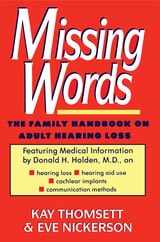
Missing Words
The Family Handbook on Adult Hearing LossKay Thomsett
Gallaudet University Press, 1993
Written by Eve Nickerson, who is deaf, and her daughter Kay Thomsett, Missing Words lays out the practical steps families can take to adjust to a loved one’s hearing loss. This excellent guidebook shows how the exchange of information can be altered at fundamental levels, what these alterations entail, and how they can affect one’s ability to understand and interpret spoken communication. Along with the hands-on tips provided throughout, this handbook considers the potential of cochlear implants, described both by audiologist Holden and by Nickerson, who underwent implant surgery in 1985. For all families coping with a loved one’s hearing loss, Missing Words is the outstanding single resource upon which they can rely.
[more]

Modern Nature
Derek Jarman
University of Minnesota Press, 2009
[more]

Mother in Summer
Susan Hahn
Northwestern University Press, 2002
Mother in Summer is a collection of poems offering candid, powerful insight into the grief of losing a parent.
[more]
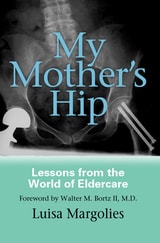
My Mother's Hip
Lessons From The World Of EldercareLuisa Margolies
Temple University Press, 2004
Some 400,000 hip fractures occur every year, the vast majority among the elderly; all too often these fractures are associated with death or severe disability. After her mother's double hip fracture, Luisa Margolies immersed herself in identifying and coordinating the services and professionals needed to provide critical care for an elderly person. She soon realized that the American medical system is ill prepared to deal with the long-term care needs of our graying society. The heart of My Mother's Hip is taken up with the author's day-to-day observations as her mother's condition worsened, then improved only to worsen again, while her father became increasingly anxious and disoriented. As both a devoted daughter and a skilled anthropologist, Margolies vividly renders her interactions with physicians, nurses, hospital workers, nursing home administrators, the Medicare bureaucracy, home care providers, and her parents. In the Lessons chapter that follows each episode, she discusses in a broader context the weighty decisions that adult children must make on their parents' behalf and the emotional toll their responsibility takes. Here she addresses the complex practical issues that commonly arise in such situations: understanding the consequences of hip fracture and its treatment, preparing health care proxies and advanced directives, enabling elders to remain at home, and the heartbreaking dilemma of prolonging life. Like many adult children, Margolies learned her lessons about eldercare in the midst of crises. This book is intended to ease the information-gathering and decision-making processes for others involved in eldercare.
[more]