Results by title
310 books match the query 'Performance' and 14 start with m
Makeshift Chicago Stages
A Century of Theater and PerformanceEdited by Megan E. Geigner, Stuart J. Hecht, and Jasmine Jamillah Mahmoud
Northwestern University Press, 2021
This book examines the rise and proliferation of Chicago’s performance spaces, which have rooted the city’s dynamic, thriving theater community. Chapters cover well‑known, groundbreaking, and understudied theatrical sites, ensembles, and artists, including the 1893 Columbian Exposition Midway Plaisance, the 57th Street Artist Colony, the Fine Arts Building, the Goodman Theatre, the Federal Theatre Project, the Kingston Mines and Body Politic Theaters, ImprovOlympics (later iO), Teatro Vista, Theaster Gates, and the Chicago Home Theater Festival. By putting space at the center of the city’s theater history, the authors in Makeshift Chicago Stages spotlight the roles of neighborhoods, racial dynamics, atypical venues, and borders as integral to understanding the work and aesthetics of Chicago’s artists, ensembles, and repertoires, which have influenced theater practices worldwide. Featuring rich archival work and oral histories, this anthology will prove a valuable resource for theater historians, as well as anyone interested in Chicago’s cultural heritage.
Making It Up Together
The Art of Collective Improvisation in Balinese Music and BeyondLeslie A. Tilley
University of Chicago Press, 2019
Through two contrasting Balinese case studies—of the reyong gong chime’s melodic norot practice and the interlocking drumming tradition kendang arja—Tilley proposes and tests analytical frameworks for examining collectively improvised performance. At the micro-level, Tilley’s analyses offer insight into the note-by-note decisions of improvising performers; at the macro-level, they illuminate larger musical, discursive, structural, and cultural factors shaping those decisions. This multi-tiered inquiry reveals that unpacking how performers play and imagine as a collective is crucial to understanding improvisation and demonstrates how music analysis can elucidate these complex musical and interactional relationships.
Highlighting connections with diverse genres from various music cultures, Tilley’s examinations of collective improvisation also suggest rich potential for cross-genre exploration. The surrounding discussions point to larger theories of communication and interaction, creativity and cognition that will be of interest to a range of readers—from ethnomusicologists and music theorists to cognitive psychologists, jazz studies scholars, and improvising performers. Setting new parameters for the study of improvisation, Making It Up Together opens up fresh possibilities for understanding the creative process, in music and beyond.
Marketing the Bard
Shakespeare in Performance and Print, 1660-1740Don-John Dugas
University of Missouri Press, 2006
To posterity, William Shakespeare may be the Bard of Avon, but to mid-seventeenth-century theatergoers he was just another dramatist. Yet barely a century later, he was England’s most popular playwright and a household name. In this intriguing study, Don-John Dugas explains how these changes came about and sealed Shakespeare’s reputation even before David Garrick performed his work on the London stage.
Mask Improvisation for Actor Training and Performance
The Compelling ImageSears Eldredge
Northwestern University Press, 1996
Featuring dozens of improvisational exercises in the innovative spirit of Viola Spolin, and supplemented with practical appendices on mask design and construction, forms and checklists, and other classroom materials, this book is an invaluable tool for teacher and student alike, as well as compelling reading for anyone interested in acquiring a deeper understanding of masks as agents of transformation, creativity, and performance.
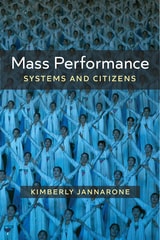
Mass Performance
Systems and CitizensKimberly Jannarone
University of Michigan Press, 2025
Although not a comprehensive study of such events, Jannarone’s analysis of the selected mass performance systems yields new theoretical perspectives on these phenomena, a central focus of her study being how political leaders find ways to create a physically coordinated mass body politic, even during times of hardship and war. By interpreting and historicizing mass assemblies of bodies, this study analyzes the choreographies and organizations that brought thousands of people together as an ensemble and kept them together in meaning-making motion.

Media Sense
The Folklore-Popular Culture ContinuumUniversity of Wisconsin Press, 0
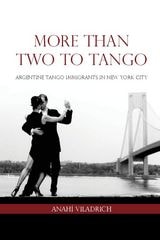
More Than Two to Tango
Argentine Tango Immigrants in New York CityAnahí Viladrich
University of Arizona Press, 2013
Based on a highly visible group of performers within the almost hidden population of Argentines in the United States, More than Two to Tango addresses broader questions on the understudied role of informal webs in the entertainment field. Through the voices of both early generations of immigrants and the latest wave of newcomers, Anahí Viladrich explores how the dancers, musicians, and singers utilize their complex social networks to survive as artists and immigrants. She reveals a diverse community navigating issues of identity, class, and race as they struggle with practical concerns, such as the high cost of living in New York City and affordable health care.
Argentina’s social history serves as the compelling backdrop for understanding the trajectory of tango performers, and Viladrich uses these foundations to explore their current unified front to keep tango as their own “authentic” expression. Yet social ties are no panacea for struggling immigrants. Even as More Than Two to Tango offers the notion that each person is truly conceived and transformed by their journeys around the globe, it challenges rosy portraits of Argentine tango artists by uncovering how their glamorous representations veil their difficulties to make ends meet in the global entertainment industry. In the end, the portrait of Argentine tango performers’ diverse career paths contributes to our larger understanding of who may attain the “American Dream,” and redefines what that means for tango artists.
Movable Londons
Performance and the Modern CityJulia H Fawcett
University of Michigan Press, 2025
Moving Performances
Divas, Iconicity, and Remembering the Modern StageScheper, Jeanne
Rutgers University Press, 2017

Mozart the Performer
Variations on the Showman's ArtDorian Bandy
University of Chicago Press, 2023
We know Mozart as one of history’s greatest composers. But his contemporaries revered him as a multi-instrumentalist, a dazzling improviser, and the foremost keyboard virtuoso of his time. When he composed, it was often with a single aim in mind: to set the stage, quite literally, for compelling and captivating performances. He wrote piano concertos not with an eye to posterity but to give himself a repertoire with which to flaunt his keyboard wizardry before an awestruck public. The same was true of his sonatas, string quartets, symphonies, and operas, all of which were painstakingly crafted to produce specific effects on those who played or heard them, amusing, stirring, and ravishing colleagues and consumers alike.
Mozart the Performer brings to life this elusive side of Mozart’s musicianship. Dorian Bandy traces the influence of showmanship on Mozart’s style, showing through detailed analysis and imaginative historical investigation how he conceived his works as a series of dramatic scripts. Mozart the Performer is a book for anyone who wishes to engage more deeply with Mozart’s artistry and legacy and understand why, centuries later, his music still captivates us.
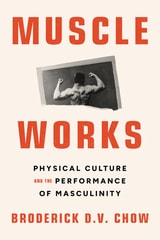
Muscle Works
Physical Culture and the Performance of MasculinityBroderick D. V. Chow
Northwestern University Press, 2024
This book recounts the story of fitness culture from its beginnings as spectacles of strongmen, weightlifters, acrobats, and wrestlers to its legitimization in the twentieth-century in the form of competitive sports and health and wellness practices. Broderick D. V. Chow shows how these modes of display contribute to the construction and deconstruction of definitions of masculinity.
Attending to its theatrical origins, Chow argues for a more nuanced understanding of fitness culture, one informed by the legacies of self-described Strongest Man in the World Eugen Sandow and the history of fakery in strongman performance; the philosophy of weightlifter George Hackenschmidt and the performances of martial artist Bruce Lee; and the intersections of fatigue, resistance training, and whiteness. Muscle Works: Physical Culture and the Performance of Masculinity moves beyond the gym and across the archive, working out techniques, poses, and performances to consider how, as gendered subjects, we inhabit and make worlds through our bodies.
Music Talent & Performance
Conservatory Cultural SystemHenry Kingsbury
Temple University Press, 2001
Author Henry Kingbury, a conservatory-trained pianist and music educator turned anthropologist forgoes the traditional ethnomusicologist approach of looking at a non-Western musical culture to focus on the "field" of an American conservatory. The result is a penetrating look at the distinction between teaching music and the nurturing of musicality. Kingsbury offers an innovative anthropological analysis of the western notion of "talent" and its cultural character, noting that many non-western societies have no such concept. Furthermore, he examines various contexts in which music is produced, experienced, and evaluated. His discussion includes the dynamics of orchestra rehearsals in the conservatory, "master class" lessons with a distinguished performer-pedagogue, the ritual characteristics of solo recitals, and an interpretive analysis of stage fright.
Ultimately, Kingsbury argues that music "is highly shifting and indeterminate in meaning," a concept that has important implications for all interpreters of culture and for the artists themselves.
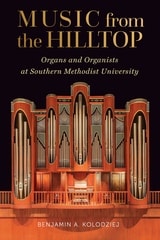
Music from the Hilltop
Organs and Organists at Southern Methodist UniversityBenjamin A. Kolodziej
University of North Texas Press, 2023
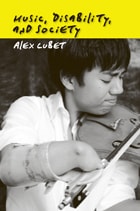
Music, Disability, and Society
Authored by Alex Lubet
Temple University Press, 2010
Musical talent in Western culture is regarded as an extraordinary combination of technical proficiency and interpretative sensitivity. In Music, Disability, and Society, Alex Lubet challenges the rigid view of technical skill and writes about music in relation to disability studies. He addresses the ways in which people with disabilities are denied the opportunity to participate in music.
Elaborating on the theory of "social confluence," Lubet provides a variety of encounters between disability and music to observe radical transformations of identity. Considering hand-injured and one-handed pianists; the impairments of jazz luminaries Django Reinhardt, Horace Parlan, and "Little" Jimmy Scott; and the "Blind Orchestra" of Cairo, he shows how the cultural world of classical music contrasts sharply with that of jazz and how musicality itself is regarded a disability in some religious contexts. Music, Disability, and Society also explains how language difference can become a disability for Asian students in American schools of music, limiting their education and careers.
Lubet offers pungent criticism of the biases in music education and the music profession, going so far as to say that culture disables some performers by adhering to rigid notions of what a musician must look like, how music must be played, who may play it, and what (if any) is the legitimate place of music in society. In Music, Disability, and Society, he convincingly argues that where music is concerned, disability is a matter of culture, not physical impairment.