Results by title
212 books match the query 'Peru' and 10 start with m

Making Institutions Work in Peru
Democracy, Development and Inequality Since 1980Edited by John Crabtree
University of London Press, 2006
Contributors include Paulo Drino (University of Manchester), Cynthia Sanborn (Centro de Investigaciones, Universidad del Pacifico, Lima), Carlos Monge (Participacion Ciudadana, Lima), Fernando Rospigliosi (Instituto de Estudios Peruanos, Lima), Pedro Franck (Departamento de Economia, Universidad Catolica, Lima), Fernando Eguren (Centro Peruano de Ciencias Sociales, Lima), Rosemary Thorp (Queen Elizabeth House/St Antony's College, Oxford), Eduardo Dargent (University of Texas,Austin), Coletta Youngers (Washington Office on Latin America,Washington D.C.), Francisco Durand (University of Texas, San Antonio), Jose Tavara (Departamento de Economia, Universidad Catolica, Lima, and OSIPTEL), and Richard Webb (Instituto Cuanto and Central Bank of Peru).
Making Music Indigenous
Popular Music in the Peruvian AndesJoshua Tucker
University of Chicago Press, 2019
Malambo
Lucía Charún-Illescas
Swan Isle Press, 2004
“In Malambo . . . the Rimac proudly rubs elbows with the freedmen, the cimarrons, and smuggled slaves. . . It runs united to the other subterranean springs underneath Blanket Street, Weavers Lane, and under Jewish Street . . . and Swordmaker’s Lanes.”
The Rimac shapes the narrative of this compelling historical novel that probes the brutal clash of ethnicity, religion, and class in sixteenth- and seventeenth-century Peru. Set against the backdrop of Spanish colonialism and the Spanish Inquisition in the “New World,” Malambo peels back the layers of Peru’s society to focus on the subtle connections among indigenous peoples— Africans, Jews, Christians, and others—whose cultural fusion pervades Latin American history and culture.
At the heart of the novel is Tomason, an African artist living along the Rimac who paints religious murals for the church and his colonial masters. The intermingling of his Yoruba heritage with his life in a Spanish colony transforms him into a griot figure who unearths the deeper truths of his painful and complex experience by sharing it. Other memorable characters’ stories intertwine with Tomason’s tale, developing a narrative that powerfully reflects on the themes of dislocation and enslavement.
Malambo is an unforgettable work that explores the origins of the Afro-Hispanic experience and offers a profound meditation on the forces of history.
Marayrasu
StoriesEdgardo Rivera Martínez, Amy Olen
Northwestern University Press, 2026
The stories in Marayrasu stage fantastical, mysterious encounters that belie the characters’ often harsh economic and political realities as they seek belonging in modern Peru through art, music, and relationships. Depicted in poetic prose, these characters are loners, orphans, and outcasts experiencing quiet, tender encounters with other people and animals, the creative arts, and the land they find themselves depending on. Living vibrantly within these stories, the leviathan of Inca lore considers its own form, a young boy moves to a mining town and gets involved with a local union leader’s fight for worker rights while feeling the powerful pull of a large mountain overlooking the town, and a Persian cat captures the attention of a family down on its luck. Amy Olen’s translation smoothly captures Rivera Martínez’s impressive stories, offering a unique lens into the region at the heart of this canonical author’s inimitable work.
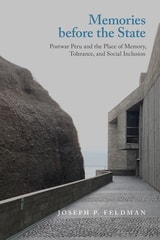
Memories before the State
Postwar Peru and the Place of Memory, Tolerance, and Social InclusionJoseph P. Feldman
Rutgers University Press, 2021
Memories before the State examines the discussions and debates surrounding the creation of the Place of Memory, Tolerance, and Social Inclusion (LUM), a national museum in Peru that memorializes the country’s internal armed conflict of the 1980s and 1990s. Emerging from a German donation that the Peruvian government initially rejected, the Lima-based museum project experienced delays, leadership changes, and limited institutional support as planners and staff devised strategies that aligned the LUM with a new class of globalized memorial museums and responded to political realities of the country’s postwar landscape. The book analyzes forms of authority that emerge as an official institution seeks to incorporate and manage diverse perspectives on recent violence.
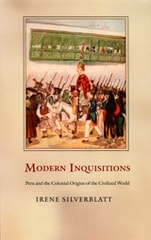
Modern Inquisitions
Peru and the Colonial Origins of the Civilized WorldIrene Silverblatt
Duke University Press, 2004
Drawing on extensive research in Peruvian and Spanish archives, Silverblatt uses church records, evangelizing sermons, and missionary guides to explore how the emerging modern world was built, experienced, and understood by colonists, native peoples, and Inquisition officials: Early missionaries preached about world history and about the races and nations that inhabited the globe; Inquisitors, able bureaucrats, defined who was a legitimate Spaniard as they executed heretics for “reasons of state”; the “stained blood” of Indians, blacks, and descendants of Jews and Moors was said to cause their deficient character; and native Peruvians began to call themselves Indian.
In dialogue with Arendt and other theorists of modernity, Silverblatt shows that the modern world’s underside is tied to its origins in colonialism and to its capacity to rationalize violence. Modern Inquisitions forces the reader to confront the idea that the Inquisition was not only a product of the modern world of the sixteenth and seventeenth centuries, but party to the creation of the civilized world we know today.
Modern Peru
A New HistoryPaulo Drinot and Alberto Vergara, editors
Duke University Press, 2025
Contributors. Eduardo Dargent, Paulo Drinot, Cynthia McClintock, José Luis Rénique, Natalia Sobrevilla Perea, Alberto Vergara, Charles Walker
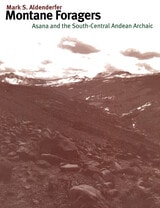
Montane Foragers
Asana and the South-Central Andean ArchaicMark S. Aldenderfer
University of Iowa Press, 1998
Aldenderfer's investigation forms a methodological and theoretical tour de force that elucidates elevational stress—what it takes for humans to adjust and survive at high altitudes. In a masterful integration of mountain biology and ecology, he emphasizes the nature of hunter-gatherer adaptations to high-mountain environments. He carefully documents the cultural history of Asana, the first stratified, open-air site discovered in the highlands of the south-central Andes. He establishes a number of major occurrences at this revolutionary site, including the origins of plant and animal domestication and transitions to food production, the growth and packing of forager populations, and the advent of some form of complexity and social hierarchy.
The rich and diversified archaeological record recovered at Asana—which spans from 10,000 to 3,500 years ago—includes the earliest houses as well as public and ceremonial buildings in the central cordillera. Built, used, and abandoned over many millennia, the Asana structures completely transform our understanding of the antiquity and development of native American architecture. Aldenderfer's detailed archaeological case study of high-elevation foraging adaptation, his description of this extreme environment as a viable human habitat, and his theoretical model of montane foraging create a new understanding of the lifeways of foraging peoples worldwide.
Mother Tongues of the High Andes
Gender, Language, and Indigenous Difference in PeruSandhya Krittika Narayanan
University of Arizona Press, 2025
Anthropologist Sandhya Krittika Narayanan begins with these challenges, and asks: What does it mean to be a Quechua or Aymara speaker in Puno today? What does it mean to be an Indigenous ethnic Quechua or Aymara individual?
Mother Tongues of the High Andes opens with these questions, exploring what Quechua and Aymara languages and identities mean for Indigenous puneños as they navigate their past and present. Narayanan argues that understanding inter-Indigenous linguistic and social differences involves examining Indigenous gender roles, responsibilities, and linguistic practices, particularly those of Indigenous puneña women. She shows how these practices have contributed to the maintenance of Indigenous multilingualism and continuity in local modes of understanding Indigenous identity and difference.
Even as ideologies around Indigenous identity and linguistic practices shift due to global discourses on Indigenous ethnic identity and nationalism, Indigenous women continue to play a crucial role, promoting new ways to speak and think about Quechua and Aymara linguistic differences, making the Indigenous roots and histories of Puno recognizable to a global audience. Through a comprehensive ethnographic exploration of gender, language, and Indigenous difference, Narayanan shows how the linguistic and social practices of Indigenous puneña women both contest and reaffirm competing visions of Quechua and Aymara linguistic identity and authority.
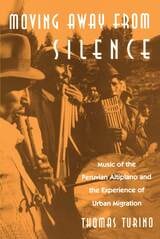
Moving Away from Silence
Music of the Peruvian Altiplano and the Experience of Urban MigrationThomas Turino
University of Chicago Press, 1993
Turino's ethnography is the first large-scale study to concentrate on the pervasive effects of migration on Andean people and their music. Turino uses the musical traditions of Conima, Peru as a unifying thread, tracing them through the varying lives of Conimeos in different locales. He reveals how music both sustains and creates meaning for a people struggling amid the dramatic social upheavals of contemporary Peru.
Moving Away from Silence contains detailed interpretations based on comparative field research of Conimeo musical performance, rehearsals, composition, and festivals in the highlands and Lima. The volume will be of great importance to students of Latin American music and culture as well as ethnomusicological and ethnographic theory and method.