Results by title
114 books match the query 'Philadelphia' and 7 start with m
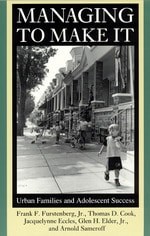
Managing to Make It
Urban Families and Adolescent SuccessFrank F. Furstenberg, Thomas D. Cook, Jacquelynne Eccles, Glen H. Elder Jr.,
University of Chicago Press, 1999
Based on nearly 500 interviews and case studies of families in inner-city Philadelphia, Managing to Make It lays out in detail the creative means parents use to manage risks and opportunities in their communities. More importantly, it also depicts the strategies parents develop to steer their children away from risk and toward resources that foster positive development and lead to success.
"Indispensible to anyone concerned about breaking the cycle of poverty and helplessness among at-risk adolescents, this book has a readable, graphic style easily grasped by those unfamiliar with statistical techniques." —Library Journal
Marketing Schools, Marketing Cities
Who Wins and Who Loses When Schools Become Urban AmenitiesMaia Bloomfield Cucchiara
University of Chicago Press, 2013
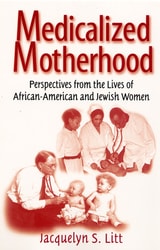
Medicalized Motherhood
Perspectives from the Lives of African-American and Jewish WomenJacquelyn S. Litt
Rutgers University Press, 1999
When Jacquelyn S. Litt interviewed African-American and Jewish women who raised their children in the 1930s and 1940s, she found that these women responded to experts' advice in ways uniquely shaped by their ethnicity, race, and class. For middle-class African-American and Jewish women, medicalization took place in ethnically/racially segregated networks and functioned as a collectively held strategy for social advance as much as a set of technical practices for raising healthy children. For poor, single African-American mothers, everyday networks offered limited access to medical institutions or mainstream norms. Medical discourse was largely controlled by white women and men, which left these women disempowered in medical institutions and marginal to dominant definitions of acceptable mothering.
Litt's book is enriched with many narratives from the mothers themselves. Both the women's voices and her acute sociological research bring to light how medicalized motherhood, while not the single cause of difference and inequality among the women, was a site where they were produced.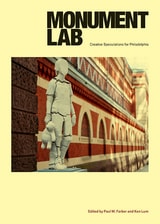
Monument Lab
Creative Speculations for PhiladelphiaPaul M. Farber
Temple University Press, 2020
What is an appropriate monument for the current city of Philadelphia? That was the question posed by the curators, artists, scholars, and students who comprise the Philadelphia-based public art and history studio Monument Lab. And in 2017, along with Mural Arts Philadelphia, they produced and organized a groundbreaking, city-wide exhibition of temporary, site-specific works that engaged directly with the community. The installations, by a cohort of diverse artists considering issues of identity, appeared in iconic public squares and neighborhood parks with research and learning labs and prototype monuments.
Monument Lab is a fabulous compendium of the exhibition and a critical reflection of the proceedings, including contributions from interlocutors and collaborators. The exhibition and this handbook were designed to generate new ways of thinking about monuments and public art as well as to find new, critical perspectives to reflect on the monuments we have inherited and to imagine those we have yet to build. Monument Lab energizes acivic dialogue about place and history as forces for a deeper questioning of what it means to be Philadelphian in a time of renewal and continuing struggle.
Contributors: Alexander Alberro, Alliyah Allen, Laurie Allen, Andrew Friedman, Justin Geller, Kristen Giannantonio, Jane Golden, Aviva Kapust, Fariah Khan, Homay King, Stephanie Mach, Trapeta B. Mayson, Nathaniel Popkin, Ursula Rucker, Jodi Throckmorton, Salamishah Tillet, Jennifer Harford Vargas, Naomi Waltham-Smith, Bethany Wiggin, Mariam I. Williams, Leslie Willis-Lowry, and the editors.
Artists: Tania Bruguera, Mel Chin, Kara Crombie, Tyree Guyton, Hans Haacke, David Hartt, Sharon Hayes, King Britt and Joshua Mays, Klip Collective, Duane Linklater, Emeka Ogboh, Karyn Olivier, Michelle Angela Ortiz, Kaitlin Pomerantz, RAIR, Alexander Rosenberg, Jamel Shabazz, Hank Willis Thomas, Shira Walinsky and Southeast by Southeast, and Marisa Williamson.
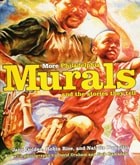
More Philadelphia Murals and the Stories They Tell
Jane Golden
Temple University Press, 2006
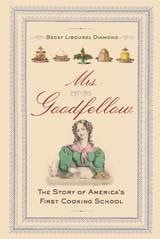
Mrs. Goodfellow
The Story of America's First Cooking SchoolBecky Libourel Diamond
Westholme Publishing, 2012
Recovering the Life and Influence of the “Mother of American Cooking,” the Woman Who Changed the Way We Learn How to Prepare Meals
In Philadelphia during the first decades of the nineteenth century, a widow, Mrs. Elizabeth Goodfellow, ran a popular bakery and sweet shop. In addition to catering to Philadelphia’s wealthy families and a reputation of having the finest desserts and sweet dishes in the young country, her business stood out from every other establishment in another way: she ran a small school to learn the art of cooking, the first of its kind in America. Despite her fame—references to her cooking as a benchmark abound in the literature of the period—we know very little about who she was. Since she did not keep a journal and never published any of her recipes, we have to rely on her students, most notably Eliza Leslie, who fortunately recorded many of Goodfellow’s creations and techniques. Goodfellow is known to have made the first lemon meringue pie and for popularizing regional foods, such as Indian (corn) meal. Her students also recall that Mrs. Goodfellow stressed using simple wholesome ingredients that were locally grown, presaging modern culinary fashion.
By assembling the many parts of this puzzle from old recipe books, advertisements, letters, diaries, genealogical records, and other primary sources, researcher and writer Becky Diamond has been able to provide a more complete portrait of this influential figure in cooking history. Mrs. Goodfellow: The Story of America’s First Cooking School begins with what we know about Elizabeth Goodfellow—where she was born, her husbands, her children, where her shop was located. We then travel back in time to discover the kinds of foods that would have been available to Goodfellow and how she may have used them. The book next turns to the rise of both commercial eating establishements and books of recipes. From here, the author explains the rapid expansion of cooking schools, such as the New York Cooking Academy and the Boston Cooking School, made famous through its association with Fannie Farmer, and ends with a discussion of the role of celebrity chefs. Thoroughly researched and including a range of authentic recipes, Mrs. Goodfellow is a delicious exploration of the life and legacy of one of America’s most influential cooks.
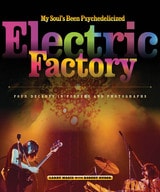
My Soul's Been Psychedelicized
Electric Factory: Four Decades in Posters and PhotographsLarry Magid
Temple University Press, 2011
On February 2, 1968, the Electric Factory, Philadelphia's first major venue for the era's new music, opened with a show featuring the Chambers Brothers. Performing their neosoul and gospel sounds in a warm and inviting venue, they declared, "My soul's been psychedelicized!"-a feeling that the Factory's cofounder, Larry Magid, has been experiencing ever since.
In My Soul's Been Psychedelicized, Magid presents a spectacular photographic history of the bands and solo acts that have performed at the Electric Factory and at other venues in Factory-produced concerts over the past four decades. The book includes concert posters, photographs, and promotional items featuring both rising stars and established performers, such as Pink Floyd, Jimi Hendrix, Bob Dylan, Bruce Springsteen, Bette Midler, Elvis Presley, Tina Turner, Pearl Jam and many, many more.
The images—candid and celebratory—create a one-of-a-kind history of rock and roll, from the wild 1960s to the Live Aid concert in 1985 and the closing of the Philadelphia Spectrum in 2009. Magid's vivid recollections constitute a who's who of pop music and culture. As one of the great concert producers, he shares his unique perspective on the business, talking about how it has changed and how lasting careers have been carefully developed.
For anyone who has ever attended a concert at the Electric Factory—or for anyone who missed a show—My Soul's Been Psychedelicized will bring back great memories of the music and the musicians.