Results by title
210 books match the query 'Philosophy, Theory & Social Aspects' and 7 start with m
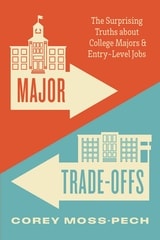
Major Trade-Offs
The Surprising Truths about College Majors and Entry-Level JobsCorey Moss-Pech
University of Chicago Press, 2025
Humanities majors are used to answering the question, “So, what are you going to do with that degree?” The common misconception is that students in humanities programs don’t learn any useful skills for the real world. In Major Trade-Offs, sociologist Corey Moss-Pech argues that not only do humanities majors learn real-world skills, but they actually use them when they graduate. Despite this discrepancy, graduates with so-called practical degrees like business and engineering are much more likely to find employment, and they earn higher salaries. Why do we belittle a liberal arts education despite the valuable skills that students acquire during their studies?
Major Trade-Offs addresses this question by following students from different majors as they enter the workforce. To understand the relationship between majors and entry-level jobs, Moss-Pech conducted nearly 200 interviews with roughly ninety students from four majors at a large Midwestern university: engineering, business, English, and communications. He follows these students through their senior years, chronicling their internships and the support their universities provide in helping them pursue their career paths. He found that graduates from practical majors entered the labor market successfully, typically through structured internship programs. However, many ended up in entry-level jobs that, while well-paid, were largely clerical and didn’t necessarily require a degree to perform. On the other hand, liberal arts majors rarely accessed structured internships and were largely left to carve out their own paths, but did use their degree skills once they secured a job. These results challenge popular myths about the “marketability” of these different majors and offer a new vision for the future of higher education. Liberal arts skills are essential in the labor market, and yet educators and policymakers still push resources into the practical arts, perpetuating the myth that those majors are more valuable while depriving students of a well-rounded education and leaving them no better prepared for the workforce than liberal arts students.
Of interest to students, educators, and employers, Major Trade-Offs calls on colleges and universities to advocate for liberal arts majors, leveling the playing field for students as they plan for entry-level work.
Major Trade-Offs
The Surprising Truths about College Majors and Entry-Level JobsCorey Moss-Pech
University of Chicago Press, 2025
This is an auto-narrated audiobook version of this book.
An eye-opening look at the relationship between students’ majors and their entry-level jobs.
Humanities majors are used to answering the question, “So, what are you going to do with that degree?” The common misconception is that students in humanities programs don’t learn any useful skills for the real world. In Major Trade-Offs, sociologist Corey Moss-Pech argues that not only do humanities majors learn real-world skills, but they actually use them when they graduate. Despite this discrepancy, graduates with so-called practical degrees like business and engineering are much more likely to find employment, and they earn higher salaries. Why do we belittle a liberal arts education despite the valuable skills that students acquire during their studies?
Major Trade-Offs addresses this question by following students from different majors as they enter the workforce. To understand the relationship between majors and entry-level jobs, Moss-Pech conducted nearly 200 interviews with roughly ninety students from four majors at a large Midwestern university: engineering, business, English, and communications. He follows these students through their senior years, chronicling their internships and the support their universities provide in helping them pursue their career paths. He found that graduates from practical majors entered the labor market successfully, typically through structured internship programs. However, many ended up in entry-level jobs that, while well-paid, were largely clerical and didn’t necessarily require a degree to perform. On the other hand, liberal arts majors rarely accessed structured internships and were largely left to carve out their own paths, but did use their degree skills once they secured a job. These results challenge popular myths about the “marketability” of these different majors and offer a new vision for the future of higher education. Liberal arts skills are essential in the labor market, and yet educators and policymakers still push resources into the practical arts, perpetuating the myth that those majors are more valuable while depriving students of a well-rounded education and leaving them no better prepared for the workforce than liberal arts students.
Of interest to students, educators, and employers, Major Trade-Offs calls on colleges and universities to advocate for liberal arts majors, leveling the playing field for students as they plan for entry-level work.
Making Up Our Mind
What School Choice Is Really AboutSigal R. Ben-Porath and Michael C. Johanek
University of Chicago Press, 2019
Those are not only the wrong questions—they’re the wrong premises, argue philosopher Sigal R. Ben-Porath and historian Michael C. Johanek in Making Up Our Mind. Market-driven school choices aren’t new. They predate the republic, and for generations parents have chosen to educate their children through an evolving mix of publicly supported, private, charitable, and entrepreneurial enterprises. The question is not whether to have school choice. It is how we will regulate who has which choices in our mixed market for schooling—and what we, as a nation, hope to accomplish with that mix of choices. Looking beyond the simplistic divide between those who oppose government intervention and those who support public education, the authors make the case for a structured landscape of choice in schooling, one that protects the interests of children and of society, while also identifying key shared values on which a broadly acceptable policy could rest.
Making Workers
Radical Geographies of EducationKatharyne Mitchell
Pluto Press, 2017
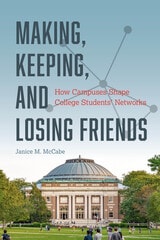
Making, Keeping, and Losing Friends
How Campuses Shape College Students' NetworksJanice M. McCabe
University of Chicago Press, 2025
We’re all familiar with the sentiment that “college is the best time of your life.” Along with a newfound sense of freedom, students have a unique opportunity to forge lifelong friendships at a point in life when friendship is particularly important. Why is it, then, that so many college students are falling victim to what the US Surgeon General termed an “epidemic of loneliness and isolation”? How do different aspects of college life help or hinder students’ ability to form deep connections?
In Making, Keeping, and Losing Friends: How Campuses Shape College Students’ Networks, sociologist Janice M. McCabe shows that the way a college is structured—whether students live in dorms or commute, study abroad or stay close to campus, have plentiful common areas for clubs to meet or not—can either encourage or hinder the making of meaningful friendships. Based on interviews with 95 students on three distinct campuses—a small private college (Dartmouth College), a large public university (University of New Hampshire), and a non-residential community college (Manchester Community College)—McCabe captures a wide range of experiences and discovers how features of the campuses make it easier or harder for students to make and keep friends. She shows how and why, across all three institutions, some students thrive in deep and lasting friendships with their peers.
As McCabe’s research reveals, we need to look at the structures of students’ networks, the institutions they attend, and the importance of their identities in these places if we are to truly uncover and address the loneliness epidemic facing today’s young adults.
Misconceiving Merit
Paradoxes of Excellence and Devotion in Academic Science and EngineeringMary Blair-Loy and Erin A. Cech
University of Chicago Press, 2022
In Misconceiving Merit, sociologists Mary Blair-Loy and Erin A. Cech uncover the cultural foundations of a paradox. On one hand, academic science, engineering, and math revere meritocracy, a system that recognizes and rewards those with the greatest talent and dedication. At the same time, women and some racial and sexual minorities remain underrepresented and often feel unwelcome and devalued in STEM. How can academic science, which so highly values meritocracy and objectivity, produce these unequal outcomes?
Blair-Loy and Cech studied more than five hundred STEM professors at a top research university to reveal how unequal and unfair outcomes can emerge alongside commitments to objectivity and excellence. The authors find that academic STEM harbors dominant cultural beliefs that not only perpetuate the mistreatment of scientists from underrepresented groups but hinder innovation. Underrepresented groups are often seen as less fully embodying merit compared to equally productive white and Asian heterosexual men, and the negative consequences of this misjudgment persist regardless of professors’ actual academic productivity. Misconceiving Merit is filled with insights for higher education administrators working toward greater equity as well as for scientists and engineers striving to change entrenched patterns of inequality in STEM.
Multiracial Mandarin
Asian Americans and Impossible LanguageDavid Shuang Song
University of Minnesota Press, 2026
Understanding the entanglement of language education with ethnicity and racialization
Who has the “right” to learn Mandarin Chinese? In Multiracial Mandarin, author David Shuang Song examines how matters of race and privilege shape US Mandarin language education and who has access to it. Through a two-year ethnographic study of two Bay Area high schools where diasporic and heritage speakers learn Mandarin alongside Black and Latinx students, Song advances a sociological and educational–linguistic inquiry into how language interacts with our understanding of identity and equity.
Comparing classroom activities in two public schools, Song investigates teachers who seek to make Mandarin accessible while detaching it from its cultural roots. As he explores the difficulties of limited resources, racial inequality, and pedagogical practices inherent in multiracial Mandarin instruction, Song shows how language education complicates how educators understand Asian American students and troubles conventional conversations around race and racial equity in schools.
Arguing that language practice and instruction must always be considered in relation to diaspora, ethnicity, and racialization, Multiracial Mandarin offers a frank analysis of the risks and benefits of teaching a diasporic language and asks if this practice ought to be replicated in more schools. As he applies innovative conceptual frameworks for talking about language among Asian Americans, Song’s timely and theoretically sophisticated analysis has wide-ranging implications for how students, teachers, and administrators approach essential questions around education, privilege, and language survival.
Retail e-book files for this title are screen-reader friendly.