Results by title
58 books match the query 'Photoessays & Documentaries' and 6 start with m

Madison
Zane Williams
Wisconsin Historical Society Press, 2008
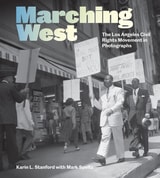
Marching West
The Los Angeles Civil Rights Movement in PhotographsKarin L. Stanford
J. Paul Getty Trust, The, 2026
This volume presents the first visual history of the people and organizations that led the fight for change during the civil rights era in Los Angeles.
During a 1963 speech to a crowd of nearly forty thousand at Wrigley Field in Los Angeles, Dr. Martin Luther King Jr. addressed the question of how Angelenos could contribute to the civil rights movement: “The most important thing that you can do is to set Los Angeles free, because you have segregation and discrimination here, and police brutality.”
Marching West illuminates the dynamic history of civil rights activism in Los Angeles and explores how the medium of photography both witnessed and advanced the fight for Black equality. Over one hundred images, some of which have never been previously published, reveal connections between the local and national movements and document the actions of Western coalitions, religious leaders, Hollywood stars, and concerned citizens. Drawn from the Tom & Ethel Bradley Center at California State University, Northridge (CSUN), the Getty Research Institute, and other Southern California collections—including prints by Harry Adams, Howard Bingham, Charles Brittin, Joe Flowers, Vera Jackson, and Charles Williams—this unprecedented volume presents less familiar but essential stories about American progress toward social justice.

Margaret Mead, Gregory Bateson, and Highland Bali
Fieldwork Photographs of Bayung Gede, 1936-1939Gerald Sullivan
University of Chicago Press, 1999
Margaret Mead, Gregory Bateson, and Highland Bali includes 200 photographs that the couple took between 1936 and 1939, the vast majority of which have never before been published. They vividly capture the everyday lives of the men, women, and children of Bayung Gedé, their homes and their temples, and many other fascinating details of village life not featured in Mead and Bateson's publications.
In a substantial introductory essay, Gerald Sullivan, who selected the photographs, uses excerpts from fieldnotes and correspondence to illuminate Mead and Bateson's ethnographic work. Tracing the project from its inception in their proposals to the publication of their work, Sullivan shows how they used the photographs both as fieldnotes and as elements in their theoretical argument. Finally, he explores what the photographs reveal—independently of Mead and Bateson's project—about the Balinese character to the contemporary viewer.
The result is a both a substantial contribution to visual anthropology and an invaluable supplement to the published works of Margaret Mead and Gregory Bateson.
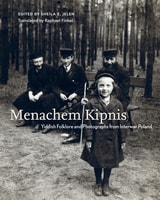
Menachem Kipnis
Yiddish Folklore and Photographs from Interwar PolandSheila E. Jelen
Rutgers University Press, 2026
Menachem Kipnis (1878–1942) was one of the early twentieth-century’s greatest Jewish eastern European ethnomusicologists, folklorists, and photographers. He had a weekly column in the Warsaw Yiddish newspaper Haynt, retelling humorous old folk stories about the fictional Polish town of Chelm, populated exclusively by fools. At the same time, his photographs of Jewish life in eastern Europe regularly appeared in the Forverts (Forward), the most popular Yiddish daily newspaper in the United States. Now, for the first time, Kipnis’s stories and photographs are published together in a single book.
Menachem Kipnis brings these photographs and stories into dialogue with one another, bridging the Jewish communities in Poland and in America during the interwar period. This dialogue, between image and text, between European metropolis and American metropolis, captures a key historical moment when American Jews sought to imagine the lives of their coreligionists in the “Old Country” and eastern European urban Jews sought to distinguish themselves from their Jewish compatriots who were still living in the shtetl. Including an introductory essay, annotations, and an epilogue by Sheila E. Jelen, Menachem Kipnis suggests new ways of understanding both visual and literary depictions of eastern European Jewish culture between the two world wars.
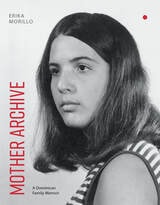
Mother Archive
A Dominican Family MemoirErika Morillo
University of Iowa Press, 2024
2024 NBCC Award Finalist, Autobiography
A family murder kept secret, the mysterious disappearance of her father, the systematic erasing of family photographs, a turbulent relationship with her mother, layers of trauma and abuse. In Mother Archive, Erika Morillo reconciles these demons of her past by searching for and seeking out the roots of her family. Intertwining memories with archival family photographs, news clippings, film stills, and artistic images, Morillo revisits her childhood growing up in the Dominican Republic, a place and time riddled with a history of violence and a tradition of erasure.
Spanning three generations across three different countries, this memoir works as a map in which the author traces incidents in her family history to help her understand herself and her own experience as a mother.
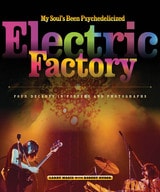
My Soul's Been Psychedelicized
Electric Factory: Four Decades in Posters and PhotographsLarry Magid
Temple University Press, 2011
On February 2, 1968, the Electric Factory, Philadelphia's first major venue for the era's new music, opened with a show featuring the Chambers Brothers. Performing their neosoul and gospel sounds in a warm and inviting venue, they declared, "My soul's been psychedelicized!"-a feeling that the Factory's cofounder, Larry Magid, has been experiencing ever since.
In My Soul's Been Psychedelicized, Magid presents a spectacular photographic history of the bands and solo acts that have performed at the Electric Factory and at other venues in Factory-produced concerts over the past four decades. The book includes concert posters, photographs, and promotional items featuring both rising stars and established performers, such as Pink Floyd, Jimi Hendrix, Bob Dylan, Bruce Springsteen, Bette Midler, Elvis Presley, Tina Turner, Pearl Jam and many, many more.
The images—candid and celebratory—create a one-of-a-kind history of rock and roll, from the wild 1960s to the Live Aid concert in 1985 and the closing of the Philadelphia Spectrum in 2009. Magid's vivid recollections constitute a who's who of pop music and culture. As one of the great concert producers, he shares his unique perspective on the business, talking about how it has changed and how lasting careers have been carefully developed.
For anyone who has ever attended a concert at the Electric Factory—or for anyone who missed a show—My Soul's Been Psychedelicized will bring back great memories of the music and the musicians.