Results by title
230 books match the query 'Physics' and 15 start with m
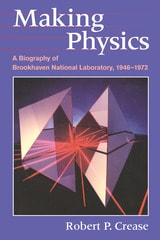
Making Physics
A Biography of Brookhaven National Laboratory, 1946-1972Robert P. Crease
University of Chicago Press, 1999
"[A] very readable, well illustrated and sometimes even racy, recounting of Brookhaven's history, politics and personalities."—Denys Wilkinson, Physics World
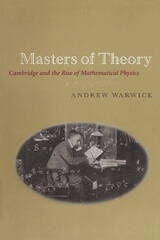
Masters of Theory
Cambridge and the Rise of Mathematical PhysicsAndrew Warwick
University of Chicago Press, 2003
When Isaac Newton published the Principia three centuries ago, only a few scholars were capable of understanding his conceptually demanding work. Yet this esoteric knowledge quickly became accessible in the nineteenth and early twentieth centuries when Britain produced many leading mathematical physicists. In this book, Andrew Warwick shows how the education of these "masters of theory" led them to transform our understanding of everything from the flight of a boomerang to the structure of the universe.
Warwick focuses on Cambridge University, where many of the best physicists trained. He begins by tracing the dramatic changes in undergraduate education there since the eighteenth century, especially the gradual emergence of the private tutor as the most important teacher of mathematics. Next he explores the material culture of mathematics instruction, showing how the humble pen and paper so crucial to this study transformed everything from classroom teaching to final examinations. Balancing their intense intellectual work with strenuous physical exercise, the students themselves—known as the "Wranglers"—helped foster the competitive spirit that drove them in the classroom and informed the Victorian ideal of a manly student. Finally, by investigating several historical "cases," such as the reception of Albert Einstein's special and general theories of relativity, Warwick shows how the production, transmission, and reception of new knowledge was profoundly shaped by the skills taught to Cambridge undergraduates.
Drawing on a wealth of new archival evidence and illustrations, Masters of Theory examines the origins of a cultural tradition within which the complex world of theoretical physics was made commonplace.
Mathematical Physics
Robert Geroch
University of Chicago Press, 1984

Mathematical Quantum Physics for Engineers and Technologists
FundamentalsAlireza Baghai-Wadji
The Institution of Engineering and Technology, 2023
Mathematical Quantum Physics for Engineers and Technologists
Fundamentals, Volume 1Alireza Baghai-Wadji
The Institution of Engineering and Technology, 2023
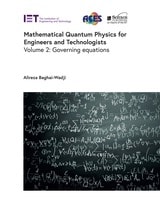
Mathematical Quantum Physics for Engineers and Technologists
Governing equations, Volume 2Alireza Baghai-Wadji
The Institution of Engineering and Technology, 2024

Mathematics and the Unexpected
Ivar Ekeland
University of Chicago Press, 1988
"In this brief, elegant treatise, assessable to anyone who likes to think, Ivar Ekelund explains some philosophical implications of recent mathematics. He examines randomness, the geometry involved in making predictions, and why general trends are easy to project (it will snow in January) but particulars are practically impossible (it will snow from 2 p.m. to 5 p.m. on the 21st)."—Village Voice
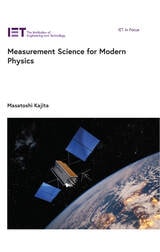
Measurement Science for Modern Physics
Masatoshi Kajita
The Institution of Engineering and Technology, 2026
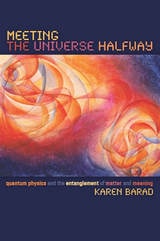
Meeting the Universe Halfway
Quantum Physics and the Entanglement of Matter and MeaningKaren Barad
Duke University Press, 2006
In an agential realist account, the world is made of entanglements of “social” and “natural” agencies, where the distinction between the two emerges out of specific intra-actions. Intra-activity is an inexhaustible dynamism that configures and reconfigures relations of space-time-matter. In explaining intra-activity, Barad reveals questions about how nature and culture interact and change over time to be fundamentally misguided. And she reframes understanding of the nature of scientific and political practices and their “interrelationship.” Thus she pays particular attention to the responsible practice of science, and she emphasizes changes in the understanding of political practices, critically reworking Judith Butler’s influential theory of performativity. Finally, Barad uses agential realism to produce a new interpretation of quantum physics, demonstrating that agential realism is more than a means of reflecting on science; it can be used to actually do science.

Megawatts and Megatons
The Future of Nuclear Power and Nuclear WeaponsRichard L. Garwin and Georges Charpak
University of Chicago Press, 2002
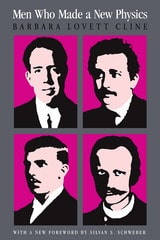
Men Who Made a New Physics
Physicists and the Quantum TheoryBarbara Lovett Cline
University of Chicago Press, 1987
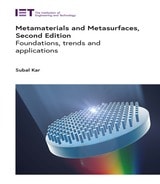
Metamaterials and Metasurfaces
Foundations, trends and applicationsSubal Kar
The Institution of Engineering and Technology, 2025
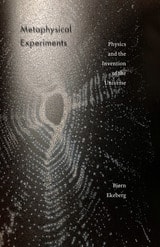
Metaphysical Experiments
Physics and the Invention of the UniverseBjørn Ekeberg
University of Minnesota Press, 2019
An engaging critique of the science and metaphysics behind our understanding of the universe
The James Webb Space Telescope, when launched in 2021, will be the premier orbital observatory, capable of studying every phase of the history of the universe, from the afterglow of the Big Bang to the formation of our solar system. Examining the theoretical basis for key experiments that have made this latest venture in astrophysics possible, Bjørn Ekeberg reveals that scientific cosmology actually operates in a twilight zone between the physical and metaphysical.
Metaphysical Experiments explains how our current framework for understanding the universe, the Big Bang theory, is more determined by a deep faith in mathematical universality than empirical observation. Ekeberg draws on philosophical insights by Spinoza, Bergson, Heidegger, and Arendt; on the critical perspectives of Latour, Stengers, and Serres; and on cutting-edge physics research at the Large Hadron Collider, to show how the universe of modern physics was invented to reconcile a Christian metaphysical premise with a claim to the theoretical unification of nature.
By focusing on the nonmathematical assumptions underlying some of the most significant events in modern science, Metaphysical Experiments offers a critical history of contemporary physics that demystifies such concepts as the universe, particles, singularity, gravity, blackbody radiation, the speed of light, wave/particle duality, natural constants, black holes, dark matter, and dark energy. Ekeberg’s incisive reading of the metaphysical underpinnings of scientific cosmology offers an innovative account of how we understand our place in the universe.
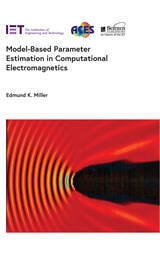
Model-Based Parameter Estimation in Computational Electromagnetics
Edmund K. Miller
The Institution of Engineering and Technology, 2026
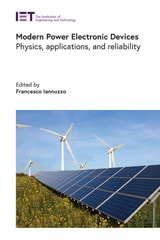
Modern Power Electronic Devices
Physics, applications, and reliabilityFrancesco Iannuzzo
The Institution of Engineering and Technology, 2020