Results by title
267 books match the query 'Poetics' and 14 start with m
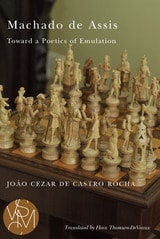
Machado de Assis
Toward a Poetics of EmulationJoão Cezar de Castro Rocha
Michigan State University Press, 2015
At the center of this alternative explanation, Castro Rocha situates the fallout from the success enjoyed by Eça de Queirós with the publication of Cousin Basílio and Machado’s two long texts condemning the author and his work. Literary and aesthetic rivalries come to the fore, allowing for a new theoretical framework based on a literary appropriation of “thick description,” the method proposed by anthropologist Clifford Geertz. From this method, Castro Rocha derives his key hypothesis: an unforeseen consequence of Machado’s reaction to Eça’s novel was a return to the classical notion of aemulatio, which led Machado to develop a “poetics of emulation.”
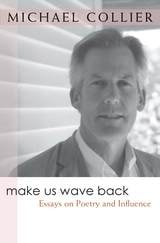
Make Us Wave Back
Essays on Poetry and InfluenceMichael Collier
University of Michigan Press, 2007
“Michael Collier’s book is refreshing in its refusal to push for one particular aesthetic. He regards his own preference for realism over abstraction as more a matter of temperament than of considered judgment, and respects poets more skeptical than he is about the ability of poetry to connect with the world. The result is an engaging record of his influences and enthusiasms, which are wide enough to include both Whitman and Larkin, both Jorge Borges and William Maxwell.”
—Carl Dennis, Pulitzer Prize–winning author of Unknown Friends and Practical Gods
“Michael Collier combines pietas and wildness in these essays on poetry as inheritance, and poetry as struggle. One feels the young man in his ‘rampage of literature,’ and the older writer reflecting on an art that is at once personal and impersonal, deeply matured in the imagination. This is a wise and well-lived book.”
—Rosanna Warren, author of Departure and Stained Glass
“The essays and remembrances in Make Us Wave Back radiate Michael Collier’s characteristic insight and sagacity on every page. Clear-minded, ardent, brightly illuminating the art of poetry, this is as lucid as writing about writing gets.”
—Campbell McGrath, author of Pax Atomica and Florida Poems
National Book Critics Circle Award finalist Michael Collier explores the influences that have made him one of the most distinguished poets of his generation. Make Us Wave Back includes essays on an expansive list of subjects, among them the literary correspondence of William Maxwell; the meaning of the author’s own role as poet laureate of the state of Maryland; the journals of Louise Bogan and how they reveal Bogan’s struggle with her own personal fears as well as the reconstruction of herself as a writer; and many more.
Michael Collier is Professor of English and Codirector of the creative writing program at the University of Maryland. He is also director of the Bread Loaf Writers’ Conference. He is the author of several books of poems, including The Clasp and Other Poems, The Folded Heart, and The Ledge.
Marie de France and the Poetics of Memory
Logan E. Whalen
Catholic University of America Press, 2008
Medbh McGuckian
The Poetics of ExemplarityShane Alcobia-Murphy
Aberdeen University Press, 2012
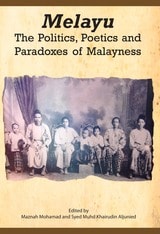
Melayu
The Politics, Poetics and Paradoxes of MalaynessEdited by Maznah Mohamad and Syed Muhd Khairudin Aljunied
National University of Singapore Press, 2012
In Melayu: The Politics, Poetics and Paradoxes of Malayness, the contributors examine the checkered, wavering and changeable understanding of the word Melayu by considering hitherto unexplored case studies dealing with use of the term in connection with origins, nations, minority-majority politics, Filipino Malays, Riau Malays, Orang Asli, Straits Chinese literature, women's veiling, vernacular television, social dissent, literary women, and modern Sufism. Taken as a whole, this volume offers a creative approach to the study of Malayness while providing new perspectives to the studies of identity formation and politics of ethnicity that have wider implications beyond the Southeast Asian region.
Mentor and Muse
Essays from Poets to PoetsEdited by Blas Falconer, Beth Martinelli, and Helena Mesa
Southern Illinois University Press, 2010
In Mentor and Muse, a collection of twenty-nine insightful essays by some of today’s leading poetic minds, editors Blas Falconer, Beth Martinelli, and Helena Mesa have brought together an illuminating anthology that draws upon both established and emerging poets to create a one-of-a-kind resource and unlock the secrets of writing and revising poetry.
Gathered here are numerous experts eager to share their wisdom with other writers. Each author examines in detail a particular poetic element, shedding new light on the endless possibilities of poetic forms. Addressed within are such topics as the fluid possibilities of imagery in poetry; the duality of myth and the personal, and the power of one to unlock the other; the surprising versatility of traditional poetic forms; and the pleasure of collaboration with other poets. Also explored in depth are the formative roles of cultural identity and expectations, and their effect on composition; advice on how to develop one’s personal poetic style and approach; the importance of setting in reading and meaning; and the value of indirection in the lyric poem. Challenges to conventional concepts of beauty are examined through Shakespeare’s sonnets, and the ghost of Longfellow is called upon to guide students through the rewards and roadblocks of writing popular poetry. Poetic persona is demystified through Newton’s law of gravity, while the countless permutations of punctuation are revealed with analysis of e. e. cummings and W. S. Merwin.
The essays include the full text of the poems discussed, and detailed, relevant writing exercises that allow students the opportunity to directly implement the strategies they have learned. While many advanced topics such as authenticity, discordant music, and prosody are covered, this highly readable volume is as user-friendly as it is informative. Offering a variety of aesthetics and approaches to tackling the issues of composition, Mentor and Muse takes poets beyond the simple stages of poetic terms and strategies. These authorsinvite students to explore more advanced concepts, enabling them to draw on the traditions of the past while at the same time forging their own creative paths into the future.
Chosen as one of the "Best Books for Writers" by Poets & Writers magazine
Meter in English
A Critical EngagementDavid Baker
University of Arkansas Press, 1997
Missing Measures
Modern Poetry and the Revolt Against MeterTimothy Steele
University of Arkansas Press, 1990
By the close of the nineteenth century, many poets had abandoned rhyme and meter in favor of “free verse.” Nearly one hundred years later, a growing number of younger poets are reclaiming traditional conventions of prosody by composing rhymed and measured poetry.
Missing Measures is the first full articulation of the aesthetics of this new movement. Timothy Steele, one of the best of those poets who are sometimes called the “New Formalists,” treats his subject against a backdrop of the long history of ideas about poetry, formulated first by the ancients and re-examined and re-interpreted by subsequent writers.
Steele offers a new perspective on the wholesale departure from tradition proclaimed in modernist critical justifications. A rare marriage of clear writing, careful scholarship, and bold thinking, Missing Measures provides a vital new movement with a critical manifesto.
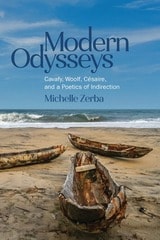
Modern Odysseys
Cavafy, Woolf, Césaire, and a Poetics of IndirectionMichelle Zerba
The Ohio State University Press, 2021
More than Cool Reason
A Field Guide to Poetic MetaphorGeorge Lakoff and Mark Turner
University of Chicago Press, 1989
We usually think of the language of poetry, the metaphors that poets use to express their intentions, as far removed from ordinary life. But in More than Cool Reason, George Lakoff and Mark Turner show how understanding how metaphor works in poetry, the tasks it takes on and the ways it shapes our patterns of thought, can be hugely helpful to seeing and understanding how we think in all manner of other fields and areas of life. Metaphor, they show, is a tool so familiar, so everyday, that we fail to notice it. Lakoff and Turner correct that failure here, helping us see how richly metaphorical our language and thought are, and what that means for not only reading and enjoying poetry and literature, but also for linguistics, philosophy, psychology, anthropology, cognitive science, and more.
Mu, 49 Marks of Abolition
Sora Y. Han
Duke University Press, 2024
My Poetics
Maureen N. McLane
University of Chicago Press, 2024
In My Poetics, Maureen N. McLane writes as a poet, critic, theorist, and scholar—but above all as an impassioned reader. Written in an innovative, conversable style, McLane’s essays illuminate her own poetics and suggest more generally all that poetics can encompass. Ranging widely from romantic-era odes and hymns to anonymous ballads to haikus and haibuns to modernist and contemporary poetries in English, My Poetics explores poems as speculative instruments and as ways of registering our very sense of being alive. McLane pursues a number of open questions: How do poems generate modes for thinking? How does rhyme help us measure out thought? What is the relation of poetry to its surroundings, and how do specific poems activate that relation?
If, as Wallace Stevens wrote, “poetry is the scholar’s art,” My Poetics flies under a slightly different banner: study and criticism are also the poet’s art. Punctuated with McLane’s poems and drawing variously on Hannah Arendt, Percy Bysshe Shelley, Roland Barthes, Bruno Latour, and other writers and poets, My Poetics is a formally as well as intellectually adventurous work. Its artful arrangement of readings and divagations shows us a way to be with poems and poetics.
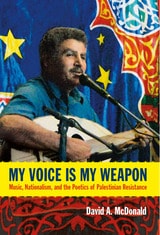
My Voice Is My Weapon
Music, Nationalism, and the Poetics of Palestinian ResistanceDavid A. McDonald
Duke University Press, 2013
My Way
Speeches and PoemsCharles Bernstein
University of Chicago Press, 1998
In My Way, (in)famous language poet and critic Charles Bernstein deploys a wide variety of interlinked forms—speeches and poems, interviews and essays—to explore the place of poetry in American culture and in the university. Sometimes comic, sometimes dark, Bernstein's writing is irreverent but always relevant, "not structurally challenged, but structurally challenging."
Addressing many interrelated issues, Bernstein moves from the role of the public intellectual to the poetics of scholarly prose, from vernacular modernism to idiosyncratic postmodernism, from identity politics to the resurgence of the aesthetic, from cultural studies to poetry as a performance art, from the small press movement to the Web. Along the way he provides "close listening" to such poets as Charles Reznikoff, Laura Riding, Susan Howe, Ezra Pound, Allen Ginsberg, and Gertrude Stein, as well as a fresh perspective on L=A=N=G=U=A=G=E, the magazine he coedited that became a fulcrum for a new wave of North American writing.
In his passionate defense of an activist, innovative poetry, Bernstein never departs from the culturally engaged, linguistically complex, yet often very funny writing that has characterized his unique approach to poetry for over twenty years. Offering some of his most daring work yet—essays in poetic lines, prose with poetic motifs, interviews miming speech, speeches veering into song—Charles Bernstein's My Way illuminates the newest developments in contemporary poetry with its own contributions to them.
"The result of [Bernstein's] provocative groping is more stimulating than many books of either poetry or criticism have been in recent years."—Molly McQuade, Washington Post Book World
"This book, for all of its centrifugal activity, is a singular yet globally relevant perspective on the literary arts and their institutions, offered in good faith, yet cranky and poignant enough to not be easily ignored."—Publishers Weekly
"Bernstein has emerged as postmodern poetry's sous-chef of insouciance. My Way is another of his rich concoctions, fortified with intellect and seasoned with laughter."—Timothy Gray, American Literature