Results by title
207 books match the query 'Political participation' and 15 start with m
Making Constituencies
Representation as Mobilization in Mass DemocracyLisa Jane Disch
University of Chicago Press, 2021
Since the turn of the twenty-first century, the idea of a divided United States has become commonplace. In the wake of the 2020 election, some commentators warned that the American public was the most divided it has been since the Civil War. Political scientists, political theorists, and public intellectuals have suggested that uninformed, misinformed, and disinformed voters are at the root of this division. Some are simply unwilling to accept facts or science, which makes them easy targets for elite manipulation. It also creates a grass-roots political culture that discourages cross-partisan collaboration in Washington.
Yet, manipulation of voters is not as grave a threat to democracy in America as many scholars and pundits make it out to be. The greater threat comes from a picture that partisans use to rally their supporters: that of an America sorted into opposing camps so deeply rooted that they cannot be shaken loose and remade. Making Constituencies proposes a new theory of representation as mobilization to argue that divisions like these are not inherent in society, but created, and political representatives of all kinds forge and deploy them to cultivate constituencies.
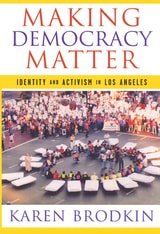
Making Democracy Matter
Identity and Activism in Los AngelesBrodkin, Karen
Rutgers University Press, 2007
This book seeks to answer these questions through conversations and interviews with a generation of activists who came of political age in Los Angeles during the 1990s. Politically schooled in the city's vibrant immigrant worker and youth-led campaigns against xenophobic and racist voter initiatives, these young activists created a new political cohort with its own signature of democratic practice and vision. Combining analytical depth, engaging oral history, and rich description, this absorbing and accessible book will appeal to all those interested in social movements, racial justice, the political activism of women and men of color, and the labor movement today.
Making Of Asian America
Through Political ParticipationPei-te Lien
Temple University Press, 2001
Professor Lien looks at political participation by Asian Americans prior to 1965 and then examines, at both organizational and mass politics levels, how race, ethnicity, and transnationalism help to construct a complex American electorate. She looks not only at rates of participation among Asian Americans as compared with blacks, Latinos, American Indians, and non-Hispanic whites, but also among specific groups of Asian Americans—Chinese, Japanese, Filipinos, Koreans, Asian Indians, and Vietnamese. She also discusses how gender, socioeconomic class, and place of birth affect political participation.
With documentation ranging from historical narrative to opinion survey data, Professor Lien creates a picture of a diverse group of politically active people who are intent on carving out a place for themselves in American political life.
Mass–Elite Representation Gap in Old and New Democracies
Critical Junctures and Elite AgencyEdited by Jaemin Shim
University of Michigan Press, 2024
Melting the Ice Curtain
The Extraordinary Story of Citizen Diplomacy on the Russia-Alaska FrontierDavid Ramseur
University of Alaska Press, 2017
Melting the Ice Curtain tells the story of how inspiration, courage, and persistence by citizen-diplomats bridged a widening gap in superpower relations. David Ramseur was a first-hand witness to the danger and political intrigue, having flown on that first Friendship Flight, and having spent thirty years behind the scenes with some of Alaska’s highest officials. As Alaska celebrates the 150th anniversary of its purchase, and as diplomatic ties with Russia become perilous, Melting the Ice Curtain shows that history might hold the best lessons for restoring diplomacy between nuclear neighbors.

Mexican Americans and the Politics of Diversity
¡Querer es poder!Lisa Magaña
University of Arizona Press, 2005
Mexican Hometown Associations in Chicagoacán
From Local to Transnational Civic EngagementBada, Xóchitl
Rutgers University Press, 0
Hometown associations (HTAs) consist of immigrants from the same town in Mexico and often begin quite informally, as soccer clubs or prayer groups. As Bada’s work shows, however, HTAs have become a powerful force for change, advocating for Mexican immigrants in the United States while also working to improve living conditions in their communities of origin. Focusing on a group of HTAs founded by immigrants from the state of Michoacán, the book shows how their activism has bridged public and private spheres, mobilizing social reforms in both inner-city Chicago and rural Mexico.
Bringing together ethnography, political theory, and archival research, Bada excavates the surprisingly long history of Chicago’s HTAs, dating back to the 1920s, then traces the emergence of new models of community activism in the twenty-first century. Filled with vivid observations and original interviews, Mexican Hometown Associations in Chicagoacán gives voice to an underrepresented community and sheds light on an underexplored form of global activism.
Millennial Makeover
MySpace, YouTube, and the Future of American PoliticsWinograd, Morley
Rutgers University Press, 2008
A 2008 New York Times Notable Book of the Year
It happens in America every four decades and it is about to happen again. America’s demand for change in the 2008 election will cause another of our country’s periodic political makeovers. This realignment, like all others before it, will result from the coming of age of a new generation of young Americans—the Millennial Generation—and the full emergence of the Internet-based communications technology that this generation uses so well. Beginning in 2008, almost everything about American politics and government will transform—voting patterns, the fortunes of the two political parties, the issues that engage the nation, and our government and its public policy.
Building on the seminal work of previous generational theorists,Morley Winograd and Michael D. Hais demonstrate and describe, for the first time, the two types of realignments—“idealist” and “civic”—that have alternated with one another throughout the nation’s history. Based on these patterns, Winograd and Hais predict that the next realignment will be very different from the last one that occurred in 1968. “Idealist” realignments, like the one put into motion forty years ago by the Baby Boomer Generation, produce, among other things, a political emphasis on divisive social issues and governmental gridlock. “Civic” realignments, like the one that is coming, and the one produced by the famous GI or “Greatest” Generation in the 1930s, by contrast, tend to produce societal unity, increased attention to and successful resolution of basic economic and foreign policy issues, and institution-building.
The authors detail the contours and causes of the country’s five previous political makeovers, before delving deeply into the generational and technological trends that will shape the next. The book’s final section forecasts the impact of the Millennial Makeover on the elections, issues, and public policies that will characterize America’s politics in the decades ahead.
For additional information go to:
Millennial Makeover website.
Millennial Momentum
How a New Generation Is Remaking AmericaWinograd, Morley
Rutgers University Press, 2011
About every eight decades, coincident with the most stressful and perilous events in U.S. history—the Revolutionary and Civil Wars and the Great Depression and World War II—a new, positive, accomplished, and group-oriented “civic generation” emerges to change the course of history and remake America. The Millennial Generation (born 1982–2003) is America’s newest civic generation.
In their 2008 book, Millennial Makeover, Morley Winograd and Michael D. Hais made a prescient argument that the Millennial Generation would change American politics for good. Later that year, a huge surge of participation from young voters helped to launch Barack Obama into the White House.
Now, in Millennial Momentum, Winograd and Hais investigate how the beliefs and practices of the Millennials are transforming other areas of American culture, from education to entertainment, from the workplace to the home, and from business to politics and government. The Millennials’ cooperative ethic and can-do spirit have only just begun to make their mark, and are likely to continue to reshape American values for decades to come.
Drawing from an impressive array of demographic data, popular texts, and personal interviews, the authors show how the ethnically diverse, socially tolerant, and technologically fluent Millennials can help guide the United States to retain its leadership of the world community and the global marketplace. They also illustrate why this generation’s unique blend of civic idealism and savvy pragmatism will enable us to overcome the internal culture wars and institutional malaise currently plaguing the country. Millennial Momentum offers a message of hope for a deeply divided nation.
Minority Parties in U.S. Legislatures
Conditions of InfluenceJennifer Hayes Clark
University of Michigan Press, 2015
Challenging conventional assumptions that the majority party dominates the legislature, Jennifer Hayes Clark investigates precisely the ways in which—and under what conditions—members of the minority party successfully pursue their interests. For this study, Clark collects fine-grained data from both the U.S. Congress and state legislatures to get a close look at three key points in the legislative process: committee assignments, bill cosponsorship, and roll-call votes. She finds that minority party members are not systematically excluded throughout the policymaking process. Indeed, their capacity to shape legislative decision-making is enhanced when party polarization is low, when institutional prerogatives are broadly dispersed rather than centralized, and when staff resources are limited. Under these conditions, bipartisanship bill cosponsorship and voting coalitions are also more prevalent.
With the sharp increase of partisan polarization in state legislatures and in Congress, it is essential to understand how and when a minority party can effectively represent constituents.
Minority Report
Evaluating Political Equality in AmericaJohn D. Griffin and Brian Newman
University of Chicago Press, 2008
Mobilizing Romani Ethnicity
Romani Political Activism in Argentina, Colombia and SpainAnna Mirga-Kruszelnicka
Central European University Press, 2022
The Roma issue is generally treated as a European matter. Indeed, the Roma are the largest European minority—their presence outside of Europe is a result of various waves of migration over the past four hundred years. Likewise, the stereotypes associated with the Roma—the problematized, stigmatized status of a “Gypsy” as well as the historical and contemporary manifestations of antigypsyism—are also of European origin. This book claims, however, that the perception of Roma being strictly a European issue is flawed, and that re-connecting the Roma issue globally represents an important learning experience and an added value.
The book offers a critical exploration of Romani political activism in Colombia and Argentina, and compares it to that in Spain, narrated from the intimate perspective of Romani actors themselves. By outlining parallel lineages of Romani activism in three countries and on two continents, the author arrives at broad conclusions regarding the nature of ethnic mobilization. Mirga-Kruszelnicka proposes a new synergetic conceptualization of this multidirectional concept as an interplay between political opportunities, mobilizing structures, and frames of identity.
Contributing to the vivid debate about the relationship between the researcher and the researched, the book also includes an original discussion of the positionality of scholars of Romani background.
Moral Politics in the Philippines
Inequality, Democracy and the Urban PoorWataru Kusaka
National University of Singapore Press, 2017
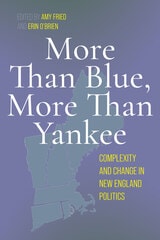
More Than Blue, More Than Yankee
Complexity and Change in New England PoliticsEdited by Amy Fried and Erin O’Brien
University of Massachusetts Press, 2024
New England politics can, at first blush, appear monochromatic. After all, only one member of the entire region’s delegation to the US Congress is a Republican, and citizens have elected few Republicans to the US House or Senate in the last decade. But this has not always been the case. In 1948, only two states in the region–Rhode Island and Connecticut–had Democratic senators. Yet a closer examination of the region today reveals fascinating political variation. Liberal policies, greater diversity, and engaged political movements are reshaping stereotypical Yankee tendencies of close-fisted government, whiteness, and laconic discourse.
This collection of new essays captures both the political history and contemporary moment in this region and exposes the surprisingly varied political landscape. It examines historical shifts, regional developments, and the politics of its states to argue that New England has been and continues to be an important part of the national political puzzle, from demonstrating democratic principles in early America to producing major contemporary figures such as Elizabeth Warren, Ayanna Pressley, and Susan Collins. The political shifts at work in New England mirror the South’s transformation, but have received much less attention. This volume corrects that omission by profiling political movements and candidates, political rhetoric from activists to pundits, and demographics and voting in each state as well as the region as a whole.
In addition to material by the editors, this important collection includes contributions from Rachael V. Cobb, Jerold Duquette, Christopher J. Galdieri, Jane JaKyung Han, Douglas B. Harris, Luis Jiménez, Scott McLean, James Melcher, Maureen Moakley, Paul Petterson, and Dante J. Scala.
Movements in Times of Democratic Transition
Bert Klandermans
Temple University Press, 2015
The editors and contributors to Movements in Times of Democratic Transition examine in comparative detail how social movements act within the context of the democratic transitions they have been fighting for, and how they are affected by the changes they helped bring about. Offering insights into the nature of how social movements decline, radicalize, revitalize, or spark new cycles of activism, Movements in Times of Democratic Transition provides a comprehensive analysis of these key questions of mobilization research.
Contributors include: Paul Almeida, Christopher J. Colvin, Stephen Ellis, Grzegorz Ekiert, Grzegorz Forys, Krzysztof Gorlach, Camila Penna, Sebastián Pereyra, Steven Robbins, Ton Salman, Mate Szabo, Ineke van Kessel, Michal Wenzel, and the editors.