Results by title
191 books match the query 'Politics and literature' and 5 start with m
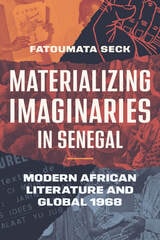
Materializing Imaginaries in Senegal
Modern African Literature and Global 1968Fatoumata Seck
Duke University Press, 2026
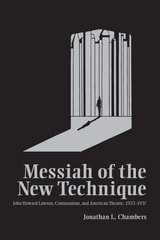
Messiah of the New Technique
John Howard Lawson, Communism, and American Theatre, 1923-1937Jonathan L. Chambers
Southern Illinois University Press, 2006
Messiah of the New Technique: John Howard Lawson, Communism, and American Theatre, 1923–1937 is a critical and political biography and a cultural and social history that focuses on Lawson’s career in the theatre. Using a materialist methodology, Jonathan L. Chambers emphasizes the evolution and interplay of the playwright’s artistic vision and political ideology, considering his art as both a documentation of this evolution and a product of the socio-political and cultural matrix in which he was immersed.
Spanning the playwright’s career, the volume details Lawson’s early indoctrination in and commitment to the avant-garde, his use and development of various nonrealistic playwriting techniques, his subtle though unfocused attacks on bourgeois society, and the varied critical responses he received. Chambers addresses Lawson’s involvement with the New Playwrights’ Theatre and his participation in the protests surrounding the case of Nicola Sacco and Bartolomeo Vanzetti, which stimulated his growing commitment to left-wing politics and radical causes.
Chambers also analyzes the social and cultural factors that shaped Lawson’s growing interest in revolutionary politics, his tutelage in Marxism under Edmund Wilson, and his tenure as president of the Screen Writers Guild. He also covers the final phase of Lawson’s playwriting career, which reveals the playwright’s internal struggle. That struggle, suggests Chambers, pitted Lawson’s view of aesthetics against his political ideology and is reflected in his scripts and theoretical writings.
Messiah of the New Technique provides a wealth of new material about both the playwright and the period, offering a critical synopsis of the artist’s career, addressing his often vehement rebuttals to his critics, and summarizing both his political activism and his creative and critical endeavors in the last forty years of his life.
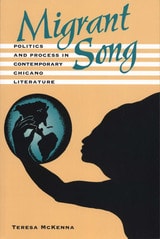
Migrant Song
Politics and Process in Contemporary Chicano LiteratureBy Teresa McKenna
University of Texas Press, 1996
Migration and continuity have shaped both the Chicano people and their oral and written literature. In this pathfinding study of Chicano literature, Teresa McKenna specifically explores how these works arise out of social, political, and psychological conflict and how the development of Chicano literature is inextricably embedded in this fact.
McKenna begins by appraising the evolution of Chicano literature from oral forms—including the important role of the corrido in the development of Chicano poetry. In subsequent chapters she examines the works of Richard Rodriguez and Rolando Hinojosa. She also devotes a chapter to the development of the Chicana voice in Chicano literature. Her epilogue considers the parallel development of Chicano literary theory and discusses some possible directions for research.
In McKenna's own words, "I believe that the future of this literature, as that of all literatures by people of color in the United States, rests largely on its being effectively introduced into the curricula at all levels, as well as its entrance into the critical consciousness of literary theory." This book will be an important step in that process.
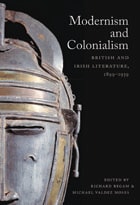
Modernism and Colonialism
British and Irish Literature, 1899–1939Richard Begam and Michael Valdez Moses, eds.
Duke University Press, 2007
Ranging over poetry, fiction, and criticism, the essays provide fresh appraisals of Joseph Conrad, T. S. Eliot, Ezra Pound, Virginia Woolf, D. H. Lawrence, Wyndham Lewis, E. M. Forster, W. B. Yeats, James Joyce, Elizabeth Bowen, Hugh MacDiarmid, and Evelyn Waugh, as well as Robert Louis Stevenson and H. Rider Haggard. The essays that bookend the collection connect the modernists to their Victorian precursors, to postwar literary critics, and to postcolonial poets. The rest treat major works written or published between 1899 and 1939, the boom years of literary modernism and the period during which the British empire reached its greatest geographic expanse. Among the essays are explorations of how primitivism figured in the fiction of Lawrence and Lewis; how, in Ulysses, Joyce used modernist techniques toward anticolonial ends; and how British imperialism inspired Conrad, Woolf, and Eliot to seek new aesthetic forms appropriate to the sense of dislocation they associated with empire.
Contributors. Nicholas Allen, Rita Barnard, Richard Begam, Nicholas Daly, Maria DiBattista, Ian Duncan, Jed Esty, Andrzej Gąsiorek, Declan Kiberd, Brian May, Michael Valdez Moses, Jahan Ramazani, Vincent Sherry
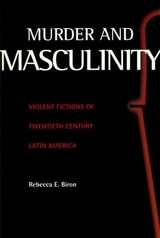
Murder and Masculinity
Violent Fictions of Twentieth-Century Latin AmericaRebecca E. Biron
Vanderbilt University Press, 2000
The introduction to this study deftly situates Biron's work in relation to previous theoretical arguments on the social and political dimensions of Latin American writing. The five subsequent chapters offer superb analyses of the individual texts. Like their male protagonists who experiment with the psychological and legal extremes of gender division, these narratives risk nonconformity to the laws of genre in their quest for liberation from violent social and literary conventions. In combining elements of detective stories, crime narratives, psychological case studies, and magical or grotesque realism, they offer metafictional commentary on a network of discourses that confuses images of masculinity, national identity, and political autonomy in postcolonial Latin America.