Results by title
115 books match the query 'Portraits' and 4 start with m

Madison
Portraits of Our NeighborsLaura Jo Amaral and Stacie Huckeba; Foreword by Carlene Carter
Vanderbilt University Press, 2025
Madison: Portraits of Our Neighbors, a photography book and living historical document of a unique Tennessee community, is the result of an artistic partnership between internationally recognized photographer Stacie Huckeba and Madison, Tennessee, community volunteer Laura Jo Amaral. This book captures the heart of the people who contribute to the Madison community as it is today, through portraits of a range of its citizens—a world-class bass player, a nonagenarian cattle farmer, a TikTok celebrity, a singer-songwriter, a mariachi band, the personal photographer for Johnny Cash, a beloved gymnastics coach, model airplane enthusiasts, educators, a fashion designer, a puppet enthusiast, a pastor and outreach worker, and an array of artists, small business owners, farmers, and local legends. Beyond a collection of portraits, it is a testament to an enduring urban community, a celebration of the shared human experience, and a reminder to see our neighbors in their best light. Madison: Portraits of Our Neighbors invites readers to celebrate the tapestry of humanity that weaves through this distinctive neighborhood.
This book is the recipient of the 2026 Norman L. and Roselea J. Goldberg Prize from Vanderbilt University Press for the best book in the area of art or medicine.

Malinowski's Kiriwina
Fieldwork Photography 1915-1918Michael W. Young
University of Chicago Press, 1998
Malinowski's Kiriwina presents nearly two hundred of Malinowski's previously unpublished photographs, taken between 1915 and 1918, of the Trobriand Islanders. The images are more than embellishments of his ethnography; they are a recreation in striking detail of a distant world. Michael Young, an anthropologist and Malinowski's authorized biographer, has selected the photographs based on one of Malinowski's unpublished studies of the region, and the plan of that abandoned project has helped structure this book.
Divided into fourteen sections, Malinowski's Kiriwina is a series of linked photo-essays based on Trobriand institutions and cultural themes as described by Malinowski. The introductory essay by Young appraises the founding anthropologist's photographic oeuvre, explains the historical circumstances and technical aspects of the images, and puts them in their colonial context. Young illuminates the photographs with quotations from Malinowski's diaries, letters, and field notes, thereby giving a biographical dimension to the collection. Commentaries on the images by contemporary Trobrianders add a further layer of interpretation. The result is a stunning record not only of a fascinating place, but of the mutual relationship between ethnography and the visual.
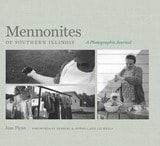
Mennonites of Southern Illinois
A Photographic JournalJane Flynn, with forewords by Herbert K. Russell and Liz Wells
Southern Illinois University Press, 2024
WINNER, Certificate of Excellence in “Publications – Other” from the Illinois State Historical Society’s 2025 Best of Illinois History Awards!
“In the World But Not of It”
Offering a glimpse into a world largely misunderstood by mainstream society, this book documents the period of eight years that Jane Flynn practiced with Mennonites in two different Southern Illinois communities: Stonefort, and Mount Pleasant in Anna. Despite her status as an outsider, Flynn was welcomed and allowed to photograph the Mennonites in their homes, making applesauce, farming, and beekeeping.
Escaping persecution from the Catholic Church in Europe, the Mennonites arrived in America in 1683, settling in what is now Pennsylvania. Today, they live in almost all 50 states, Canada, and South America. To reflect the Mennonites’ manual-labor lifestyle, Flynn processed her black-and-white photographs by hand and hand-printed them in a dark room. The imagery explores the Mennonites’ labors, leisure, and faith by documenting their homes, places of work and worship, and the Illinois Ozark landscape they inhabit.
Similar to the Amish and the Quakers, Mennonites consider the Bible the supreme authority and insist on a separation between church and state. To enact that separation, they distinguish themselves from society in speech, dress, business, recreation, education, pacifism, and by refusing to participate in politics. They believe in nonconformity to the world, discipleship, and being born again through adult baptism. With Mennonites of Southern Illinois, Jane Flynn provides representation for these closed communities and illustrates the Mennonites’ struggle to find and maintain balance between rustic and modern life while remaining faithful to their religious beliefs.

My Race Is My Gender
Portraits of Nonbinary People of ColorStephanie Hsu
Rutgers University Press, 2024
Genderqueer and nonbinary people of color often experience increased marginalization, belonging to an ethnic group that seldom recognizes their gender identity and a queer community that subscribes to white norms. Yet for this very reason, they have a lot to teach about how racial, sexual, and gender identities intersect. Their experiences of challenging social boundaries demonstrate how queer communities can become more inclusive and how the recognition of nonbinary genders can be an anti-racist practice.
My Race is My Gender is the first anthology by nonbinary writers of color to include photography and visual portraits, centering their everyday experiences of negotiating intersectional identities. While informed by queer theory and critical race theory, the authors share their personal stories in accessible language. Bringing together Black, Indigenous, Latine, and Asian perspectives, its six contributors present an intergenerational look at what it means to belong to marginalized queer communities in the U.S. and feel solidarity with a global majority at the same time. They also provide useful insights into how genderqueer and nonbinary activism can both energize and be fueled by such racial justice movements as Black Lives Matter.