160 books match the query 'Poverty & Homelessness' and 4 start with m
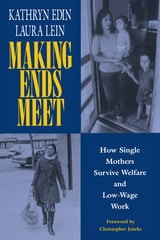
cover of Making Ends Meet: How Single Mothers Survive Welfare and Low-Wage Work

Making Ends Meet

How Single Mothers Survive Welfare and Low-Wage Work

Kathryn Edin

Russell Sage Foundation, 1997
Welfare mothers are popularly viewed as passively dependent on their checks and averse to work. Reformers across the political spectrum advocate moving these women off the welfare rolls and into the labor force as the solution to their problems. Making Ends Meet offers dramatic evidence toward a different conclusion: In the present labor market, unskilled single mothers who hold jobs are frequently worse off than those on welfare, and neither welfare nor low-wage employment alone will support a family at subsistence levels. Kathryn Edin and Laura Lein interviewed nearly four hundred welfare and low-income single mothers from cities in Massachusetts, Texas, Illinois, and South Carolina over a six year period. They learned the reality of these mothers' struggles to provide for their families: where their money comes from, what they spend it on, how they cope with their children's needs, and what hardships they suffer. Edin and Lein's careful budgetary analyses reveal that even a full range of welfare benefits—AFDC payments, food stamps, Medicaid, and housing subsidies—typically meet only three-fifths of a family's needs, and that funds for adequate food, clothing and other necessities are often lacking. Leaving welfare for work offers little hope for improvement, and in many cases threatens even greater hardship. Jobs for unskilled and semi-skilled women provide meager salaries, irregular or uncertain hours, frequent layoffs, and no promise of advancement. Mothers who work not only assume extra child care, medical, and transportation expenses but are also deprived of many of the housing and educational subsidies available to those on welfare. Regardless of whether they are on welfare or employed, virtually all these single mothers need to supplement their income with menial, off-the-books work and intermittent contributions from family, live-in boyfriends, their children's fathers, and local charities. In doing so, they pay a heavy price. Welfare mothers must work covertly to avoid losing benefits, while working mothers are forced to sacrifice even more time with their children. Making Ends Meet demonstrates compellingly why the choice between welfare and work is more complex and risky than is commonly recognized by politicians, the media, or the public. Almost all the welfare-reliant women interviewed by Edin and Lein made repeated efforts to leave welfare for work, only to be forced to return when they lost their jobs, a child became ill, or they could not cover their bills with their wages. Mothers who managed more stable employment usually benefited from a variety of mitigating circumstances such as having a relative willing to watch their children for free, regular child support payments, or very low housing, medical, or commuting costs. With first hand accounts and detailed financial data, Making Ends Meet tells the real story of the challenges, hardships, and survival strategies of America's poorest families. If this country's efforts to improve the self-sufficiency of female-headed families is to succeed, reformers will need to move beyond the myths of welfare dependency and deal with the hard realities of an unrewarding American labor market, the lack of affordable health insurance and child care for single mothers who work, and the true cost of subsistence living. Making Ends Meet is a realistic look at a world that so many would change and so few understand.
[more]
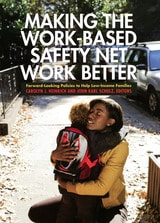
cover of Making the Work-Based Safety Net Work Better: Forward-Looking Policies to Help Low-Income Families

Making the Work-Based Safety Net Work Better

Forward-Looking Policies to Help Low-Income Families

Carolyn J. Heinrich

Russell Sage Foundation, 2009
Work first. That is the core idea behind the 1996 welfare reform legislation. It sounds appealing, but according to Making the Work-Based Safety Net Work Better, it collides with an exceptionally difficult reality. The degree to which work provides a way out of poverty depends greatly on the ability of low-skilled people to maintain stable employment and make progress toward an income that provides an adequate standard of living. This forward-looking volume examines eight areas of the safety net where families are falling through and describes how current policies and institutions could evolve to enhance the self-sufficiency of low-income families. David Neumark analyzes a range of labor market policies and finds overwhelming evidence that the minimum wage is ineffective in promoting self-sufficiency. Neumark suggests the Earned Income Tax Credit is a much more promising policy to boost employment among single mothers and family incomes. Greg Duncan, Lisa Gennetian, and Pamela Morris find no evidence that encouraging parents to work leads to better parenting, improved psychological health, or more positive role models for children. Instead, the connection between parental work and child achievement is linked to parents' improved access to quality child care. Rebecca Blank and Brian Kovak document an alarming increase in the number of single mothers who receive neither wages nor public assistance and who are significantly more likely to suffer from medical problems of their own or of a child. Time caps and work hour requirements embedded in benefits policies leave some mothers unable to work and ineligible for cash benefits. Marcia Meyers and Janet Gornick identify another gap: low-income families tend to lose financial support and health coverage long before they earn enough to access employer-based benefits and tax provisions. They propose building "institutional bridges" that minimize discontinuities associated with changes in employment, earnings, or family structure. Steven Raphael addresses a particularly troubling weakness of the work-based safety net—its inadequate provision for the large number of individuals who are or were incarcerated in the United States. He offers tractable suggestions for policy changes that could ease their transition back into non-institutionalized society and the labor market. Making the Work-Based Safety Net Work Better shows that the "work first" approach alone isn't working and suggests specific ways the social welfare system might be modified to produce greater gains for vulnerable families.
[more]
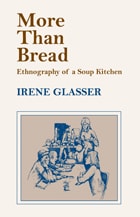
cover of More Than Bread: Ethnography of a Soup Kitchen

More Than Bread

Ethnography of a Soup Kitchen

Irene Glasser

University of Alabama Press, 2010

A powerful ethnographic portrait of hunger, dignity, and community in America.

In More than Bread: Ethnography of a Soup Kitchen, sociologist Irene Glasser presents a compelling and deeply human exploration of poverty, hunger, and community through the lens of an American soup kitchen. Drawing on immersive ethnographic research, Glasser moves beyond stereotypes and statistics to examine the daily experiences of individuals who depend on emergency food assistance, as well as the volunteers and staff who work to meet their needs.

Through firsthand observations and personal narratives, the book reveals the complex social relationships, challenges, and acts of resilience that unfold within this vital community institution. Glasser explores how issues such as homelessness, unemployment, inequality, mental health, and social isolation intersect in the lives of those seeking assistance, while also highlighting the dignity and humanity of people often overlooked in public discussions of poverty.

More than Bread invites readers to consider broader questions about social responsibility, public policy, and the effectiveness of charitable responses to human need. A valuable resource for understanding the realities of food insecurity in America, this book offers an informative and compassionate perspective on one of society's most pressing challenges. It is an essential read for students, scholars, social workers, policymakers, nonprofit professionals, and anyone interested in poverty, homelessness, and social justice.
[more]
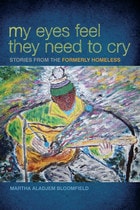
cover of My Eyes Feel They Need to Cry: Stories from the Formerly Homeless

My Eyes Feel They Need to Cry

Stories from the Formerly Homeless

Martha Aladjem Bloomfield

Michigan State University Press, 2013

As intimate as they are inspiring, these stories of transformation, drawn from the oral histories of formerly homeless adults, testify to the determination of the human spirit and the healing power of sharing one’s journey. This gripping collection gives voice to the traditionally voiceless, inviting men and women from a variety of cultural and ethnic backgrounds to share their experiences of what it was like to live on the streets, in cars, under bridges, and of how they discovered the inner motivation to change the course of their lives in a positive direction. An important contribution to understanding how destructive patterns can be broken, this book examines some key questions: How do those who have suffered from homelessness and the hardships that accompany it find the inspiration and courage to break the seemingly endless cycle, transform their lives, and become self-sufficient? What emotional price do they pay? When do they realize that enough is enough? How do they learn to trust new people when so many have disappointed them? Homeless people can and do find a way off the streets, as these men and women reveal through their stories, paintings, and poetry.
[more]