Results by title
83 books match the query 'Pragmatism' and 2 start with m
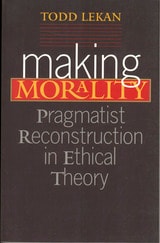
Making Morality
Pragmatist Reconstruction in Ethical TheoryTodd Lekan
Vanderbilt University Press, 2003
In this new contribution to moral theory, Todd Lekan argues for a pragmatist conception of morality as an evolving, educational, and fallible practice of everyday life. Drawing on the work of John Dewey, Lekan asserts that moral norms are neither timeless truths nor subjective whims, but habits transmitted through practices. Like the habits that make up medicine or engineering, moral habits are subject to rational evaluation and change according to new challenges and circumstances. This pragmatic interpretation of morality provides a way out of the conundrum of relativism and absolutism.
Building on classical American philosophy to address current philosophical concerns, Lekan's theory revises our basic understanding of moral life and the place of theorizing within that life. Making Morality will prove of great interest to ethical theorists, as it enjoins them to measure theoretical inquiries by how well they produce intellectual tools for problem-solving in dynamic, complex communities.
[more]
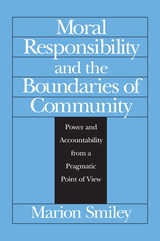
Moral Responsibility and the Boundaries of Community
Power and Accountability from a Pragmatic Point of ViewMarion Smiley
University of Chicago Press, 1992
The question of responsibility plays a critical role not only in our attempts to resolve social and political problems, but in our very conceptions of what those problems are. Who, for example, is to blame for apartheid in South Africa? Is the South African government responsible? What about multinational corporations that do business there? Will uncovering the "true facts of the matter" lead us to the right answer?
In an argument both compelling and provocative, Marion Smiley demonstrates how attributions of blame—far from being based on an objective process of factual discovery—are instead judgments that we ourselves make on the basis of our own political and social points of view. She argues that our conception of responsibility is a singularly modern one that locates the source of blameworthiness in an individual's free will. After exploring the flaws inherent in this conception, she shows how our judgments of blame evolve out of our configuration of social roles, our conception of communal boundaries, and the distribution of power upon which both are based.
The great strength of Smiley's study lies in the way in which it brings together both rigorous philosophical analysis and an appreciation of the dynamics of social and political practice. By developing a pragmatic conception of moral responsibility, this work illustrates both how moral philosophy can enhance our understanding of social and political practices and why reflection on these practices is necessary to the reconstruction of our moral concepts.
[more]