214 books match the query 'Presidents & Heads of State' and 7 start with m
cover of Macmillan

Macmillan

Francis Beckett

Haus Publishing, 2006
Fatherly friend to JFK he repaired the rift between the USA and Britain created by the Suez crisis.
[more]
cover of Maharajah of Bikaner: India

Maharajah of Bikaner

India

Hugh Purcell

Haus Publishing, 2010

The story of the Indian soldiery in the Great War needs a new telling and one important chapter of it will be about the Maharajah of Bikaner: Dashing, autocratic and a formidable public speaker, Ganga Singh commanded his own camel corps called the Ganga Risala, fought on the Western Front and in Egypt, became the first Indian general in the British Indian army and persuaded the maharajas to unite into the Chamber of Princes. As a result of this and his war record he was invited by Lloyd George to attend the Imperial War Conference in 1917 and then the Versailles Peace Conference two years later, where he persuaded the other delegates to include India in the new League of Nations, quite an achievement as it was not an independent nation. Less successfully he tried to prevent the dismemberment of Turkey.
[more]
cover of Major

Major

Robert Taylor

Haus Publishing, 2006
British Prime Minister who worked with Clinton to bring peace to Northern Ireland
[more]
cover of Mannerheim: President, Soldier, Spy

Mannerheim

President, Soldier, Spy

Jonathan Clements

Haus Publishing, 2012
Baron Gustaf Mannerheim was one of the greatest figures of the twentieth century, and the only man to be decorated by both sides in the Second World War. As a Finnish officer in Russian service, he witnessed the coronation of the last Tsar, and was both reprimanded for foolhardiness and decorated for bravery in the Russo-Japanese War. He spent two years undercover in Asia as an agent in the 'Great Game', posing as a Swedish anthropologist. He crossed China on horseback, stopping en route to teach the 13th Dalai Lama how to shoot with a pistol, and spying on the Japanese navy on his way home. He escaped the Bolsheviks by the skin of his teeth in 1917, arriving in the newly independent Finland just in time to lead the anti-Russian forces in the local revolt and civil war. During Finland's darkest hour, he lead the defence of his country against the impossible odds of the Winter War. This major new life of Gustaf Mannerheim, the first to be published for over a decade, includes new historical material on Mannerheim's time in China.
[more]
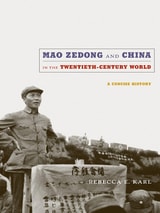
cover of Mao Zedong and China in the Twentieth-Century World: A Concise History

Mao Zedong and China in the Twentieth-Century World

A Concise History

Rebecca E. Karl

Duke University Press, 2010
Throughout this lively and concise historical account of Mao Zedong’s life and thought, Rebecca E. Karl places the revolutionary leader’s personal experiences, social visions and theory, military strategies, and developmental and foreign policies in a dynamic narrative of the Chinese revolution. She situates Mao and the revolution in a global setting informed by imperialism, decolonization, and third worldism, and discusses worldwide trends in politics, the economy, military power, and territorial sovereignty. Karl begins with Mao’s early life in a small village in Hunan province, documenting his relationships with his parents, passion for education, and political awakening during the fall of the Qing dynasty in late 1911. She traces his transition from liberal to Communist over the course of the next decade, his early critiques of the subjugation of women, and the gathering force of the May 4th movement for reform and radical change. Describing Mao’s rise to power, she delves into the dynamics of Communist organizing in an overwhelmingly agrarian society, and Mao’s confrontations with Chiang Kaishek and other nationalist conservatives. She also considers his marriages and romantic liaisons and their relation to Mao as the revolutionary founder of Communism in China. After analyzing Mao’s stormy tenure as chairman of the People’s Republic of China, Karl concludes by examining his legacy in China from his death in 1976 through the Beijing Olympics in 2008.
[more]
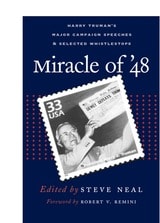
cover of Miracle of '48

Miracle of '48

Edited by Steve Neal. Foreword by Robert V. Remini

Southern Illinois University Press, 2003

Miracle of ’48: Harry Truman’s Major Campaign Speeches and Selected Whistle-stopsis the first published collection of the public addresses Harry Truman made as he crisscrossed the United States from New York City to Los Angeles to Independence, Missouri in 1948. Edited by veteran political journalist Steve Neal, and complemented by a foreword from presidential historian Robert V. Remini, this volume captures the infectious spirit and determination of Truman’s message to the American people.

In an era when policy issues were paramount and televised debates were a thing of the future, Truman boldly stated his case directly to the American people, and they responded. “Senator Barkley and I will win this election and make these Republicans like it,” he declared in his acceptance speech at the Democratic National Convention in Philadelphia. “Don’t you forget that. We will do that because they are wrong and we are right.”

From the start of his “non-political” western tour in Crestline, Ohio, through his victory celebration in his hometown of Independence, the plainspoken Truman waged the good fight against all odds, never mixing his words or apologizing for his aggressively honest tactics. In blaming the GOP for a decline in farm prices, he alleged that the 80th Congress had “stuck a pitchfork in the farmer’s backs.” Truman is now regarded as among our greatest presidents and the populist message of his ’48 campaign is still as compelling and relevant today as it was over half a century ago.

“The political history of the United States reveals many unusual developments,” General Dwight D. Eisenhower wrote Truman after the 1948 election, “but certainly at no point does it record a greater accomplishment than yours, that can be traced so clearly to the stark courage and fighting heart of one man.”
[more]
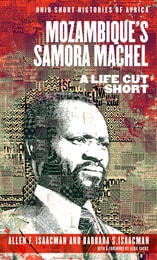
cover of Mozambique’s Samora Machel: A Life Cut Short

Mozambique’s Samora Machel

A Life Cut Short

Allen F. Isaacman

Ohio University Press, 2020

The precipitous rise and controversial fall of a formidable African leader.

Samora Machel (1933–1986), the son of small-town farmers, led his people through a war against their Portuguese colonists and became the first president of the People’s Republic of Mozambique.

Machel’s military successes against a colonial regime backed by South Africa, Rhodesia, the United States, and its NATO allies enhanced his reputation as a revolutionary hero to the oppressed people of Southern Africa. In 1986, during the country’s civil war, Machel died in a plane crash under circumstances that remain uncertain.

Allen and Barbara Isaacman lived through many of these changes in Mozambique and bring personal recollections together with archival research and interviews with others who knew Machel or participated in events of the revolutionary or post-revolutionary years.

[more]