262 books match the query 'Public health' and 22 start with m
cover of Making Americans Healthier: Social and Economic Policy as Health Policy

Making Americans Healthier

Social and Economic Policy as Health Policy

Robert F. Schoeni

Russell Sage Foundation, 2008
The United States spends billions of dollars annually on social and economic policies aimed at improving the lives of its citizens, but the health consequences associated with these policies are rarely considered. In Making Americans Healthier, a group of multidisciplinary experts shows how social and economic policies seemingly unrelated to medical well-being have dramatic consequences for the health of the American people. Most previous research concerning problems with health and healthcare in the United States has focused narrowly on issues of medical care and insurance coverage, but Making Americans Healthier demonstrates the important health consequences that policymakers overlook in traditional cost-benefit evaluations of social policy. The contributors examine six critical policy areas: civil rights, education, income support, employment, welfare, and neighborhood and housing. Among the important findings in this book, David Cutler and Adriana Lleras-Muney document the robust relationship between educational attainment and health, and estimate that the health benefits of education may exceed even the well-documented financial returns of education. Pamela Herd, James House, and Robert Schoeni discover notable health benefits associated with the Supplemental Security Income Program, which provides financial support for elderly and disabled Americans. George Kaplan, Nalini Ranjit, and Sarah Burgard document a large and unanticipated improvement in the health of African-American women following the enactment of civil rights legislation in the 1960s. Making Americans Healthier presents ground-breaking evidence that the health impact of many social policies is substantial. The important findings in this book pave the way for promising new avenues for intervention and convincingly demonstrate that ultimately social and economic policy is health policy. A Volume in the National Poverty Center Series on Poverty and Public Policy
[more]
cover of Making Room in the Clinic: Nurse Practitioners and the Evolution of Modern Health Care

Making Room in the Clinic

Nurse Practitioners and the Evolution of Modern Health Care

Fairman, Julie

Rutgers University Press, 2009

In Making Room in the Clinic, Julie Fairman examines the context in which the nurse practitioner movement emerged, how large political and social movements influenced it, and how it contributed to the changing definition of medical care. Drawing on primary source material, including interviews with key figures in the movement, Fairman describes how this evolution helped create an influential foundation for health policies that emerged at the end of the twentieth century, including health maintenance organizations, a renewed interest in health awareness and disease prevention, and consumer-based services.
[more]
cover of Making Uncertainty: Tuberculosis, Substance Use, and Pathways to Health in South Africa

Making Uncertainty

Tuberculosis, Substance Use, and Pathways to Health in South Africa

Anna Versfeld

Rutgers University Press, 2023

In Cape Town, South Africa, many people with tuberculosis also use substances. This sets up a seemingly impossible problem: People who use substances are at increased risk of tuberculosis disease; and substance use seems to result in erratic behavior that makes successful treatment of people affected by tuberculosis extremely difficult. People affected don’t get healthy, healthcare providers are frustrated, and families seek to balance love and care for those who are ill with self-protection. How are we to understand this? Where does the responsibility for poor health and healing lie? What are the possibilities for an effective healthcare response? Through a close look at lives and care, Making Uncertainty: Tuberculosis, Substance Use, and Pathways to Health shows how patterns of substance use, tuberculosis disease, and their interaction are shaped by history, social context, and political economy. This, in turn, generates new perspectives on what makes poor health, and what good care might look like.
[more]
cover of Making the American Mouth: Dentists and Public Health in the Twentieth Century

Making the American Mouth

Dentists and Public Health in the Twentieth Century

Picard, Alyssa

Rutgers University Press, 2009

Why are Americans so uniquely obsessed with teeth? Brilliantly white, straight teeth?

Making the American Mouth is at once a history of United States dentistry and a study of a billion-dollar industry. Alyssa Picard chronicles the forces that limited Americans' access to dental care in the early twentieth century and the ways dentists worked to expand that access--and improve the public image of their profession. Comprehensive in scope, this work describes how dentists' early public health commitments withered under the strain of fights over fluoride, mid-century social movements for racial and gender equity, and pressure to insure dental costs. It explains how dentists came to promote cosmetic services, and why Americans were so eager to purchase them. As we move into the twentyfirst century, dentists' success in shaping their industry means that for many, the perfect American smile will remain a distant--though tantalizing--dream.
[more]
cover of Malady of Monoculture: Pellagra, Public Health, and the Pathologies of Cotton's Capitalism

Malady of Monoculture

Pellagra, Public Health, and the Pathologies of Cotton's Capitalism

Dana Landress

University of Chicago Press, 2027

How the cotton industry restricted sharecroppers’ access to nutritious food, a public health crisis that spurred a wave of influential and inspiring activism.

Pellagra, a nutritional deficiency disease, was once widespread in the southern United States, where it was concentrated in areas of high-yield cotton production. This wasn’t a coincidence. In the early twentieth century, pellagra was ubiquitous in regions where monocultural cotton production foreclosed cotton workers’ access to nutritious foods. Planters paid sharecroppers and millworkers in their own currency—tokens, coins, and other substitutes for money—and sold them unhealthy and overpriced food in company-owned stores. Employers kept workers poor through wage theft, predatory credit systems, and labor coercion, all of which maintained a system of food scarcity.

In Malady of Monoculture, Dana Landress reveals how the unrelenting demands of the cotton economy during the Jim Crow South created a public health crisis in the form of pellagra. She carefully details a “closed food system” that restricted workers’ diets through employer-generated currency; the use of food as an instrument of labor compulsion; manufactured debt structures; alliances between government and private industry; and restrictions on foraging, gardening, and land use. Though official public health programs framed pellagra in personal and behavioral terms, those afflicted with the illness actively challenged the closed food system through union organizing, community health care, freedom farms, and collective action lawsuits. Excavating the landmark contributions of Black nutritionists to the field of public health, Landress spotlights the many constituencies that worked tirelessly to combat hunger and foregrounds their creativity, resilience, and determination.
[more]
cover of Malaria on the Move: Rural Communities and Public Health in Zimbabwe, 1890-2015

Malaria on the Move

Rural Communities and Public Health in Zimbabwe, 1890-2015

Kundai Manamere

Ohio University Press, 2025
Malaria on the Move explores the socioeconomic aspects of endemic malaria in the southeastern lowveld of Zimbabwe. The book provides a historical analysis of malaria control and eradication programs in Rhodesia and independent Zimbabwe from the late nineteenth century to 2015. Kundai Manamere draws connections between malaria epidemiology and human mobility relating to large- and small-scale farming, labor migration, colonial displacement, war, and rural-to-urban movements. She examines how circular labor migration and rural travel influence the risk of malaria for individuals and communities and shows how migration and travel have spread the disease and impeded control efforts. More important, the book demonstrates that the need to travel for work is an indicator of a local hierarchy of priorities. It reaffirms the urgent need for partners in malaria control to consider local socioeconomic factors in their design and implementation of intervention programs. The inclusion of local contexts, perspectives, and voices in the formulation of national and global public health policies and interventions is critical to addressing public noncooperation. To date, biomedical studies of malaria have outnumbered socioeconomic and political studies of the disease. Manamere advocates for a multipronged approach that goes beyond standard scientific research methods. Such an approach incorporates an understanding of how socioeconomic considerations of recipient communities influence malaria epidemiology, local perceptions of the disease, and responses to interventions. This context is particularly important for understanding why malaria has remained a global health challenge and why so many interventions have failed. Scientifically, malaria is a disease of the landscape, and its ecological complexity poses challenges to its eradication. Yet, biological and ecological landscapes are not exclusive factors in the spread of disease; as Manamere demonstrates, the socioeconomic environment is equally important.
[more]
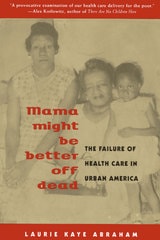
cover of Mama Might Be Better Off Dead: The Failure of Health Care in Urban America

Mama Might Be Better Off Dead

The Failure of Health Care in Urban America

Laurie Kaye Abraham

University of Chicago Press, 1993

Mama Might Be Better Off Dead is an unsettling, profound look at the human face of health care. Both disturbing and illuminating, it immerses readers in the lives of four generations of a poor, African-American family beset with the devastating illnesses that are all too common in America's inner-cities.

The story takes place in North Lawndale, a neighborhood that lies in the shadows of Chicago's Loop. Although surrounded by some of the city's finest medical facilities, North Lawndale is one of the sickest, most medically underserved communities in the country. Headed by Jackie Banes, who oversees the care of a diabetic grandmother, a husband on kidney dialysis, an ailing father, and three children, the Banes family contends with countless medical crises. From visits to emergency rooms and dialysis units, to trials with home care, to struggles for Medicaid eligibility, Abraham chronicles their access (or lack of access) to medical care.

Told sympathetically but without sentimentality, their story reveals an inadequate health care system that is further undermined by the direct and indirect effects of poverty. When people are poor, they become sick easily. When people are sick, their families quickly become poorer.

Embedded in the family narrative is a lucid analysis of the gaps, inconsistencies, and inequalities the poor face when they seek health care. This book reveals what health care policies crafted in Washington, D. C. or state capitals look like when they hit the street. It shows how Medicaid and Medicare work and don't work, the Catch-22s of hospital financing in the inner city, the racial politics of organ transplants, the failure of childhood immunization programs, the vexed issues of individual responsibility and institutional paternalism. One observer puts it this way: "Show me the poor woman who finds a way to get everything she's entitled to in the system, and I'll show you a woman who could run General Motors."

Abraham deftly weaves these themes together to make a persuasive case for health care reform while unflinchingly presenting the complexities that will make true reform as difficult as it is necessary. Mama Might Be Better Off Dead is a book with the power to change the way health care is understood in America. For those seeking to learn what our current system of health care promises and what it delivers, it offers a place for the debate to begin.

[more]
cover of Mama Might Be Better Off Dead: The Failure of Health Care in Urban America

Mama Might Be Better Off Dead

The Failure of Health Care in Urban America

Laurie Kaye Abraham

University of Chicago Press, 1994

North Lawndale, a neighborhood that lies in the shadows of Chicago’s Loop, is surrounded by some of the city’s finest medical facilities, Yet, it is one of the sickest, most medically underserved communities in the country.

Mama Might Be Better Off Dead immerses readers in the lives of four generations of a poor, African-American family in the neighborhood, who are beset with the devastating illnesses that are all too common in America’s inner-cities. Headed by Jackie Banes, who oversees the care of a diabetic grandmother, a husband on kidney dialysis, an ailing father, and three children, the Banes family contends with countless medical crises. From visits to emergency rooms and dialysis units, to trials with home care, to struggles for Medicaid eligibility, Laurie Kaye Abraham chronicles their access—or more often, lack thereof—to medical care. Told sympathetically but without sentimentality, their story reveals an inadequate health care system that is further undermined by the direct and indirect effects of poverty.

Both disturbing and illuminating, Mama Might Be Better Off Dead is an unsettling, profound look at the human face of health care in America. Published to great acclaim in 1993, the book in this new edition includes an incisive foreword by David Ansell, a physician who worked at Mt. Sinai Hospital, where much of the Banes family’s narrative unfolds.
 
[more]
cover of Mapping Medical Anthropology for the Twenty-First Century

Mapping Medical Anthropology for the Twenty-First Century

Matthew J. Wolf-Meyer

Rutgers University Press, 2026

Mapping Medical Anthropology for the Twenty-First Century provides readers with a comprehensive survey of topics, methodologies, and theories in the discipline, drawing on contributions from leading anthropologists around the world. As a discipline, medical anthropology provides situational analysis of health, disease, and disability to show how the experiences of medical experts, patients, and their broader communities are informed by their social and cultural contexts. Adopting a keywords-driven approach, Mapping Medical Anthropology for the Twenty-First Century provides readers with an introduction to the concepts and approaches that have animated medical anthropology over the course of the twentieth century. Authors put these keywords into dialogue with their ethnographic and archival research to demonstrate how these concepts can be expanded to address contemporary phenomena related to health, disease, and disability. Mapping Medical Anthropology for the Twenty-First Century provides newcomers to medical anthropology with a robust introduction to the discipline, while providing experienced readers a set of chapters that explore the discipline in novel and exciting ways. 
 

[more]
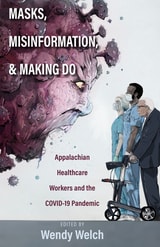
cover of Masks, Misinformation, and Making Do: Appalachian Health-Care Workers and the COVID-19 Pandemic

Masks, Misinformation, and Making Do

Appalachian Health-Care Workers and the COVID-19 Pandemic

Wendy Welch

Ohio University Press, 2023
The firsthand pandemic experiences of rural health-care providers—who were already burdened when COVID-19 hit—raise questions about the future of public health and health-care delivery. This volume comprises the COVID-19 pandemic experiences of Appalachian health-care workers, including frontline providers, administrators, and educators. The combined narrative reveals how governmental and corporate policies exacerbated the region’s injustices, stymied response efforts, and increased the death toll. Beginning with an overview of the SARS-CoV-2 virus and its impact on the body, the essays in the book’s first section provide background material and contextualize the subsequent explosion of telemedicine, the pandemic’s impact on medical education, and its relationship to systemic racism and related disparities in mental health treatment. Next, first-person narratives from diverse perspectives recount the pandemic’s layered stresses, including the scramble for ventilators, masks, and other personal protective equipment the neighbors, friends, and family members who flouted public-health mandates, convinced that COVID-19 was a hoax the added burden the virus leveled on patients whose health was already compromised by cancer, diabetes, or addiction the acute ways the pandemic’s arrival exacerbated interpersonal and systemic racism that Black and other health-care workers of color bear not only the battle against the virus but also the growing suspicion and even physical abuse from patients convinced that doctors and nurses were trying to kill them These visceral, personal experiences of how Appalachian health-care workers responded to the pandemic amid the nation’s deeply polarized political discourse will shape the historical record of this “unprecedented time” and provide a glimpse into the future of rural medicine. Contributors: Lucas Aidukaitis, Clay Anderson, Tammy Bannister, Alli Delp, Lynn Elliott, Monika Holbein, Laura Hungerford, Nikki King, Brittany Landore, Jeffrey J. LeBoeuf, Sojourner Nightingale, Beth O’Connor, Rakesh Patel, Mildred E. Perreault, Melanie B. Richards, Tara Smith, Kathy Osborne Still, Darla Timbo, Kathy Hsu Wibberly
[more]
cover of Medical Entanglements: Rethinking Feminist Debates about Healthcare

Medical Entanglements

Rethinking Feminist Debates about Healthcare

Kristina Gupta

Rutgers University Press, 2020
Medical Entanglements uses intersectional feminist, queer, and crip theory to move beyond “for or against” approaches to medical intervention. Using a series of case studies – sex-confirmation surgery, pharmaceutical treatments for sexual dissatisfaction, and weight loss interventions – the book argues that, because of systemic inequality, most mainstream medical interventions will simultaneously reinforce social inequality and alleviate some individual suffering. The book demonstrates that there is no way to think ourselves out of this conundrum as the contradictions are a product of unjust systems. Thus, Gupta argues that feminist activists and theorists should allow individuals to choose whether to use a particular intervention, while directing their social justice efforts at dismantling systems of oppression and at ensuring that all people, regardless of race, gender, sexuality, class, or ability, have access to the basic resources required to flourish.
 
[more]
cover of Medical Professionalism in the New Information Age

Medical Professionalism in the New Information Age

Edited and with an Introduction by David J. Rothman and David Blumenthal

Rutgers University Press, 2011

With computerized health information receiving unprecedented government support, a group of health policy scholars analyze the intricate legal, social, and professional implications of the new technology. These essays explore how Health Information Technology (HIT) may alter relationships between physicians and patients, physicians and other providers, and physicians and their home institutions. Patient use of web-based information may undermine the traditional information monopoly that physicians have long enjoyed. New IT systems may increase physicians' legal liability and heighten expectations about transparency. Case studies on kidney transplants and maternity practices reveal the unanticipated effects, positive and negative, of patient uses of the new technology. An independent HIT profession may emerge, bringing another organized interest into the medical arena. Taken together, these investigations cast new light on the challenges and opportunities presented by HIT.
[more]
cover of Medical Research for Hire: The Political Economy of Pharmaceutical Clinical Trials

Medical Research for Hire

The Political Economy of Pharmaceutical Clinical Trials

Fisher, Jill A

Rutgers University Press, 2008

Today, more than 75 percent of pharmaceutical drug trials in the United States are being conducted in the private sector. Once the sole province of academic researchers, these important studies are now being outsourced to non-academic physicians.

According to Jill A. Fisher, this major change in the way medical research is performed is the outcome of two problems in U.S. health care: decreasing revenue for physicians and decreasing access to treatment for patients. As physicians report diminishing income due to restrictive relationships with insurers, increasing malpractice insurance premiums, and inflated overhead costs to operate private practices, they are attracted to pharmaceutical contract research for its lucrative return. Clinical trials also provide limited medical access to individuals who have no or inadequate health insurance because they offer "free" doctors' visits, diagnostic tests, and medications to participants. Focusing on the professional roles of those involved, as well as key research practices, Fisher assesses the risks and advantages for physicians and patients alike when pharmaceutical drug studies are used as an alternative to standard medical care.

A volume in the Critical Issues in Health and Medicine series, edited by Rima D. Apple and Janet Golden
[more]
cover of Medicine and Health in Africa: Multidisciplinary Perspectives

Medicine and Health in Africa

Multidisciplinary Perspectives

Paula Viterbo

Michigan State University Press, 2011
Over the last two decades, the implosion of economies under the burden of debt, the negative repercussions of structural adjustment programs, the crisis of legitimacy, civil wars, and the collapse of some states have resulted in serious health issues across the African continent. Newly emerging diseases, such as Ebola virus and HIV/AIDS have killed and disabled millions. Some “old diseases,” such as yellow fever, tuberculosis, and polio have reappeared. Malaria, cholera, and meningitis continue to kill thousands. In many countries, the medical infrastructure has collapsed, while an increasing number of physicians and nurses have migrated to more hospitable places. Stigmatization of the affected people has exacerbated social and racial discrimination and has affected the implementation of national and international public health programs. The complexity of the situation requires an interdisciplinary approach. This collection, including contributions by historians, sociologists, anthropologists, and biologists, emphasizes the social and cultural contexts of African health, paying particular attention to the history of the colonial public health system and its legacy.
[more]
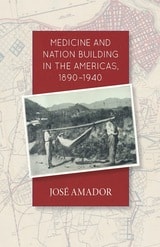
cover of Medicine and Nation Building in the Americas, 1890-1940

Medicine and Nation Building in the Americas, 1890-1940

Jose Amador

Vanderbilt University Press, 2015

As medical science progressed through the nineteenth century, the United States was at the forefront of public health initiatives across the Americas. Dreadful sanitary conditions were relieved, lives were saved, and health care developed into a formidable institution throughout Latin America as doctors and bureaucrats from the United States flexed their scientific muscle. This wasn't a purely altruistic enterprise, however, as Jose Amador reveals in Medicine and Nation Building in the Americas, 1890-1940. Rather, these efforts almost served as a precursor to modern American interventionism. For places like Cuba, Puerto Rico, and Brazil, these initiatives were especially invasive.

Drawing on sources in Cuba, Puerto Rico, Brazil, and the United States, Amador shows that initiatives launched in colonial settings laid the foundation for the rise of public health programs in the hemisphere and transformed debates about the formation of national culture. Writers rethought theories of environmental and racial danger, while Cuban reformers invoked the yellow fever campaign to exclude nonwhite immigrants. Puerto Rican peasants flooded hookworm treatment stations, and Brazilian sanitarians embraced regionalist and imperialist ideologies. Together, these groups illustrated that public health campaigns developed in the shadow of empire propelled new conflicts and conversations about achieving modernity and progress in the tropics.

This book is a recipient of the annual Norman L. and Roselea J. Goldberg Prize for the best project in the area of medicine.
[more]
cover of Medicine in the Meantime: The Work of Care in Mozambique

Medicine in the Meantime

The Work of Care in Mozambique

Ramah McKay

Duke University Press, 2018
In Mozambique, where more than half of the national health care budget comes from foreign donors, NGOs and global health research projects have facilitated a dramatic expansion of medical services. At once temporary and unfolding over decades, these projects also enact deeply divergent understandings of what care means and who does it. In Medicine in the Meantime, Ramah McKay follows two medical projects in Mozambique through the day-to-day lives of patients and health care providers, showing how transnational medical resources and infrastructures give rise to diverse possibilities for work and care amid constraint. Paying careful attention to the specific postcolonial and postsocialist context of Mozambique, McKay considers how the presence of NGOs and the governing logics of the global health economy have transformed the relations—between and within bodies, medical technologies, friends, kin, and organizations—that care requires and how such transformations pose new challenges for ethnographic analysis and critique.
[more]
cover of Medicine over Mind: Mental Health Practice in the Biomedical Era

Medicine over Mind

Mental Health Practice in the Biomedical Era

Dena T. Smith

Rutgers University Press, 2019
We live in an era in which medicalization—the process of conceptualizing and treating a wide range of human experiences as medical problems in need of medical treatment—of mental health troubles has been settled for several decades. Yet little is known about how this biomedical framework affects practitioners’ experiences. Using interviews with forty-three practitioners in the New York City area, this book offers insight into how the medical model maintains its dominant role in mental health treatment. Smith explores how practitioners grapple with available treatment models, and make sense of a field that has shifted rapidly in just a few decades. This is a book about practitioners working in a medicalized field; for some practitioners this is a straightforward and relatively tension-free existence while for others, who believe in and practice in-depth talk therapy, the biomedical perspective is much more challenging and causes personal and professional strains.
 
[more]
cover of Metrics: What Counts in Global Health

Metrics

What Counts in Global Health

Vincanne Adams, editor

Duke University Press, 2016
This volume's contributors evaluate the accomplishments, limits, and consequences of using quantitative metrics in global health. Whether analyzing maternal mortality rates, the relationships between political goals and metrics data, or the links between health outcomes and a program's fiscal support, the contributors question the ability of metrics to solve global health problems. They capture a moment when global health scholars and practitioners must evaluate the potential effectiveness and pitfalls of different metrics—even as they remain elusive and problematic.
 
Contributors. Vincanne Adams, Susan Erikson, Molly Hales, Pierre Minn, Adeola Oni-Orisan, Carolyn Smith-Morris, Marlee Tichenor, Lily Walkover, Claire L. Wendland
[more]
cover of Migration and Health

Migration and Health

Edited by Sandro Galea, Catherine K. Ettman, and Muhammad H. Zaman

University of Chicago Press, 2022

A new introduction to a timeless dynamic: how the movement of humans affects health everywhere.

International migrants compose more than three percent of the world’s population, and internal migrants—those migrating within countries—are more than triple that number. Population migration has long been, and remains today, one of the central demographic shifts shaping the world around us. The world’s history—and its health—is shaped and colored by stories of migration patterns, the policies and political events that drive these movements, and narratives of individual migrants. 

Migration and Health offers the most expansive framework to date for understanding and reckoning with human migration’s implications for public health and its determinants. It interrogates this complex relationship by considering not only the welfare of migrants, but also that of the source, destination, and ensuing-generation populations. The result is an elevated, interdisciplinary resource for understanding what is known—and the considerable territory of what is not known—at an intersection that promises to grow in importance and influence as the century unfolds.
[more]
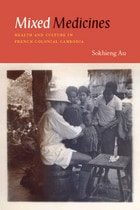
cover of Mixed Medicines: Health and Culture in French Colonial Cambodia

Mixed Medicines

Health and Culture in French Colonial Cambodia

Sokhieng Au

University of Chicago Press, 2011

During the first half of the twentieth century, representatives of the French colonial health services actively strove to expand the practice of Western medicine in the frontier colony of Cambodia. But as the French physicians ventured beyond their colonial enclaves, they found themselves negotiating with the plurality of Cambodian cultural practices relating to health and disease. These negotiations were marked by some success, a great deal of misunderstanding, and much failure.


Bringing together colorful historical vignettes, social and anthropological theory, and quantitative analyses, Mixed Medicines examines these interactions between the Khmer, Cham, and Vietnamese of Cambodia and the French, documenting the differences in their understandings of medicine and revealing the unexpected transformations that occurred during this period—for both the French and the indigenous population.
[more]
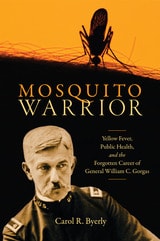
cover of Mosquito Warrior: Yellow Fever, Public Health, and the Forgotten Career of General William C. Gorgas

Mosquito Warrior

Yellow Fever, Public Health, and the Forgotten Career of General William C. Gorgas

Carol R. Byerly

University of Alabama Press, 2024

A compelling biography of General William C. Gorgas, the US Army doctor's campaign against mosquito-borne disease reshaped public health, military medicine, and U. S. power on the world stage. 

Mosquito Warrior tells the engrossing story of General William C. Gorgas (1854–1920), the once-renowned pioneer in tropical disease research and public health. His fascinating life illuminates vast transformations in the United States, including the end of the Civil War and the industrialization of the US military and economy, the emergence of germ theory and the modernization of the public health system, and the rise of the United States as a world power.

A scion of Confederate elites, Gorgas came of age amidst war and disease and the politics of racial segregation. He followed his father into military service as an army medical officer, treating troops on America’s western frontier posts. During the US occupation of Cuba, Gorgas applied Walter Reed’s research on the theory of mosquito-borne disease transmission, ending centuries of yellow fever in Havana through the eradication of the deadly Aedes aegypti mosquito. Applying similar strategies on the isthmus of Panama against yellow fever and malaria, Gorgas enabled the completion of the Panama Canal, then the largest engineering project in the world. Hailed a hero, he pursued his fight against mosquito-borne disease throughout the tropics, expanding American interests as he went. Appointed as US Army surgeon general on the eve of World War I, Gorgas resumed work modernizing the army health care system, strengthening US medical and military authority on the world stage.

Celebrated in life, Gorgas’s reputation fell victim to competing political interests and jealousies after his death, a cautionary tale about historical memory and the politics of science and personality. Carol R. Byerly’s balanced and contemporary examination of Gorgas illuminates his complex legacy in medicine and public health, military history, and American ambitions at the dawn of US global ascendency.
 

[more]
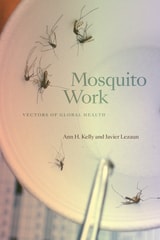
cover of Mosquito Work: Vectors of Global Health

Mosquito Work

Vectors of Global Health

Ann H. Kelly and Javier Lezaun

Duke University Press, 2026

In Mosquito Work, Ann H. Kelly and Javier Lezaun reimagine global health by returning to its most persistent problem: the mosquito. Drawing on nearly two decades of ethnographic and historical research across Africa, Latin America, Europe, and the former Soviet Union, the authors follow entomologists, technicians, community volunteers, and the mosquitoes themselves to illuminate the collaborations, experimental improvisations, and political entanglements that shape contemporary disease control. In each setting, Kelly and Lezaun explore how expertise is crafted, how interventions take shape, and how scientific attention to mosquito life becomes a vehicle for imagining different futures of global health. The painstaking effort to come to grips with the dynamic behaviors, elusive ecology, and irrepressible recalcitrance of mosquitoes offers crucial insight into what global health can know and do. Mosquito Work reveals a world where intervention depends less on silver bullets than on forms of care, persistence, and collaboration that unfold close to the problem at hand.
[more]