59 books match the query 'Public libraries' and 5 start with m
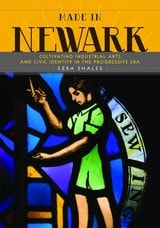
cover of Made in Newark: Cultivating Industrial Arts and Civic Identity in the Progressive Era

Made in Newark

Cultivating Industrial Arts and Civic Identity in the Progressive Era

Shales, Ezra

Rutgers University Press, 2010

What does it mean to turn the public library or museum into a civic forum? Made in Newark describes a turbulent industrial city at the dawn of the twentieth century and the ways it inspired the library's outspoken director, John Cotton Dana, to collaborate with industrialists, social workers, educators, and New Women.

This is the story of experimental exhibitions in the library and the founding of the Newark Museum Associationùa project in which cultural literacy was intertwined with civics and consumption. Local artisans demonstrated crafts, connecting the cultural institution to the department store, school, and factory, all of which invoked the ideal of municipal patriotism. Today, as cultural institutions reappraise their relevance, Made in Newark explores precedents for contemporary debates over the ways the library and museum engage communities, define heritage in a multicultural era, and add value to the economy.
[more]
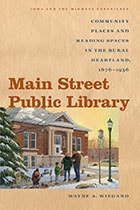
cover of Main Street Public Library: Community Places and Reading Spaces in the Rural Heartland, 1876-956

Main Street Public Library

Community Places and Reading Spaces in the Rural Heartland, 1876-956

Wayne A. Wiegand

University of Iowa Press, 2011
The United States has more public libraries than it has McDonald’s restaurants.
 
By any measure, the American public library is a heavily used and ubiquitous institution. Popular thinking identifies the public library as a neutral agency that protects democratic ideals by guarding against censorship as it makes information available to people from all walks of life. Among librarians this idea is known as the “library faith.” But is the American public library as democratic as it appears to be?
 
 In Main Street Public Library, eminent library historian Wayne Wiegand studies four emblematic small-town libraries in the Midwest from the late nineteenth century through the federal Library Service Act of 1956, and shows that these institutions served a much different purpose than is so often perceived. Rather than acting as neutral institutions that are vital to democracy, the libraries of Sauk Centre, Minnesota; Osage, Iowa; Rhinelander, Wisconsin; and Lexington, Michigan, were actually mediating community literary values and providing a public space for the construction of social harmony. These libraries, and the librarians who ran them, were often just as susceptible to the political and social pressures of their time as any other public institution.
 
By analyzing the collections of all four libraries and revealing what was being read and why certain acquisitions were passed over, Wiegand challenges both traditional perceptions and professional rhetoric about the role of libraries in our small-town communities. While the American public library has become essential to its local community, it is for reasons significantly different than those articulated by the “library faith.”
[more]
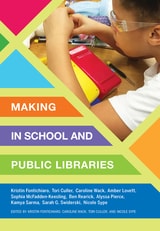
cover of Making in School and Public Libraries

Making in School and Public Libraries

Edited by Kristin Fontichiaro, Caroline Wack, Tori Culler, and Nicole Sype

Michigan Publishing Services, 2020

Whether you are just beginning your library’s maker efforts or are recalibrating a few years into your work, Making in School and Public Libraries is designed to help you grow your makerspace in a way that is engaging, affordable, and sustainable. Building on eight years of makerspace activities in the Michigan Makers and Making in Michigan Libraries project, the authors share their experiences creating or co-creating makerspace spaces and activities with for a wide band of interests, materials, tools, age groups, communities, budgets, and needs.

Readers will gain practical insights about how to

  • Define goals and target audiences
  • Customize programs to meet community needs
  • Equip a makerspace
  • Document activities
  • Assess achievements and areas for growth
  • Engage makers in a variety of technology and hands-on activities, including robots, 3D printing, sewing, cardboard challenges, knitting and crochet, design thinking, and zines

The authors’ experiences include co-creating one of the nation’s first school library makerspaces; establishing after-school maker programs with elementary and middle school learners; co-designing one-off and ongoing maker events for community-building in diverse public libraries; engaging with senior citizens in a low-income Senior Summer Camp pilot; and state, national, and international workshops for teachers, librarians, and youth mentors.

[more]
cover of Managing Facilities for Results: Optimizing Space for Services

Managing Facilities for Results

Optimizing Space for Services

Cheryl Bryan

American Library Association, 2007

[more]
cover of Managing with Data: Using ACRLMetrics and PLAmetrics

Managing with Data

Using ACRLMetrics and PLAmetrics

Peter Hernon

American Library Association, 2015

[more]