56 books match the query 'Public schools' and 3 start with m
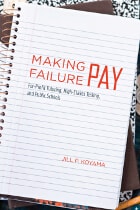
cover of Making Failure Pay: For-Profit Tutoring, High-Stakes Testing, and Public Schools

Making Failure Pay

For-Profit Tutoring, High-Stakes Testing, and Public Schools

Jill P. Koyama

University of Chicago Press, 2010

A little-discussed aspect of the No Child Left Behind Act (NCLB) is a mandate that requires failing schools to hire after-school tutoring companies—the largest of which are private, for-profit corporations—and to pay them with federal funds. Making Failure Pay takes a hard look at the implications of this new blurring of the boundaries between government, schools, and commerce in New York City, the country’s largest school district.

As Jill P. Koyama explains in this revelatory book, NCLB—a federally legislated, state-regulated, district-administered, and school-applied policy—explicitly legitimizes giving private organizations significant roles in public education. Based on her three years of ethnographic fieldwork, Koyama finds that the results are political, problematic, and highly profitable. Bringing to light these unproven, unregulated private companies’ almost invisible partnership with the government, Making Failure Pay lays bare the unintended consequences of federal efforts to eliminate school failure—not the least of which is more failure.
[more]
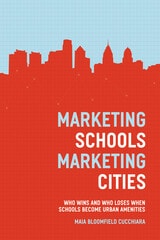
cover of Marketing Schools, Marketing Cities: Who Wins and Who Loses When Schools Become Urban Amenities

Marketing Schools, Marketing Cities

Who Wins and Who Loses When Schools Become Urban Amenities

Maia Bloomfield Cucchiara

University of Chicago Press, 2013
Discuss real estate with any young family and the subject of schools is certain to come up—in fact, it will likely be a crucial factor in determining where that family lives. Not merely institutions of learning, schools have increasingly become a sign of a neighborhood’s vitality, and city planners have ever more explicitly promoted “good schools” as a means of attracting more affluent families to urban areas, a dynamic process that Maia Bloomfield Cucchiara critically examines in Marketing Schools, Marketing Cities.
 
Focusing on Philadelphia’s Center City Schools Initiative, she shows how education policy makes overt attempts to prevent, or at least slow, middle-class flight to the suburbs. Navigating complex ethical terrain, she balances the successes of such policies in strengthening urban schools and communities against the inherent social injustices they propagate—the further marginalization and disempowerment of lowerclass families. By asking what happens when affluent parents become “valued customers,” Marketing Schools, Marketing Cities uncovers a problematic relationship between public institutions and private markets, where the former are used to leverage the latter to effect urban transformations.
[more]
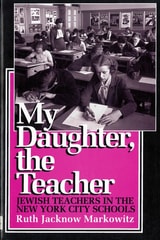
cover of My Daughter, the Teacher: Jewish Teachers in the New York City Schools

My Daughter, the Teacher

Jewish Teachers in the New York City Schools

Markowitz, Ruth Jacknow

Rutgers University Press, 1993

'My son, the doctor' and 'my daughter, the teacher' were among the most cherished phrases of Jewish immigrant parents," writes Ruth Markowitz in recounting this story of Jewish women who taught school in New York. Teaching was an attractive profession to the daughters of immigrants. It provided status, security, was compatible with marriage, and licenses did not require expensive training. In the interwar years, Jewish women in New York entered teaching in large and unprecedented numbers. In fact, by 1960 the majority of all New York teachers were Jewish women. By interviewing sixty-one retired teachers, Ruth Markowitz re-created their lives and the far-reaching influence they had on public education.These women faced many barriers--from lack of parental and financial support to discrimination--as they pursued their educations. Those women who completed their training still had difficulty finding teaching positions, especially during the Depression. Once hired, the teachers' days were filled with overcrowded classes, improperly maintained facilities, enormous amounts of paperwork, few free periods, and countless extracurricular obligations. They also found themselves providing social services; Markowitz finds a large number of teachers who took a special interest in minority children.The teachers Markowitz interviewed often agree with the assessment others have made that the 1930s were in their own way a golden age in the schools. The retired teachers remember the difficult times, but also their love of teaching and the difference they made in the classrooms. Their energy, initiative, and drive will help inspire teachers today, who face the serious problems of drugs, teenage pregnancy, and violence in their classrooms.
[more]