Results by title
70 books match the query 'Pueblo Indians' and 4 start with m
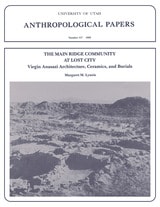
Main Ridge Community At Lost City
Virgin Anazazi Architecture, Ceramics, and BurialsMargaret Lyneis
University of Utah Press, 1992

Masked Gods
Navaho and Pueblo CeremonialismFrank Waters
Ohio University Press, 1950
Masked Gods is a vast book, a challenging and profoundly original account of the history, legends, and ceremonialism of the Navajo and Pueblo Indians of the Southwest. Following a brief but vivid history of the two tribes through the centuries of conquest, the book turns inward to the meaning of Native American legends and ritual—Navajo songs, Pueblo dances, Zuni kachina ceremonies. Enduring still, these rituals and ceremonies express a view of life, of man’s place in the creation, which is compared with Taoism and Buddhism—and with the aggressive individualism of the Western world.
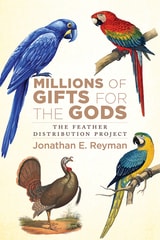
Millions of Gifts for the Gods
The Feather Distribution ProjectJonathan Reyman
University Press of Colorado, 2025
Grounded in Sol Tax’s concept of “action anthropology,” the project facilitated community-driven decision-making rather than imposing external solutions. This collaborative approach enabled Indigenous communities to maintain cultural practices that have persisted for over a millennium, dating back to the Ancestral Pueblo people and the Mogollon and Sinagua tribes, who viewed birds as sacred beings that helped humans emerge from the underworld. Yet the project’s impact extended far beyond cultural preservation. Over three decades, it distributed approximately 14.5 million feathers, valued at $20 million, to the Southwest Pueblos and other Indigenous Americans at no cost to them. Through partnerships with turkey hunters, zoos, bird clubs, the National Wild Turkey Federation, and dozens of volunteers, the initiative reduced illegal bird smuggling from Latin America, alleviated pressure on threatened bird populations, and eliminated harmful plucking practices.
Millions of Gifts for the Gods is an extended case study in applied anthropology, demonstrating how sustained collaboration between anthropologists and Indigenous communities can effectively address complex cultural, legal, and environmental challenges while preserving sacred traditions. This unique project is of special interest to anthropologists working in the American Southwest, as well as students and scholars of archaeology, ethnography, and ethnohistory.
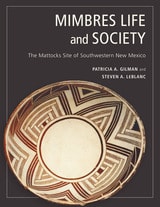
Mimbres Life and Society
The Mattocks Site of Southwestern New MexicoPatricia A. Gilman and Steven A. LeBlanc
University of Arizona Press, 2017
Mimbres pueblos, as early examples of people using surface room blocks, are ideal for investigating questions about how and why people moved from earlier subterranean pit structures to aboveground room blocks. The authors consider the number of households living at the site before and after the transition, as well as the lack of evidence for subsistence intensification and population growth as causes of this transition. These analyses suggest that each room block on the site housed a single family as opposed to multiple families, the more common interpretation. There were not necessarily more households on the site during the Classic period than earlier.
Patricia A. Gilman and Steven A. LeBlanc spent five seasons excavating at the Mattocks site and many more analyzing and writing about Mattocks site data. They note that subtle social differences among people were at play, and they emphasize that the Mattocks site may be unique among Mimbres pueblos in many aspects. Mimbres Life and Society reveals broad-ranging implications for southwestern archaeologists and anyone interested in understanding the ancient Southwest and early village societies.