50 books match the query 'Realism' and 3 start with m
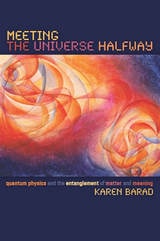
cover of Meeting the Universe Halfway: Quantum Physics and the Entanglement of Matter and Meaning

Meeting the Universe Halfway

Quantum Physics and the Entanglement of Matter and Meaning

Karen Barad

Duke University Press, 2006

Meeting the Universe Halfway is an ambitious book with far-reaching implications for numerous fields in the natural sciences, social sciences, and humanities. In this volume, Karen Barad, theoretical physicist and feminist theorist, elaborates her theory of agential realism. Offering an account of the world as a whole rather than as composed of separate natural and social realms, agential realism is at once a new epistemology, ontology, and ethics. The starting point for Barad’s analysis is the philosophical framework of quantum physicist Niels Bohr. Barad extends and partially revises Bohr’s philosophical views in light of current scholarship in physics, science studies, and the philosophy of science as well as feminist, poststructuralist, and other critical social theories. In the process, she significantly reworks understandings of space, time, matter, causality, agency, subjectivity, and objectivity.

In an agential realist account, the world is made of entanglements of “social” and “natural” agencies, where the distinction between the two emerges out of specific intra-actions. Intra-activity is an inexhaustible dynamism that configures and reconfigures relations of space-time-matter. In explaining intra-activity, Barad reveals questions about how nature and culture interact and change over time to be fundamentally misguided. And she reframes understanding of the nature of scientific and political practices and their “interrelationship.” Thus she pays particular attention to the responsible practice of science, and she emphasizes changes in the understanding of political practices, critically reworking Judith Butler’s influential theory of performativity. Finally, Barad uses agential realism to produce a new interpretation of quantum physics, demonstrating that agential realism is more than a means of reflecting on science; it can be used to actually do science.
[more]
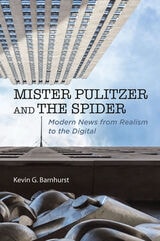
cover of Mister Pulitzer and the Spider: Modern News from Realism to the Digital

Mister Pulitzer and the Spider

Modern News from Realism to the Digital

Kevin G. Barnhurst

University of Illinois Press, 2018

A spidery network of mobile online media has supposedly changed people, places, time, and their meanings. A prime case is the news. Digital webs seem to have trapped "legacy media," killing off newspapers and journalists' jobs. Did news businesses and careers fall prey to the digital "Spider"?
 
To solve the mystery, Kevin Barnhurst spent thirty years studying news going back to the realism of the 1800s. The usual suspects--technology, business competition, and the pursuit of scoops--are only partly to blame for the fate of news. The main culprit is modernism from the "Mister Pulitzer" era, which transformed news into an ideology called "journalism." News is no longer what audiences or experts imagine. Stories have grown much longer over the past century and now include fewer events, locations, and human beings. Background and context rule instead.
 
News producers adopted modernism to explain the world without recognizing how modernist ideas influence the knowledge they produce. When webs of networked connectivity sparked a resurgence in realist stories, legacy news stuck to big-picture analysis that can alienate audience members accustomed to digital briefs.
 
[more]
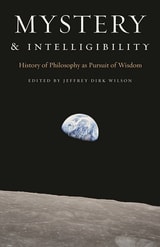
cover of Mystery and Intelligibility: History of Philosophy as Pursuit of Wisdom

Mystery and Intelligibility

History of Philosophy as Pursuit of Wisdom

Jeffrey Dirk Wilson

Catholic University of America Press, 2021

Philosophy is born in its history as pursuit of the wisdom we are never able fully to know. Mystery and Intelligibility: History of Philosophy as Pursuit of Wisdom both argues for that method and presents the results it can achieve. Editor Jeffrey Dirk Wilson has gathered essays from six philosophical luminaries. In “History, Philosophy, and the History of Philosophy,” Timothy B. Noone provides the volume’s discourse on method in which he distinguishes three tiers of history. History of philosophy as method occupies the third and highest tier. John Rist reckons with contemporary corruption of the method in “A Guide for the Perplexed or How to Present or Pervert the History of Philosophy.” Wilson’s own essay, “Wonder and the Discovery of Being: From Homeric Myth to the Natural Genera of Early Greek Philosophy,” shows the loss of wonder, so evident in mythology, by early Greek thinkers and its recovery by Plato and Aristotle. In “Metaphysics and the Origin of Culture,” Donald Phillip Verene demonstrates the wide cultural implications of philosophical discoveries even when the discovery is the boundary of what humans can know. William Desmond offers an essay, “Flux-Gibberish: For and Against Heraclitus,” that owes as much to the humor of James Joyce as to the philosophical insights of philosophers, ancient, medieval, and modern. Eric D. Perl’s essay turns to the apophatic character of pursuing wisdom, perhaps especially when asking what may be the most fundamental metaphysical question: “Into the Dark: How (Not) to Ask, ‘Why is There Anything at All.’” Philipp W. Rosemann concludes the volume with the question best asked at the end of this literary seminar, “What is Philosophy?” Although there are philosophers within the analytic and continental schools who are committed to the history of philosophy, Mystery and Intelligibility demonstrates that history of philosophy as a third and distinct philosophical method is revelatory of the nature and structure of reality.
[more]