Results by title
62 books match the query 'Reality' and 5 start with m
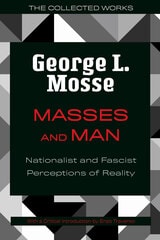
Masses and Man
Nationalist and Fascist Perceptions of RealityGeorge L. Mosse
University of Wisconsin Press, 2024
Masses and Man comprises three parts. The first lays out a cultural history of nationalism, essentially the first of its kind, emphasizing the importance of sacred expressions like myths, symbols, and rituals as appropriated in a political context. The second zeroes in on fascism’s most dramatic irruptions in European history in the rise of Italian Fascism and the Nazi Party in Germany, elucidating these as not just political movements but also cultural and even aesthetic ones. The third part considers nationalism and fascism from the particular standpoint of German Jews.
Taken in full, the volume offers an eloquent summation of Mosse’s groundbreaking insights into European nationalism, fascism, and Jewish history in the twentieth century. A new critical introduction by Enzo Traverso helpfully situates Mosse’s work in context and exposes the many ways in which Masses and Man, first published in 1980, remains relevant today.
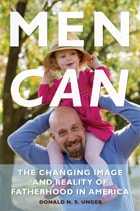
Men Can
The Changing Image and Reality of Fatherhood in AmericaDonald N.S. Unger
Temple University Press, 2010
Fatherhood is evolving in America. Stay at home dads are becoming more commonplace; men are becoming more visible in domestic, caregiving activities. In Men Can, writer, teacher, and father Donald Unger uses his personal experiences, stories of real-life families, as well as representations of fathers in film, on television, and in advertising, to illuminate the role of men in the increasingly fluid domestic sphere.
In thoughtful interviews, Don Unger tells the stories of a half dozen families—of varied ethnicities, geographical locations, and philosophical orientations—in which fathers are either primary or equally sharing parents, personalizing what is changing in how Americans care for their children. These stories are complemented by a discussion of how the language of parenting has evolved and how media representations of fathers have shifted over several decades.
Men Can shows how real change can take place when families divide up domestic labor on a gender-neutral basis. The families whose stories he tells offer insights into the struggles of—and opportunities for—men caring for children. When it comes to taking up the responsibility of parenting, his argument, ultimately, is in favor of respecting personal choices and individual differences, crediting and supporting functional families, rather than trying to force every household into a one-size-fits-all mold.
Metaphysical Disputation II
On the Essential Concept or Concept of BeingFrancisco Suarez
Catholic University of America Press, 2022
Mystery Of Being Vol 1
Reflection & MysteryGabriel Marcel
St. Augustine's Press, 2001
These volumes deal with almost all of the major themes of Marcel's thought: the nature of philosophy, our broken world, man's deep ontological need for being, i.e., for permanent eternal values, our incarnate bodily existence, primary and secondary reflection, participation, being in situation, the identity of the human self, intersubjectivity, mystery and problem, faith, hope, and the reality of God, and immortality.
Mystery Of Being Vol 2
Faith & RealityGabriel Marcel
St. Augustine's Press, 2001
The Mystery of Being contains the most systematic exposition of the philosophical thought of Gabriel Marcel, a convert to Catholicism and the most distinguished twentieth-century exponent of Christian existentialism. Its two volumes are the Gifford lectures which Marcel delivered in Aberdeen, Scotland, in 1949 and 1950. Marcel's work fundamentally challenges most of the major positions of the atheistic existentialists (Sartre, Beauvoir, Camus), especially their belief in an absurd, meaningless, godless universe.
These volumes deal with almost all of the major themes of Marcel's thought: the nature of philosophy, our broken world, man's deep ontological need for being, i.e., for permanent eternal values, our incarnate bodily existence, primary and secondary reflection, participation, being in situation, the identity of the human self, intersubjectivity, mystery and problem, faith, hope, and the reality of God, and immortality.