Results by title
119 books match the query 'Religious life and customs' and 9 start with m
Madumo, a Man Bewitched
Adam Ashforth
University of Chicago Press, 2000
So begins this true story of witchcraft and friendship set against the turbulent backdrop of contemporary Soweto. Adam Ashforth, an Australian who has spent many years in the black township, finds his longtime friend Madumo in dire circumstances: his family has accused him of using witchcraft to kill his mother and has thrown him out on the street. Convinced that his life is cursed, Madumo seeks help among Soweto's bewildering array of healers and prophets. An inyanga, or traditional healer, confirms that he has indeed been bewitched. With Ashforth by his side, skeptical yet supportive, Madumo embarks upon a physically grueling treatment regimen that he follows religiously-almost to the point of death-despite his suspicion that it may be better to "Westernize my mind and not think about witchcraft."
Ashforth's beautifully written, at times poignant account of Madumo's struggle shows that the problem of witchcraft is not simply superstition, but a complex response to spiritual insecurity in a troubling time of political and economic upheaval. Post-apartheid Soweto, he discovers, is suffering from a deluge of witchcraft. Through Madumo's story, Ashforth opens up a world that few have seen, a deeply unsettling place where the question "Do you believe in witchcraft?" is not a simple one at all. The insights that emerge as Ashforth accompanies his friend on an odyssey through Soweto's supernatural perils have profound implications even for those of us who live in worlds without witches.
Mary, Michael, and Lucifer
Folk Catholicism in Central MexicoBy John M. Ingham
University of Texas Press, 1986
The physical signs of Roman Catholicism pervade the Mexican countryside. Colonial churches and neighborhood chapels, wayside shrines, and mountaintop crosses dot the landscape. Catholicism also permeates the traditional cultures of rural communities, although this ideational influence is less immediately obvious. It is often couched in enigmatic idiom and imagery, and it is further obscured by the vestiges of pagan customs and the anticlerical attitudes of many villagers. These heterodox tendencies have even led some observers to conclude that Catholicism in rural Mexico is little more than a thin veneer on indigenous practice.
In Mary, Michael, and Lucifer John M. Ingham attempts to develop a modern semiotic and structuralist interpretation of traditional Mexican culture, an interpretation that accounts for the culture's apparent heterodoxy. Drawing on field research in Tlayacapan, Morelos, a village in the central highlands, he shows that nearly every domain of folk culture is informed with religious meaning. More precisely, the Catholic categories of spirit, nature, and evil compose the basic framework of the villagers' social relations and subjective experiences.
Mary, Mother and Warrior
The Virgin in Spain and the AmericasBy Linda B. Hall
University of Texas Press, 2004
A Mother who nurtures, empathizes, and heals... a Warrior who defends, empowers, and resists oppression... the Virgin Mary plays many roles for the peoples of Spain and Spanish-speaking America. Devotion to the Virgin inspired and sustained medieval and Renaissance Spaniards as they liberated Spain from the Moors and set about the conquest of the New World. Devotion to the Virgin still inspires and sustains millions of believers today throughout the Americas.
This wide-ranging and highly readable book explores the veneration of the Virgin Mary in Spain and the Americas from the colonial period to the present. Linda Hall begins the story in Spain and follows it through the conquest and colonization of the New World, with a special focus on Mexico and the Andean highlands in Peru and Bolivia, where Marian devotion became combined with indigenous beliefs and rituals. Moving into the nineteenth century, Hall looks at national cults of the Virgin in Mexico, Bolivia, and Argentina, which were tied to independence movements. In the twentieth century, she examines how Eva Perón linked herself with Mary in the popular imagination; visits contemporary festivals with significant Marian content in Spain, Peru, and Mexico; and considers how Latinos/as in the United States draw on Marian devotion to maintain familial and cultural ties.
Medusa's Hair
An Essay on Personal Symbols and Religious ExperienceGananath Obeyesekere
University of Chicago Press, 1981
The increasing popularity of these ecstatics poses a challenge not only to orthodox Sinhala Buddhism (the official religion of Sri Lanka) but also, as Gananath Obeyesekere shows, to the traditional anthropological and psychoanalytic theories of symbolism. Focusing initially on one symbol, matted hair, Obeyesekere demonstrates that the conventional distinction between personal and cultural symbols is inadequate and naive. His detailed case studies of ecstatics show that there is always a reciprocity between the personal-psychological dimension of the symbol and its public, culturally sanctioned role. Medusa's Hair thus makes an important theoretical contribution both to the anthropology of individual experience and to the psychoanalytic understanding of culture. In its analyses of the symbolism of guilt, the adaptational and integrative significance of belief in spirits, and a host of related issues concerning possession states and religiosity, this book marks a provocative advance in psychological anthropology.

Miracles & Prophecies in Nineteenth-Century France
SELMAN, THOMAS K
Rutgers University Press, 1983
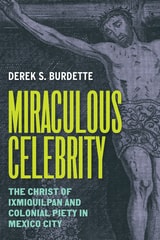
Miraculous Celebrity
The Christ of Ixmiquilpan and Colonial Piety in Mexico CityDerek S. Burdette
University of Texas Press, 2025
A study of the Christ of Ixmiquilpan, a historically beloved religious icon from sixteenth-century Mexico, and its evolving cultural importance.
The life-sized crucifix known as the Christ of Ixmiquilpan (also the Señor de Santa Teresa) was one of the most important artworks in colonial Mexico. The statue began as an ordinary devotional image, but in 1621 devotees witnessed it undergo a miraculous renovation that gave it a supernatural beauty. Over the next two and half centuries, its perceived power increased until it was surpassed in importance only by the Virgin of Guadalupe. Despite its historical significance, the Christ of Ixmiquilpan’s history has yet to be fully told.
Derek Burdette brings the miraculous crucifix out of the shadows and explores its instrumental role in shaping the devotional culture of New Spain. Following the arc of the statue’s life, he chronicles the story of the statue’s creation, miraculous renovation, and subsequent veneration at the heart of Mexico City. He also reveals how colonial politics were woven into the statue’s life from the very start. Reconstructing the history of a key artwork, Miraculous Celebrity sheds new light on the intersection of art, faith, and politics in the Spanish colonial world.
Monks and Magic
Revisiting a Classic Study of Religious Ceremonies in ThailandBarend Jan Terwiel
National University of Singapore Press, 2012
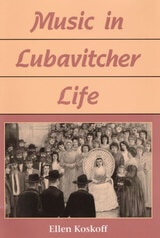
Music in Lubavitcher Life
Ellen Koskoff
University of Illinois Press, 2001
Drawing on twenty years of close study, Ellen Koskoff illuminates the world of the Lubavitcher Hasidim, a community of ultra-orthodox Jews centered in the Crown Heights section of Brooklyn, New York. Her classic ethnography offers an unprecedented look at nigunim, a body of paraliturgical, folk, and popular melodies that Lubavitchers regard as a primary form of spiritual communication with the divine.
Along with vivid descriptions of musical performance in religious contexts and private gatherings, Koskoff details the musical sounds and structures that symbolize Lubavitcher social relations. In particular, she examines the differences between Lubavitcher women's and men's music making and the underlying beliefs and assumptions that give rise to gendered musical behaviors, such as the dictum that prohibits men from hearing a woman sing.
Insightful and distinctive, Music in Lubavitcher Life combines anecdotes with history and musical analysis to reveal music making among the Lubavitchers as a gateway to their ideas about the nature of human spirituality, human social interaction, and God.
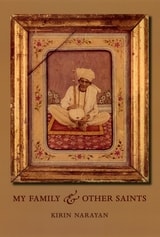
My Family and Other Saints
Kirin Narayan
University of Chicago Press, 2007
A touching, funny, and always affectionate memoir, My Family and Other Saints traces the reverberations of Rahoul's spiritual journey through the entire family. As their beachside Bombay home becomes a crossroads for Westerners seeking Eastern enlightenment, Kirin’s sari-wearing American mother wholeheartedly embraces ashrams and gurus, adopting her son’s spiritual quest as her own. Her Indian father, however, coins the term “urug”—guru spelled backward—to mock these seekers, while young Kirin, surrounded by radiant holy men, parents drifting apart, and a motley of young, often eccentric Westerners, is left to find her own answers. Deftly recreating the turbulent emotional world of her bicultural adolescence, but overlaying it with the hard-won understanding of adulthood, Narayan presents a large, rambunctious cast of quirky characters. Throughout, she brings to life not just a family but also a time when just about everyone, it seemed, was consumed by some sort of spiritual quest.
“A lovely book about the author's youth in Bombay, India. . . . The family home becomes a magnet for truth-seekers, and Narayan is there to affectionately document all of it.”—Body + Soul