Results by title
53 books match the query 'Research & Methodology' and 3 start with m

Materiality
Daniel Miller, ed.
Duke University Press, 2005
Considering topics as diverse as theology, technology, finance, and art, the contributors—most of whom are anthropologists—examine the many different ways in which materiality has been understood and the consequences of these differences. Their case studies show that the latest forms of financial trading instruments can be compared with the oldest ideals of ancient Egypt, that the promise of software can be compared with an age-old desire for an unmediated relationship to divinity. Whether focusing on the theology of Islamic banking, Australian Aboriginal art, derivatives trading in Japan, or textiles that respond directly to their environment, each essay adds depth and nuance to the project that Materiality advances: a profound acknowledgment and rethinking of one of the basic properties of being human.
Contributors. Matthew Engelke, Webb Keane, Susanne Küchler, Bill Maurer, Lynn Meskell, Daniel Miller, Hirokazu Miyazaki, Fred Myers, Christopher Pinney, Michael Rowlands, Nigel Thrift
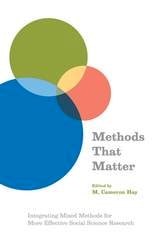
Methods That Matter
Integrating Mixed Methods for More Effective Social Science ResearchEdited by M. Cameron Hay
University of Chicago Press, 2016
Historically, the largest division between social science methods has been that between quantitative and qualitative measures. For people trained in psychology or sociology, the bias has been toward the former, using surveys and experiments that yield readily comparable numerical results. For people trained in anthropology, it has been toward the latter, using ethnographic observations and interviews that offer richer nuances of meaning but are difficult to compare across societies. Discussing their own endeavors to combine the quantitative with the qualitative, the authors invite readers into a conversation about the best designs and practices of mixed methodologies to stimulate creative ideas and find new pathways of insight. The result is an engaging exploration of a promising new approach to the social sciences.
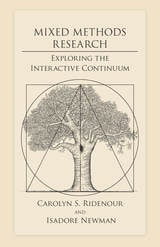
Mixed Methods Research
Exploring the Interactive ContinuumCarolyn S. Ridenour and Isadore Newman
Southern Illinois University Press, 2008
In Mixed Methods Research: Exploring the Interactive Continuum, the second edition of Qualitative-Quantitative Research Methodology, authors Carolyn S. Ridenour and Isadore Newman reject the artificial dichotomy between qualitative and quantitative research strategies in the social and behavioral sciences and argue that the two approaches are neither mutually exclusive nor interchangeable; rather, the actual relationship between the two paradigms is one of isolated events on a continuum of scientific inquiry.
In their original model for research—the “interactive continuum”—Ridenour and Newman emphasize four major points: that the research question dictates the selection of research methods; that consistency between question and design can lead to a method of critiquing research studies in journals; that the interactive continuum model is built around the place of theory; and that the assurance of validity of research is central to all studies. With this edition, the authors incorporate the concept of research purpose into their analysis.
To contextualize their new argument and to propose strategies for enhancement, Ridenour and Newman review the historical and contemporary debates around research frameworks and define the nature of scientific validity. Establishing five criteria that render a study “scientific,” they propose ways to strengthen validity in research design. They argue that by employing multiple methods, researchers may enhance the quality of their research outcomes. By integrating the quantitative research standards of internal and external validity and the qualitative research standards of trustworthiness, Ridenour and Newman suggest a principle for mixed methods research.
Ridenour and Newman apply this theoretical concept to a systematic analysis of four published research studies, with special emphasis on the consistency among research purpose, question, and design.
Ridenour and Newman have completely rewritten their conclusions in light of their evolving analyses. They incorporate their most recent ideas into the qualitative-quantitative continuum and emphasize the “model of consistency” as key for research to meet the standard of “scientific.”
This book occupies a vital place at the junction of methodological theory and scientific practice and makes connections between the traditionally separate realms of quantitative and qualitative research.