Results by title
53 books match the query 'Revolutionaries' and 4 start with m

Memoirs of a Revolutionary
Victor Serge
University of Iowa Press, 2002
[more]

Minds and Hearts
The Story of James Otis Jr. and Mercy Otis WarrenJeffrey H. Hacker
University of Massachusetts Press, 2021
As a firebrand attorney and political agitator, James Otis Jr. helped to shape colonial resistance in the decades leading up to the American Revolution, establishing individual rights and "no taxation without representation" as cornerstones of the patriot cause. After his violent coffeehouse altercation and bouts with mental illness, his younger sister, Mercy Otis Warren, took up his cause. Her incendiary plays and poems rallied colonial opinion in the lead-up to the war, and her chronicle of the period established her as America's first female historian.
Minds and Hearts is the dual biography of these remarkable siblings, placing James and Mercy in the spotlight together for the first time, amid the rush of events, competing ideologies, and changing social conditions of eighteenth-century America. Jeffrey H. Hacker crafts a compelling narrative that focuses on the Otises' unique and dramatic relationship and traces their impact on the Revolutionary movement in Massachusetts. If the real American Revolution took place "in the minds and hearts of the people," as John Adams claimed, then the Otises were among the nation's true patriots.
Minds and Hearts is the dual biography of these remarkable siblings, placing James and Mercy in the spotlight together for the first time, amid the rush of events, competing ideologies, and changing social conditions of eighteenth-century America. Jeffrey H. Hacker crafts a compelling narrative that focuses on the Otises' unique and dramatic relationship and traces their impact on the Revolutionary movement in Massachusetts. If the real American Revolution took place "in the minds and hearts of the people," as John Adams claimed, then the Otises were among the nation's true patriots.
[more]
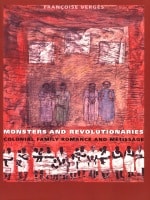
Monsters and Revolutionaries
Colonial Family Romance and MetissageFrançoise Vergès
Duke University Press, 1999
In Monsters and Revolutionaries Françoise Vergès analyzes the complex relationship between the colonizer and colonized on the Indian Ocean island of Réunion. Through novels, iconography, and texts from various disciplines including law, medicine, and psychology, Vergès constructs a political and cultural history of the island’s relations with France. Woven throughout is Vergès’s own family history, which is intimately tied to the history of Réunion itself.
Originally settled by sugar plantation owners and their Indian and African slaves following a seventeenth-century French colonial decree, Réunion abolished slavery in 1848. Because plantation owners continued to import workers from India, Africa, Asia, and Madagascar, the island was defined as a place based on mixed heritages, or métissage. Vergès reads the relationship between France and the residents of Réunion as a family romance: France is the seemingly protective mother, La Mère-Patrie, while the people of Réunion are seen and see themselves as France’s children. Arguing that the central dynamic in the colonial family romance is that of debt and dependence, Verges explains how the republican ideals of the French Revolution and the Enlightenment are seen as gifts to Réunion that can never be repaid. This dynamic is complicated by the presence of métissage, a source of anxiety to the colonizer in its refutation of the “purity” of racial bloodlines. For Vergès, the island’s history of slavery is the key to understanding métissage, the politics of assimilation, constructions of masculinity, and emancipatory discourses on Réunion.
Originally settled by sugar plantation owners and their Indian and African slaves following a seventeenth-century French colonial decree, Réunion abolished slavery in 1848. Because plantation owners continued to import workers from India, Africa, Asia, and Madagascar, the island was defined as a place based on mixed heritages, or métissage. Vergès reads the relationship between France and the residents of Réunion as a family romance: France is the seemingly protective mother, La Mère-Patrie, while the people of Réunion are seen and see themselves as France’s children. Arguing that the central dynamic in the colonial family romance is that of debt and dependence, Verges explains how the republican ideals of the French Revolution and the Enlightenment are seen as gifts to Réunion that can never be repaid. This dynamic is complicated by the presence of métissage, a source of anxiety to the colonizer in its refutation of the “purity” of racial bloodlines. For Vergès, the island’s history of slavery is the key to understanding métissage, the politics of assimilation, constructions of masculinity, and emancipatory discourses on Réunion.
[more]
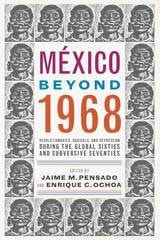
México Beyond 1968
Revolutionaries, Radicals, and Repression During the Global Sixties and Subversive SeventiesEdited by Jaime M. Pensado and Enrique C. Ochoa
University of Arizona Press, 2018
México Beyond 1968 examines the revolutionary organizing and state repression that characterized Mexico during the 1960s and 1970s. The massacre of students in Mexico City in October 1968 is often considered the defining moment of this period. The authors in this volume challenge the centrality of that moment by looking at the broader story of struggle and repression across Mexico during this time. México Beyond 1968 complicates traditional narratives of youth radicalism and places urban and rural rebellions within the political context of the nation’s Dirty Wars during this period.
The book illustrates how expressions of resistance developed from the ground up in different regions of Mexico, including Chihuahua, Guerrero, Jalisco, Mexico City, Puebla, and Nuevo León. Movements in these regions took on a variety of forms, including militant strikes, land invasions, cross-country marches, independent forums, popular organizing, and urban and rural guerrilla uprisings.
México Beyond 1968 brings together leading scholars of Mexican studies today. They share their original research from Mexican archives partially opened after 2000 and now closed again to scholars, and they offer analysis of this rich primary source material, including interviews, political manifestos, newspapers, and human rights reports.
By centering on movements throughout Mexico, México Beyond 1968 underscores the deep-rooted histories of inequality and the frustrations with a regime that monopolized power for decades. It challenges the conception of the Mexican state as “exceptional” and underscores and refocuses the centrality of the 1968 student movement. It brings to light the documents and voices of those who fought repression with revolution and asks us to rethink Mexico’s place in tumultuous times.
Contributors:
Alexander Aviña
Adela Cedillo
A. S. Dillingham
Luis Herrán Avila
Fernando Herrera Calderón
Gladys I. McCormick
Enrique C. Ochoa
Verónica Oikión Solano
Tanalís Padilla
Wil G. Pansters
Jaime M. Pensado
Gema Santamaría
Michael Soldatenko
Carla Irina Villanueva
Eric Zolov
Enrique C. Ochoa
Verónica Oikión Solano
Tanalís Padilla
Wil G. Pansters
Jaime M. Pensado
Gema Santamaría
Michael Soldatenko
Carla Irina Villanueva
Eric Zolov
[more]