Results by title
231 books match the query 'Revolutionary Period (1775-1800)' and 5 start with m

Magna Carta
history, context and influence: Papers delivered at Peking University on the 800th anniversary of Magna CartaEdited by Lawrence Goldman
University of London Press, 2018
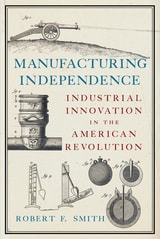
Manufacturing Independence
Industrial Innovation in the American RevolutionRobert F. Smith
Westholme Publishing, 2021
Benjamin Franklin was serious when he suggested the colonists arm themselves with the longbow. The American colonies were not logistically prepared for the revolution and this became painfully obvious in war’s first years. Trade networks were destroyed, inflation undermined the economy, and American artisans could not produce or repair enough weapons to keep the Continental Army in the field. The Continental Congress responded to this crisis by mobilizing the nation’s manufacturing sector for war. With information obtained from Europe through both commercial exchange and French military networks, Congress became familiar with the latest manufacturing techniques and processes of the nascent European industrial revolution. They therefore initiated an innovative program of munitions manufacturing under the Department of the Commissary General of Military Stores. The department gathered craftsmen and workers into three national arsenals where they were trained for the large-scale production of weapons. The department also engaged private manufacturers, providing them with materials and worker training, and instituting a program of inspecting their finished products.
As historian Robert F. Smith relates in Manufacturing Independence: Industrial Innovation in the American Revolution, the colonies were able to provide their military with the arms it needed to fight, survive, and outlast the enemy—supplying weapons for the victory at Saratoga, rearming their armies in the South on three different occasions, and providing munitions to sustain the siege at Yorktown. But this manufacturing system not only successfully supported the Continental Army, it also demonstrated new production ideas to the nation. Through this system, the government went on to promote domestic manufacturing after the war, becoming a model for how the nation could produce goods for its own needs. The War for Independence was not just a political revolution, it was an integral part of the Industrial Revolution in America.
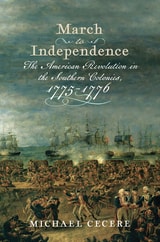
March to Independence
The Revolutionary War in the Southern Colonies, 1775–1776Michael Cecere
Westholme Publishing, 2027
The Independence Trilogy
The American Revolutionary War began when Massachusetts militiamen and British troops clashed at Lexington and Concord on April 19, 1775. Two months later, a much larger engagement occurred at Bunker Hill in Boston. The conflict then expanded into a continent-wide war for independence from Great Britain. Or so we are taught. A closer look at events in the South in the eighteen months following Lexington and Concord tells different story. The practice of teaching the Revolutionary War as one generalized conflict between the American colonies and Great Britain assumes the South’s support for the Revolutionary War was a foregone conclusion. However, once shots were fired, it was not certain that the southern colonies would support the independence movement. What is clear is that both the fledgling American republic and the British knew that the southern colonies were critical to any successful prosecution of the war by either side.
In March to Independence: The American Revolution in the Southern Colonies, 1775–1776, historian Michael Cecere, consulting primary source documents, examines how Virginia, North Carolina, South Carolina, and Georgia ended up supporting the colonies to the north, while East Florida remained within the British sphere. South Carolina, Georgia, and East Florida all retained their royal governors through the summer of 1775, and no military engagements occurred in any of the southern colonies in the six months following the battles in Massachusetts. The situation changed significantly in the fall, however, with armed clashes in Virginia and South Carolina; by early 1776 the war had spread to all of the southern colonies except East Florida. Although their march to independence did not follow the exact route as the colonies to the north, events in the South pulled the southern colonists in the same direction, culminating with a united Declaration of Independence on July 4, 1776. This book explores the crucial events in the southern colonies that led all but East Florida to support the American cause.

Minds and Hearts
The Story of James Otis Jr. and Mercy Otis WarrenJeffrey H. Hacker
University of Massachusetts Press, 2021
Minds and Hearts is the dual biography of these remarkable siblings, placing James and Mercy in the spotlight together for the first time, amid the rush of events, competing ideologies, and changing social conditions of eighteenth-century America. Jeffrey H. Hacker crafts a compelling narrative that focuses on the Otises' unique and dramatic relationship and traces their impact on the Revolutionary movement in Massachusetts. If the real American Revolution took place "in the minds and hearts of the people," as John Adams claimed, then the Otises were among the nation's true patriots.
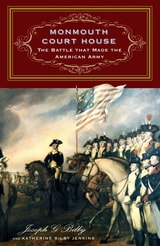
Monmouth Court House
The Battle that Made the American ArmyJoseph G. Bilby
Westholme Publishing, 2010
The Strategic Victory that Established the Continental Army as a True Fighting Force
The battle of Monmouth Court House, New Jersey, is among the most important battles in the history of the American Army. Well known in American mythology as the battle where Molly Pitcher fought alongside her fallen husband, Monmouth Court House is regarded by historians as the moment when the image of the American army in both Europe and the colonies was transformed from that of a rag-tag band of ill-trained civilians to that of a disciplined, well-guided, professional military unit. In June 1778, British General Henry Clinton’s army evacuated Philadelphia and struck out across “the Jerseys” on its way back to New York City. George Washington’s Continental Army, retrained and confident after enduring a winter at Valley Forge and supplemented by a large number of fresh New Jersey militia, marched in pursuit. About 50 miles south of New York City, the armies clashed at Monmouth Court House on June 28, in the last major Revolutionary War battle in the north. Essentially a draw, the battle marked the first time in the war that the Continental Army was able to hold a battlefield, fighting the full force of the British army to a standstill. Monmouth Court House: The Battle that Made the American Army by Joseph G. Bilby and Katherine Bilby Jenkins is the story of this battle, how it came to be, and its influence on the course of the war and American history.
The authors set Monmouth Court House within the context of the American Revolution and the civil war between Tories and Whigs that erupted in New Jersey during that time. The entire campaign and battle are described, including an analysis of the commanders, personnel, organization, training, and weapons of both armies. The book also assesses the historiography and folklore of the battle, including the story of the real “Molly Pitcher,” the use of the battleground as Civil War muster-in camp, its eventual status as Monmouth Battleground State Park, and current efforts at interpretation and battlefield archaeology and how they have changed our understanding of the battle.