Results by title
51 books match the query 'Risk' and 2 start with m
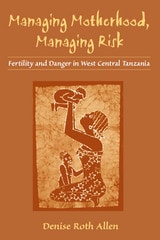
Managing Motherhood, Managing Risk
Fertility and Danger in West Central TanzaniaDenise Roth Allen
University of Michigan Press, 2004
In Managing Motherhood, Managing Risk, Denise Roth Allen persuasively argues that development interventions in the Third World often have unintended and unacknowledged consequences. Based on twenty-two months of fieldwork in the Shinyanga Region of west central Tanzania, this rich and engaging ethnography of women's fertility-related experiences highlights the processes by which a set of seemingly well-intentioned international maternal health policy recommendations go awry when implemented at the local level.
An exploration of how threats to maternal health have been defined and addressed at the global, national, and local levels, Managing Motherhood, Managing Risk presents two contrasting, and oftentimes competing, definitions of risk: those that form the basis of international recommendations and national maternal health policies and those that do not. The effect that these contrasting definitions of risk have on women's fertility-related experiences at the local level are explored throughout the book.
This study employs an innovative approach to the analysis of maternal health risk, one that situates rural Tanzanian women's fertility-related experiences within a broader historical and sociocultural context. Beginning with an examination of how maternal health risk was defined and addressed during the early years of British colonial rule in Tanganyika and moving to a discussion of an internationally conceived maternal health initiative that was launched on the world stage in the late 1980s, the author explores the similarities in the language used and solutions proposed by health development experts over time.
This set of "official" maternal health risks is then compared to an alternative set of risks that emerge when attention is focused on women's experiences of pregnancy and childbirth at the local level. Although some of these latter risks are often spoken about as deriving from spiritual or supernatural causes, the case studies presented throughout the second half of the book reveal that the concept of risk in the context of pregnancy and childbirth is much more complex, involving the interplay of spiritual, physical, and economic aspects of everyday life.
Modes of Uncertainty
Anthropological CasesEdited by Limor Samimian-Darash and Paul Rabinow
University of Chicago Press, 2015
Organizing contributions from various anthropological subfields—including economics, business, security, humanitarianism, health, and environment—Limor Samimian-Darash and Paul Rabinow offer new tools with which to consider uncertainty, its management, and the differing modes of subjectivity appropriate to it. Taking up policies and experiences as objects of research and analysis, the essays here seek a rigorous inquiry into a sound conceptualization of uncertainty in order to better confront contemporary problems. Ultimately, they open the way for a participatory anthropology that asks crucial questions about our contemporary state.