Results by title
64 books match the query 'Ritual' and 7 start with m
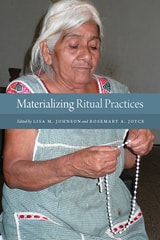
Materializing Ritual Practices
Lisa M. Johnson
University Press of Colorado, 2021
Ritual action produces sequences of creation, destruction, and transformation, which involve a variety of materials that are active and agential. The materialities of ritual may persist at temporal scales long beyond the lives of humans or be as ephemeral as spoken words, music, and scents. In this book, archaeologists and ethnographers, including specialists in narrative, music, and ritual practice, explore the rhythms and materiality of rituals that accompany everyday actions, like the construction of houses, healing practices, and religious festivals, and that paced commemoration of rulers, ancestor veneration, and relations with spiritual beings in the past.
Connecting the kinds of observed material discursive practices that ethnographers witness to the sedimented practices from which archaeologists infer similar practices in the past, Materializing Ritual Practices addresses how specific materialities encourage repetition in ritual actions and, in other circumstances, resist changes to ritual sequences. The volume will be of interest to cultural anthropologists, archaeologists, and linguists with interests in Central America, ritual, materiality, and time.
Contributors: M. Charlotte Arnauld, Giovani Balam Caamal, Isaac Barrientos, Cedric Becquey, Johann Begel, Valeria Bellomia, Juan Carillo Gonzalez, Maire Chosson, Julien Hiquet, Katrina Kosyk, Olivier Le Guen, Maria Luisa Vasquez de Agredos Pascual, Alessandro Lupo, Philippe Nondedeo, Julie Patrois, Russel Sheptak, Valentina Vapnarsky, Francisca Zalaquett Rock
Mecca and Eden
Ritual, Relics, and Territory in IslamBrannon Wheeler
University of Chicago Press, 2006
Integrating Islamic examples into the comparative study of religion, Brannon Wheeler shows how the treatment of rituals, relics, and territory is related to the more general mythological depiction of the origins of Islamic civilization. Along the way, Wheeler considers the contrast between Mecca and Eden in Muslim rituals, the dispersal and collection of relics of the prophet Muhammad, their relationship to the sanctuary at Mecca, and long tombs associated with the gigantic size of certain prophets mentioned in the Quran.
Mecca and Eden succeeds, as few books have done, in making Islamic sources available to the broader study of religion.
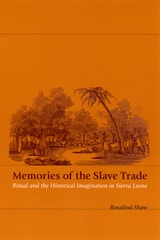
Memories of the Slave Trade
Ritual and the Historical Imagination in Sierra LeoneRosalind Shaw
University of Chicago Press, 2002
Drawing on extensive fieldwork and archival research, Shaw argues that memories of the slave trade have shaped (and been reshaped by) experiences of colonialism, postcolonialism, and the country's ten-year rebel war. Thus money and commodities, for instance, are often linked to an invisible city of witches whose affluence was built on the theft of human lives. These ritual and visionary memories make hitherto invisible realities manifest, forming a prism through which past and present mutually configure each other.
Mishkan Ga'avah
Where Pride Dwells: A Celebration of LGBTQ Jewish Life and RitualRabbi Denise L. Eger
Central Conference of American Rabbis, 2020
This groundbreaking collection of LGBTQ prayers, poems, liturgy, and rituals is both a spiritual resource and a celebratory affirmation of Jewish diversity. Giving voice to the private and public sectors of queer Jewish experience, Mishkan Ga'avah is also a commemoration of the fiftieth anniversary of both the Stonewall Riots and the first pride march, reflecting the longtime advocacy of the Reform Movement for full LGBTQ inclusion.

Music, ritual, and Falasha history
Kay Kaufman. Shelemay
Michigan State University Press, 1989
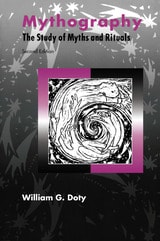
Mythography
The Study of Myths and RitualsWilliam G. Doty
University of Alabama Press, 2000
This new edition of William Doty's critically acclaimed study provides a comprehensive guidebook to the many schools of interpretation in this burgeoning field
William Doty's popular text has been hailed as the most comprehensive work of its kind. Extensively rewritten and completely restructured, the new edition provides further depth and perspective and is even more accessible to students of myth. It includes expanded coverage of postmodern and poststructuralist perspectives, the Gernet Center, mythic iconography, neo-Jungian approaches, and cultural studies, and it summarizes what is new in the study of Greek myth, iconography, French classical scholarship, and ritual studies. It also features a comprehensive index of names and topics, a glossary, an up-to-date annotated bibliography, and a guide to myth on the Internet.
Presenting all major myth theorists from antiquity to the present, Mythography is an encyclopedic work that offers a cross-disciplinary approach to the study of myth. By reflecting the dramatic increase in interest in myth among both scholars and general readers since publication of the first edition, it remains a key study of modern approaches to myth and
an essential guide to the wealth of mythographic research available today.
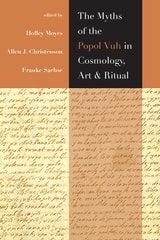
Myths of the Popol Vuh in Cosmology, Art, and Ritual
Holley Moyes
University Press of Colorado, 2021
The chapters are grouped into four sections. The first section interprets the Highland Maya worldview through examination of the text, analyzing interdependence between deities and human beings as well as the textual and cosmological coherence of the Popol Vuh as a source. The second section analyzes the Precolumbian Maya archaeological record as it relates to the myths of the Popol Vuh, providing new interpretations of the use of space, architecture, burials, artifacts, and human remains found in Classic Maya caves. The third explores ancient Maya iconographic motifs, including those found in Classic Maya ceramic art; the nature of predatory birds; and the Hero Twins’ deeds in the Popol Vuh. The final chapters address mythological continuities and change, reexamining past methodological approaches using the Popol Vuh as a resource for the interpretation of Classic Maya iconography and ancient Maya religion and mythology, connecting the myths of the Popol Vuh to iconography from Preclassic Izapa, and demonstrating how narratives from the Popol Vuh can illuminate mythologies from other parts of Mesoamerica.
The Myths of the Popol Vuh in Cosmology, Art, and Ritual is the first volume to bring together multiple perspectives and original interpretations of the Popol Vuh myths. It will be of interest not only to Mesoamericanists but also to art historians, archaeologists, ethnohistorians, iconographers, linguists, anthropologists, and scholars working in ritual studies, the history of religion, historic and Precolumbian literature and historic linguistics.
Contributors: Jaime J. Awe, Karen Bassie-Sweet, Oswaldo Chinchilla Mazariegos, Michael D. Coe, Iyaxel Cojtí Ren, Héctor Escobedo, Thomas H. Guderjan, Julia Guernsey, Christophe Helmke, Nicholas A. Hopkins, Barbara MacLeod, Jesper Nielsen, Colin Snider, Karl A. Taube