Results by title
110 books match the query 'Romanticism' and 3 start with m
Metaromanticism
Aesthetics, Literature, TheoryPaul Hamilton
University of Chicago Press, 2003
Through a close look at the aesthetics of Friedrich Schiller and Jean-Jacques Rousseau, and key works by Samuel Taylor Coleridge, Percy and Mary Shelley, John Keats, Sir Walter Scott, Jane Austen, and many others, Hamilton shows how the romantic movement's struggle with its own tenets was not an effort to seek an alternative way of thought, but instead a way of becoming what it already was. And yet, as he reveals, the romanticists were still not content with their own self-consciousness. Pushed to the limit, such contemplation either manifested itself as self-disgust or found aesthetic ideas regenerated in discourses outside of aesthetics altogether.
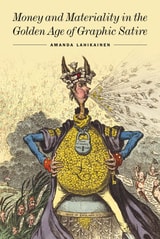
Money and Materiality in the Golden Age of Graphic Satire
Amanda Lahikainen
University of Delaware Press, 2022
This book examines the entwined and simultaneous rise of graphic satire and cultures of paper money in late eighteenth- and early nineteenth-century Britain. Asking how Britons learned to value both graphic art and money, the book makes surprising connections between two types of engraved images that grew in popularity and influence during this time. Graphic satire grew in visual risk-taking, while paper money became a more standard carrier of financial value, courting controversy as a medium, moral problem, and factor in inflation. Through analysis of satirical prints, as well as case studies of monetary satires beyond London, this book demonstrates several key ways that cultures attach value to printed paper, accepting it as social reality and institutional fact. Thus, satirical banknotes were objects that broke down the distinction between paper money and graphic satire altogether.
Monstrosities
Bodies And British RomanticismPaul Youngquist
University of Minnesota Press, 2003
A surprising evaluation of the role of the physical body in the construction of British identity
Eighteenth-century medicine used the word “monstrosities” to describe physically deformed bodies—those irreducible to the “proper body” in their singular, sometimes startling difference. Considering British society in confrontation with such monstrosities, Paul Youngquist reveals the cultural politics of embodiment in Britain during the late eighteenth and early nineteenth centuries. Drawing on the histories of medicine, economics, liberalism, and nationalism, his work shows that bodies are not simply born but rather built by cultural practices directed toward particular social ends.
Among the phenomena Youngquist treats are the science of comparative anatomy, the annual festivity of Bartholomew Fair, the social status of black Britons, opium habitués, pregnant women, and wounded war veterans. The authors he engages include John Locke, William Blake, Olaudah Equiano, Samuel Taylor Coleridge, Thomas De Quincey, Mary Wollstonecraft, Lord Byron, and Mary Shelley. Uniquely interdisciplinary, formidably researched, and replete with curious illustrations, this remarkable book should be of interest to anyone concerned with the historical and cultural fate of bodies in liberal society—and with the importance of deviance in determining that fate.