Results by title
149 books match the query 'Russia (Federation)' and 4 start with m
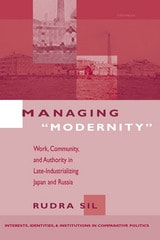
Managing "Modernity"
Work, Community, and Authority in Late-Industrializing Japan and RussiaRudra Sil
University of Michigan Press, 2002
Managing "Modernity" engages a variety of intellectual perspectives in the social sciences. The theoretical approach represents a conscious effort to overcome the contentious debates in political science and sociology among proponents of historical institutionalism, cultural analysis, and rational-choice theory. The substantive argument draws on, and partially integrates, concepts and findings from comparative politics, economic sociology, industrial relations, organization theory, business management, and the political economy of Japan and Russia.
In light of ongoing debates over the significance and impact of "globalization," the eclectic and integrative approach in Managing "Modernity" offers a fresh and provocative contribution that will interest scholars and graduate students across a variety of disciplines and subfields. It offers compelling insights to anyone generally concerned with the social forces that facilitate or hinder the diffusion of ideas and institutions across national boundaries.
Rudra Sil is Janice and Julian Bers Assistant Professor in the Social Sciences, Department of Political Science, University of Pennsylvania.
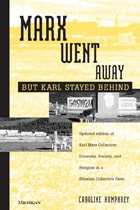
Marx Went Away--But Karl Stayed Behind
Caroline Humphrey
University of Michigan Press, 1999
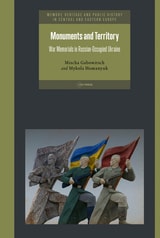
Monuments and Territory
War Memorials in Russian-Occupied UkraineMischa Gabowitsch
Central European University Press, 2025
From the very first weeks of Russia’s large-scale attack on Ukraine in February 2022, Russian soldiers, politicians, and proxy administrators expended considerable effort interacting with monuments on newly occupied territory. Why did the invaders care enough about war memorials to divert scarce resources to destroying, maintaining, or building them amid a massive war? Why did they remove some memorials and spare others? What was the point of commemorating past victories and defeats while bombing Ukrainian cities, and how did commemorative ceremonies in the occupied territories
change over the first year of the war? What was the broader impact of monument-related practices beyond the local settings in which they occurred? And what does the Ukrainian case teach us more generally about how memorials to past wars can be used to justify new conquests? These are some of the questions this book explores, based on fieldwork in occupied Ukraine and online research.
Morphology of the Folktale
Second EditionBy V. Propp
University of Texas Press, 1968