Results by title
111 books match the query 'Science Fiction' and 5 start with m

Marimo, Mon Amour
A NovelKaren An-hwei Lee
University of Alabama Press, 2026
WINNER OF THE CATHERINE DOCTOROW INNOVATIVE FICTION PRIZE
A technocratic collapse erases an obscure poet from existence, she and her pet moss ball refuse to disappear
Marimo, Mon Amour is a surreal, contemplative novel set in the quarantined borough of Alphabet City, where a botched data migration leaves obscure poet Zinger Zingiber effectively erased from the record. Furloughed from her jobs as a dumpling-maker and asylum specialist, she withdraws to her apartment with only her pet moss ball, Marimo, for company. As the Bureau of Misidentification bans forbidden words and controls identity, Zinger appoints herself the “Minister of Loneliness,” observing a world suspended in time.
From this quiet refuge, Zinger meditates on solitude, the fragility of memory, and the small, ephemeral moments that become acts of meaning. Her narration drifts between dream and reality, blending whimsy with philosophical inquiry. Lyrical and recursive, the novel draws on the psychological depth of Dostoevsky and the surreal sensibilities of Italo Calvino and Yoko Ogawa as it explores agency a plague of absentia. Marimo, Mon Amour will appeal to readers of literary and speculative fiction, fans of surreal or philosophical narratives, and anyone drawn to meditations on isolation, resistance, and the endurance of the human spirit.
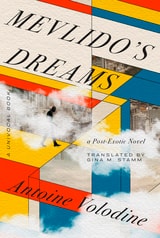
Mevlido's Dreams
A Post-Exotic NovelAntoine Volodine
University of Minnesota Press, 2024
A postapocalyptic noir that asks if love and political ideals can survive civilizational collapse
A meditative, postapocalyptic noir, Mevlido’s Dreams is an urgent communiqué from a far-future reality of irreversible environmental damage and civilizational collapse. Mevlido is a double agent working for the police and living in the last habitable city on the planet, a sprawling abyssal ruin marked by war and ruled by criminals. Suspended in the bardo between his loyalty to the surveillance state and to the anarchists, communists, and other rebels he monitors, Mevlido clings to life and hope—barely—in the city’s vast slums, haunted by the memory of the wife he failed to save during the last war and dreaming of a mysterious mission he is told he must accomplish. At the same time, an enigmatic organization existing elsewhere—the Organs—observes Mevlido’s actions and debates its responsibility to him and to humanity as a whole.
Asking what it means to love and care for others at the end of the world, this dense, brilliantly detailed postcollapse reality imagined by Antoine Volodine is one that grows ever more relevant amidst intensifying climate and political catastrophes. A key work in Volodine’s post-exotic fictional universe, Mevlido’s Dreams envisions a world changed beyond recognition and ruled under irrational authoritarianism in which dreams nest within dreams and the boundaries between life and death are fluid and uncertain.

Mindscapes
The Geographies of Imagined WorldsEdited by George E. Slusser and Eric S. Rabkin
Southern Illinois University Press, 1989
Eighteen essays plus four examples from the ninth annual J. Lloyd Eaton Conference on Science Fiction and Fantasy Literature at the University of California, Riverside.
The concept of mindscape, Slusser and Rabkin explain, allows critics to focus on a single fundamental problem: "The constant need for a relation between mind and some being external to mind."
The essayists are Poul Anderson, Wendy Doniger O’Flaherty, Ronald J. Heckelman, David Brin, Frank McConnell, George E. Slusser, James Romm, Jack G. Voller, Peter Fitting, Michael R. Collings, Pascal J. Thomas, Reinhart Lutz, Joseph D. Miller, Gary Westfahl, Bill Lee, Max P. Belin, William Lomax, and Donald M. Hassler.
The book concludes with four authors discussing examples of mindscape. The participants are Jean-Pierre Barricelli, Gregory Benford, Gary Kern, and David N. Samuelson.
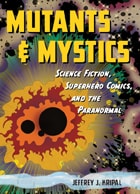
Mutants and Mystics
Science Fiction, Superhero Comics, and the ParanormalJeffrey J. Kripal
University of Chicago Press, 2011
But that's just scratching the surface, says Jeffrey Kripal. In Mutants and Mystics, Kripal offers a brilliantly insightful account of how comic book heroes have helped their creators and fans alike explore and express a wealth of paranormal experiences ignored by mainstream science. Delving deeply into the work of major figures in the field—from Jack Kirby’s cosmic superhero sagas and Philip K. Dick’s futuristic head-trips to Alan Moore’s sex magic and Whitley Strieber’s communion with visitors—Kripal shows how creators turned to science fiction to convey the reality of the inexplicable and the paranormal they experienced in their lives. Expanded consciousness found its language in the metaphors of sci-fi—incredible powers, unprecedented mutations, time-loops and vast intergalactic intelligences—and the deeper influences of mythology and religion that these in turn drew from; the wildly creative work that followed caught the imaginations of millions. Moving deftly from Cold War science and Fredric Wertham's anticomics crusade to gnostic revelation and alien abduction, Kripal spins out a hidden history of American culture, rich with mythical themes and shot through with an awareness that there are other realities far beyond our everyday understanding.
A bravura performance, beautifully illustrated in full color throughout and brimming over with incredible personal stories, Mutants and Mystics is that rarest of things: a book that is guaranteed to broaden—and maybe even blow—your mind.

My Daughter's Eyes and Other Stories
StoriesAnnecy Báez
Northwestern University Press, 2007