Results by title
63 books match the query 'Scientists' and 3 start with m
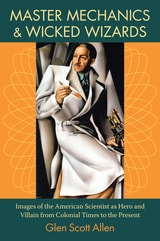
Master Mechanics and Wicked Wizards
Images of the American Scientist as Hero and Villain from Colonial Times to the PresentGlen Scott Allen
University of Massachusetts Press, 2009
From the earliest depictions of Benjamin Franklin and his kite experiment to 21st-century renderings of mad scientists, representations of American scientists in the popular media reveal a great deal about our cultural hopes and fears. In an entertaining and insightful survey of popular media over three hundred years of American history—religious tracts, political cartoons, literature, theater, advertising, art, comic books, radio, music, television, and film—Glen Scott Allen examines the stereotypes assigned to scientists for what they tell us about America's pride in its technological achievements as well as our prejudices about certain “suspect” kinds of scientific investigation.
Working in the tradition of cultural studies, Allen offers an analysis that is historically comprehensive and critically specific. Integrating both “high” literature and “low” comedy, he delves into the assumptions about scientists—good, bad, and mad—that have been shaped by and have in turn shaped American cultural forces. Throughout the book, his focus is on why certain kinds of scientists have been lionized as American heroes, while others have been demonized as anti-American villains.
Allen demonstrates that there is a continuous thread running from the seminal mad scientists of Hawthorne's nineteenth-century fiction to modern megalomaniacs like Dr. Strangelove; that marketing was as important to the reputation of the great independent inventors as technological prowess was; and that cultural prejudices which can be traced all the way back to Puritan ideology are at work in modern scientific controversies over cloning and evolution.
The periods and movements examined are remarkably far-ranging: the literature and philosophy of the Romantics; the technology fairs and utopian fiction of the nineteenth century; political movements of the 1930s and 1940s; the science fiction boom of the 1950s; the space and arms races of the 1960s and 1970s; the resurgence of pseudo-sciences in the 1980s and 1990s. This book will be of interest not just to teachers and students of cultural studies and the history of science and technology but to anyone interested in American culture and how it shapes our experience and defines our horizons.
Medal Winners
How the Vietnam War Launched Nobel CareersBy Raymond S. Greenberg
University of Texas Press, 2020
As the ground war in Vietnam escalated in the late 1960s, the US government leveraged the so-called doctor draft to secure adequate numbers of medical personnel in the armed forces. Among newly minted physicians’ few alternatives to military service was the Clinical Associate Training Program at the National Institutes of Health. Though only a small percentage of applicants were accepted, the elite program launched an unprecedented number of remarkable scientific careers that would revolutionize medicine at the end of the twentieth century.
Medal Winners recounts this overlooked chapter and unforeseen byproduct of the Vietnam War through the lives of four former NIH clinical associates who would go on to become Nobel laureates. Raymond S. Greenberg traces their stories from their pre-NIH years and apprenticeships through their subsequent Nobel Prize–winning work, which transformed treatment of heart disease, cancer, and other diseases. Greenberg shows how the Vietnam draft unintentionally ushered in a golden era of research by bringing talented young physicians under the tutelage of leading scientists and offers a lesson in what it may take to replicate such a towering center of scientific innovation as the NIH in the 1960s and 1970s.
Misconceiving Merit
Paradoxes of Excellence and Devotion in Academic Science and EngineeringMary Blair-Loy and Erin A. Cech
University of Chicago Press, 2022
In Misconceiving Merit, sociologists Mary Blair-Loy and Erin A. Cech uncover the cultural foundations of a paradox. On one hand, academic science, engineering, and math revere meritocracy, a system that recognizes and rewards those with the greatest talent and dedication. At the same time, women and some racial and sexual minorities remain underrepresented and often feel unwelcome and devalued in STEM. How can academic science, which so highly values meritocracy and objectivity, produce these unequal outcomes?
Blair-Loy and Cech studied more than five hundred STEM professors at a top research university to reveal how unequal and unfair outcomes can emerge alongside commitments to objectivity and excellence. The authors find that academic STEM harbors dominant cultural beliefs that not only perpetuate the mistreatment of scientists from underrepresented groups but hinder innovation. Underrepresented groups are often seen as less fully embodying merit compared to equally productive white and Asian heterosexual men, and the negative consequences of this misjudgment persist regardless of professors’ actual academic productivity. Misconceiving Merit is filled with insights for higher education administrators working toward greater equity as well as for scientists and engineers striving to change entrenched patterns of inequality in STEM.