Results by title
53 books match the query 'Secondary' and 2 start with m
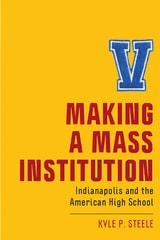
Making a Mass Institution
Indianapolis and the American High SchoolKyle P. Steele
Rutgers University Press, 2020
Making a Mass Institution describes how Indianapolis, Indiana created a divided and unjust system of high schools over the course of the twentieth century, one that effectively sorted students geographically, economically, and racially. Like most U.S. cities, Indianapolis began its secondary system with a singular, decidedly academic high school, but ended the 1960s with multiple high schools with numerous paths to graduation. Some of the schools were academic, others vocational, and others still for what was eventually called “life adjustment.” This system mirrored the multiple forces of mass society that surrounded it, as it became more bureaucratic, more focused on identifying and organizing students based on perceived abilities, and more anxious about teaching conformity to middle-class values. By highlighting the experiences of the students themselves and the formation of a distinct, school-centered youth culture, Kyle P. Steele argues that high school, as it evolved into a mass institution, was never fully the domain of policy elites, school boards and administrators, or students, but a complicated and ever-changing contested meeting place of all three.
[more]
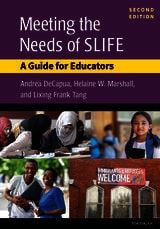
Meeting the Needs of SLIFE, Second Ed.
A Guide for EducatorsAndrea DeCapua, Helaine W. Marshall, and Lixing Frank Tang
University of Michigan Press, 2020
Today's public schools are brimming with students who are not only new to English but who also have limited or interrupted schooling. These students, referred to as SLIFE (or SIFE), create unique challenges for teachers and administrators.
Like its predecessor, this book is grounded in research and is designed to be an accessible and practical resource for teachers, staff, and administrators who work with students with limited or interrupted formal education. Chapters 3-5 focus on classroom instruction, but others address issues of concern to administrators and staff too. For example, Chapter 6 explores different program models for SLIFE instruction, but the planning and commitment to creating a successful program require the involvement of many across the school community, not just teachers.
This edition features case studies, model programs, and teaching techniques and tips; also included is a new chapter focused on the Mutually Adaptive Learning Paradigm (MALP (R)). A major theme of this new edition is moving school personnel away from a deficit perspective, when it comes to teaching SLIFE, and toward one of difference. The goal is to help all stakeholders in the school community create and foster inclusion of, and equity for, a population that is all too often marginalized, ignored, and underserved.
[more]