Results by title
64 books match the query 'Self in literature' and 5 start with m
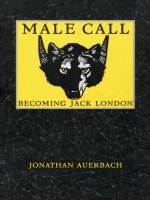
Male Call
Becoming Jack LondonJonathan Auerbach
Duke University Press, 1996
Jonathan Auerbach shows that London’s personal identity was not a basis of his literary success, but rather a consequence of it. Unlike previous studies of London that are driven by the author’s biography, Male Call examines how London carefully invented a trademark “self” in order to gain access to a rapidly expanding popular magazine and book market that craved authenticity, celebrity, power, and personality. Auerbach demonstrates that only one fact of London’s life truly shaped his art: his passionate desire to become a successful author. Whether imagining himself in stories and novels as a white man on trail in the Yukon, a sled dog, a tramp, or a professor; or engaging questions of manhood and mastery in terms of work, race, politics, class, or sexuality, London created a public persona for the purpose of exploiting the conventions of the publishing world and marketplace.
Revising critical commonplaces about both Jack London’s work and the meaning of “nature” within literary naturalism and turn-of-the-century ideologies of masculinity, Auerbach’s analysis intriguingly complicates our view of London and sheds light on our own postmodern preoccupation with celebrity. Male Call will attract readers with an interest in American studies, American literature, gender studies, and cultural studies.

Mark Twain on the Loose
A Comic Writer and the American SelfBruce Michelson
University of Massachusetts Press, 1995
Can we rediscover the wildness in Mark Twain’s humor? Can we understand how that wildness helped make him a national legend and a key figure in the expression of an American self? In Mark Twain on the Loose, Bruce Michelson writes about Twain as a body of literature, as a public personality, and as a myth. Michelson shows that many of Twain’s most ambitious and memorable works, from the very beginning to the end of his career, express a drive for absolute liberation from every social, psychological, and artistic limit.
The outrageous and anarchic sides of Twain play a vital role in his art. But these traits are undervalued even by his admirers, who often favor clean shapes and steady affirmations in Twain’s writing —not the dangerous comic outbreak, or the deep yearning to free the self from every definition and confinement.
Reviewing works from a wide range of Twain’s writings, Michelson brings to light those wild dimensions, their literary consequences, and their cultural importance. He reveals this great author as “the best escape artist in the American canon,” a reflexive, paradoxical, rule-shattering comic genius.
Melancholy, Love, and Time
Boundaries of the Self in Ancient LiteraturePeter Toohey
University of Michigan Press, 2004
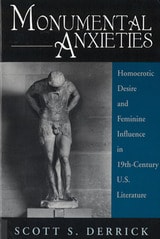
Monumental Anxieties
Homoerotic Desire and Feminine Influence in 19-th Century U.S. LiteratureDerrick, Scott S
Rutgers University Press, 1997
Scott Derrick has written an original book that contributes significantly to current revisions of the nineteenth-century American literary tradition's representation of gender and sexuality. His interpretation of feminist, lesbian-feminist, and gay issues in nineteenth-century American literature as complementary enlarges our historical understanding and helps build the coalition politics needed in these areas."-John Carlos Rowe, University of California, Irvine
Recent gender-based scholarship on nineteenth-century American literature has established male authors' crucial awareness of the competition from popular women writers. And critical work in gay studies and queer theory has stressed the importance in canonical American literature of homoerotic relations between men, even before "homosexuality" became codified at the end of the century. Scott Derrick draws on these insights to explore the ways in which male authors struggle to refigure literature-historically devalued as feminine-as a masculine and heterosexual enterprise. Derrick focuses on scenes of compositional crisis that reveal how male identity itself is at risk in the perils and possibilities of being a male author in a feminized literary marketplace.
He suggests that traditionally valued texts by Hawthorne, Poe, James, Sinclair, and Crane have at their core combustible four-sided conflicts between feminine identifications and masculine distancings, homoerotic longings and homophobic dreads, conflicts which are largely determined by domestic ideals of male and female roles within the nineteenth-century family. The negotiation of such conflicts is controlled by the nature of fiction writing, which both frees the imagination to explore forbidden fantasies and harnesses the imagination to public understandings of the proper form and content of fiction. Thus Monumental Anxieties also contributes to recent debates about the social shaping of contemporary homosexuality and to the history of American masculinity.
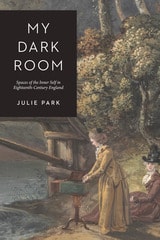
My Dark Room
Spaces of the Inner Self in Eighteenth-Century EnglandJulie Park
University of Chicago Press, 2023
In what kinds of spaces do we become most aware of the thoughts in our own heads? In My Dark Room, Julie Park explores places of solitude and enclosure that gave eighteenth-century subjects closer access to their inner worlds: grottos, writing closets, landscape follies, and the camera obscura, that beguiling “dark room” inside which the outside world in all its motion and color is projected. The camera obscura and its dreamlike projections within it served as a paradigm for the everyday spaces, whether in built environments or in imaginative writing, that generated the fleeting states of interiority eighteenth-century subjects were compelled to experience and inhabit.
My Dark Room illuminates the spatial and physical dimensions of inner life in the long eighteenth century by synthesizing material analyses of diverse media, from optical devices and landscape architecture to women’s intimate dress, with close readings of literary texts not traditionally considered together, among them Andrew Marvell’s country house poem Upon Appleton House, Margaret Cavendish’s experimental epistolary work Sociable Letters, Alexander Pope’s heroic verse epistle Eloisa to Abelard, and Samuel Richardson’s novel Pamela. Park also analyzes letters and diaries, architectural plans, prints, drawings, paintings, and more, drawing our attention to the lively interactions between spaces and psyches in private environments. Park’s innovative method of “spatial formalism” reveals how physical settings enable psychic interiors to achieve vitality in lives both real and imagined.