Results by title
87 books match the query 'Sexual minorities' and 2 start with m
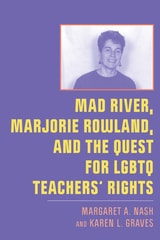
Mad River, Marjorie Rowland, and the Quest for LGBTQ Teachers’ Rights
Margaret A. Nash
Rutgers University Press, 2022
Mad River, Marjorie Rowland, and the Quest for LGBTQ Teachers’ Rights addresses an important legal case that set the stage for today’s LGBTQ civil rights–a case that almost no one has heard of. Marjorie Rowland v. Mad River School District involves an Ohio guidance counselor fired in 1974 for being bisexual. Rowland’s case made it to the U.S. Supreme Court, but the justices declined to consider it. In a spectacular published dissent, Justice Brennan laid out arguments for why the First and Fourteenth Amendments apply to bisexuals, gays, and lesbians. That dissent has been the foundation for LGBTQ civil rights advances since.
In the first in-depth treatment of this foundational legal case, authors Margaret A. Nash and Karen L. Graves tell the story of that case and of Marjorie Rowland, the pioneer who fought for employment rights for LGBTQ educators and who paid a heavy price for that fight. It brings the story of LGBTQ educators’ rights to the present, including commentary on Bostock v Clayton County, the 2020 Supreme Court case that struck down employment discrimination against LGBT workers.
In the first in-depth treatment of this foundational legal case, authors Margaret A. Nash and Karen L. Graves tell the story of that case and of Marjorie Rowland, the pioneer who fought for employment rights for LGBTQ educators and who paid a heavy price for that fight. It brings the story of LGBTQ educators’ rights to the present, including commentary on Bostock v Clayton County, the 2020 Supreme Court case that struck down employment discrimination against LGBT workers.
[more]
Menace to the Future
A Disability and Queer History of Carceral EugenicsJess Whatcott
Duke University Press, 2024
In Menace to the Future, Jess Whatcott traces the link between US disability institutions and early twentieth-century eugenicist ideology, demonstrating how the legacy of those ideas continues to shape incarceration and detention today. Whatcott focuses on California, examining records from state institutions and reform organizations, newspapers, and state hospital museum exhibits. They reveal that state confinement, coercive treatment, care neglect, and forced sterilization were done out of the belief that the perceived unfitness of disabled, mad, and neurodivergent people was hereditary and thus posed a biological threat—a so-called menace to the future. Whatcott uncovers a history of disabled resistance to these institutions that predates disability rights movements, builds a genealogy of resistance, and tells a history of eugenics from below. Theorizing how what they call “carceral eugenics” informed state treatment of disabled, mad, and neurodivergent people a century ago, Whatcott shows not only how that same logic still exists in secure treatment facilities, state prisons, and immigration detention centers, but also why it must continue to be resisted.
[more]