Results by title
177 books match the query 'Shakespeare' and 7 start with m
Macbeth
William Shakespeare
Arizona Center for Medieval and Renaissance Studies, 2021
In Migdalia Cruz’s Macbeth, the Witches run the world. The Macbeths live out a dark cautionary tale of love, greed, and power, falling from glory into calamity as the Witches spin their fate. Translating Shakespeare’s language for a modern audience, Nuyorican playwright Migdalia Cruz rewrites Macbeth with all the passion of the Bronx.
This translation of Macbeth was presented in 2018 as part of the Play On! Shakespeare project, an ambitious undertaking from the Oregon Shakespeare Festival that commissioned new translations of 39 Shakespeare plays. These translations present the Bard’s work in language accessible to modern audiences while never losing the beauty of Shakespeare’s verse. Enlisting the talents of a diverse group of contemporary playwrights, screenwriters, and dramaturges from diverse backgrounds, this project reenvisions Shakespeare for the twenty-first century. These volumes make these works available for the first time in print—a new First Folio for a new era.

Macbeth
A Visual CompanionWendy Beth Hyman
Arizona Center for Medieval and Renaissance Studies, 2026
A collaboration between experienced Shakespeare scholar-educator Wendy Beth Hyman and her former student, emerging queer illustrator and animator Clair Wang, that seeks to visualize the literary language of Macbeth.
Macbeth: A Visual Companion offers a unique resource to readers, teachers, and performers of Shakespeare: an illustrated guide to those literary features of Shakespeare’s texts that can’t be represented on stage. How do you unravel a complex metaphor, an antiquated pun, an embedded allegory? What if allusions and images and similes could appear before the reader’s eyes? What if we could learn to read as Renaissance readers did: with fewer footnotes, but greater capacity to “see” literary language like chiasmus or equivocation? This is the aim of this creative collaboration.
Designed to be read alongside the free online editions provided by the Folger Shakespeare Library, Macbeth: A Visual Companion illuminates the most obscure features of a very complex play, empowering readers to unpack Shakespeare without reliance on watered-down modernizations or even staged productions. Hyman and Wang present a two-part strategy. One, illustrations that, rather than counterfeiting the action of drama, provide a visual representation of the inner worlds of language. And two, scholarly commentary that, rather than inertly explain or obtusely theorize difficulty, shows how literary devices themselves generate meaning. They thus model for readers how to access metaphors, allusions, and images in real time—just like Shakespeare’s original audience did. In the process, they aim to empower students and non-specialist teachers not only to understand Macbeth or Shakespeare more generally, but also to showcase a model for more confidently grappling with challenging literary texts of all kinds.
Mapping Shakespeare's World
Peter Whitfield
Bodleian Library Publishing, 2015
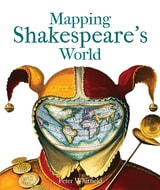
Mapping Shakespeare’s World explores these questions with surprising results. It has often been said that setting is irrelevant to Shakespeare’s plays—that, wherever they are set, their enduring appeal lies in their ability to speak to broad questions of human nature. Peter Whitfield shows that, on the contrary, many of Shakespeare’s locations were carefully chosen for their ability to convey subtle meanings an Elizabethan audience would have picked up on and understood. Through the use of paintings, drawings, contemporary maps and geographical texts, Whitfield suggests answers to such questions as where Illyria was located, why The Merry Wives of Windsor could only have taken place in Windsor, and how two utterly different comedies—The Comedy of Errors and Pericles, Prince of Tyre—both came to take place in ancient Ephesus.
Just when one might think there was nothing more to be said about Shakespeare, with Mapping Shakespeare’s World, Whitfield offers a fascinating new point of view.
Marketing the Bard
Shakespeare in Performance and Print, 1660-1740Don-John Dugas
University of Missouri Press, 2006
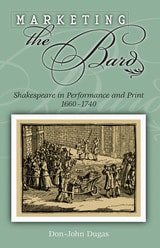
To posterity, William Shakespeare may be the Bard of Avon, but to mid-seventeenth-century theatergoers he was just another dramatist. Yet barely a century later, he was England’s most popular playwright and a household name. In this intriguing study, Don-John Dugas explains how these changes came about and sealed Shakespeare’s reputation even before David Garrick performed his work on the London stage.
Measure for Measure
William Shakespeare
Arizona Center for Medieval and Renaissance Studies, 2023
One of Shakespeare’s most difficult plays, Measure for Measure has long challenged performers and audiences alike. In reworking the play in her translation, Aditi Brennan Kapil honors the structure, rhythms, and themes of Shakespeare’s original. Kapil’s updated language makes this cautionary fable about frailty, power, and the perils of legislating morality accessible for today’s audiences.
This translation of Measure for Measure was written as part of the Oregon Shakespeare Festival’s Play On! project, which commissioned new translations of thirty-nine Shakespeare plays. These translations present the work of “The Bard” in language accessible to modern audiences while never losing the beauty of Shakespeare’s verse. Enlisting the talents of a diverse group of contemporary playwrights, screenwriters, and dramaturges from diverse backgrounds, this project reenvisions Shakespeare for the twenty-first century. These volumes make these works available for the first time in print—a new First Folio for a new era.
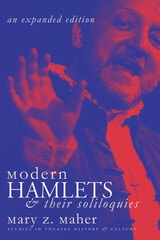
Modern Hamlets & Soliloquies
An Expanded EditionMary Z. Maher
University of Iowa Press, 2003
In Modern Hamlets and Their Soliloquies (Iowa, 1992), Mary Maher examined how modern actors have chosen to perform Hamlet’s soliloquies, and why they made the choices they made, within the context of their specific productions of the play.
Adding to original interviews with, among others, Derek Jacobi, David Warner, Kevin Kline, and Ben Kingsley, Modern Hamlets and Their Soliloquies: An Expanded Edition offers two new and insightful interviews, one with Kenneth Branagh, focusing on his 1997 film production of the play, and one with Simon Russell Beale, discussing his 2000-2001 run as Hamlet at the Royal National Theatre.
Much Ado About Nothing
William Shakespeare
Arizona Center for Medieval and Renaissance Studies, 2021
In Much Ado About Nothing, a series of miscommunications and misunderstandings spiral out of control, leaving two sets of lovers to untangle their words and their hearts. Ranjit Bolt, an accomplished translator, takes on Shakespeare’s well-loved comedy to update much of the obscure language while maintaining the humor, characterization, and wit that audiences know and love. For modern readers, Beatrice, Benedick, Hero, and Claudio are just as enchanting as always—and perhaps funnier than ever before.
This translation of Much Ado About Nothing was written as part of the Oregon Shakespeare Festival’s Play On! project, which commissioned new translations of thirty-nine Shakespeare plays. These translations present work from “The Bard” in language accessible to modern audiences while never losing the beauty of Shakespeare’s verse. Enlisting the talents of a diverse group of contemporary playwrights, screenwriters, and dramaturges from diverse backgrounds, this project reenvisions Shakespeare for the twenty-first century. These volumes make these works available for the first time in print—a new First Folio for a new era.