Results by title
151 books match the query 'Sign Language' and 7 start with m
Manual Communication
Implications for EducationHarry Bornstein
Gallaudet University Press, 1990
Manual Communication: Implications for Education offers the first authoritative examination of sign systems used in the education of deaf students. Professionals, teachers, and parents will appreciate the individual, expert explanations of:
American Sign Language
Pidgin Sign (Contact Sign)
Signed English
Signing Exact English
Cued Speech.
The descriptions by the acknowledged designer, administrator, or scholar of each system ensures the highest accuracy and thoroughness, distinguishing Manual Communication as a significant, important resource.
The first chapter recounts the history of sign language, particularly American Sign Language (ASL), including foreign influences and conflicts about its use. An overview follows, describing factors that affect manual communication, such as learner characteristics. Also, an analysis of a nationwide survey of teachers shows the results of their use of the various forms of manual communication in different settings.
Many Ways to Be Deaf
International Variation in Deaf CommunitiesLeila Monaghan
Gallaudet University Press, 2003

Metaphor in American Sign Language
Phyllis Perrin Wilcox
Gallaudet University Press, 2001
Only recently have linguists ceased to regard metaphors as mere frills on the periphery of language and begun to recognize them as cornerstones of discourse. Phyllis Wilcox takes this innovation one step further in her fascinating study of metaphors in American Sign Language (ASL).
Such an inquiry has long been obscured by, as Wilcox calls it, “the shroud of iconicity.” ASL’s iconic nature once discouraged people from recognizing it as a language; more recently it has served to confuse linguists examining its metaphors. Wilcox, however, presents methods for distinguishing between icon and metaphor, allowing the former to clarify, not cloud, the latter. “If the iconic influence that surrounds metaphor is set aside, the results will be greater understanding, and interpretations that are less opaque.”
Wilcox concludes her study with a close analysis of the ASL poem, “The Dogs,” by Ella Mae Lentz. In presenting Deaf Americans’, Deaf Germans’, and Deaf Italians’ reactions to the poem, Wilcox manages not only to demonstrate the influence of culture upon metaphors, but also to illuminate the sources of sociopolitical division within the American Deaf community. Metaphor in American Sign Language proves an engrossing read for those interested in linguistics and Deaf culture alike.
More Than Meets the Eye
Revealing the Complexities of an Interpreted EducationMelissa B. Smith
Gallaudet University Press, 2013
Sign language interpreters often offer the primary avenue of access for deaf and hard of hearing students in public schools. More than 80% of all deaf children today are mainstreamed, and few of their teachers sign well enough to provide them with full access. As a result, many K-12 interpreters perform multiple roles beyond interpreting. Yet, very little is known about what they actually do and what factors inform their moment-to-moment decisions. This volume presents the range of activities and responsibilities performed by educational interpreters, and illuminates what they consider when making decisions.
To learn about the roles of K-12 interpreters, author Melissa B. Smith conducted in-depth analyses at three different schools. She learned that in response to what interpreters feel that their deaf students need, many focus on three key areas: 1) visual access, 2) language and learning, and 3) social and academic participation/inclusion. To best serve their deaf students in these contexts, they perform five critical functions: they assess and respond to the needs and abilities of deaf students; they interpret with or without modification as they deem appropriate; they capitalize on available resources; they rely on interactions with teachers and students to inform their choices; and they take on additional responsibilities as the need arises.
Multicultural Aspects of Sociolinguistics in Deaf Communities
Ceil Lucas
Gallaudet University Press, 2001
This collection offers a wide variety of fascinating studies that consider multicultural aspects among deaf people worldwide. Mala Kleinfeld and Noni Warner investigate variation in the use of gay, lesbian, and bisexual signs in the Deaf community; Jan Branson, Don Miller, and I Gede Marsaja, assisted by I Wayan Negara, profile a deaf village in Bali, Indonesia in which hearing people are fluent in both sign and spoken languages. Alejandro Oviedo in Venezuela comments on bilingual deaf education in Venezuela, and Sara Schley outlines the sociolinguistic and educational implications of comparing ASL and English word definitions.
Susan Mather discusses initiation in visually constructed dialogue from reading books with 3- to 8-year-old students who are deaf or hard of hearing. Pietro Celo offers insights on the interrogative in Italian Sign Language, and Julie Wilson examines narrative structure in American Sign Language ASL) through her analysis of “the tobacco story.” Rhonda Jacobs completes this significant, wide-ranging volume with her research on second language learning, as she presents the case for ASL as a truly foreign language by posing the question, “Just how hard is it to learn ASL?”
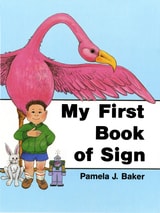
My First Book of Sign
Pamela J. Baker
Gallaudet University Press, 1986
My First Book of Sign, a full-color alphabet book, gives the signs for 150 of the words most frequently used by young children. The vocabulary comes from recognized word list sources such as the Dale List of 769 Easy Words. The proportion of word category choices (nouns, modifiers, and verbs) is based on early language acquisition research.
Readers do not have to know American Sign Language to enjoy My First Book of Sign; the book provides explanations of how to form each sign. This is a very special alphabet book appropriate for all children who are just beginning to read.

My Signing Book of Numbers
Patricia Bellan Gillen
Gallaudet University Press, 1988