Results by title
56 books match the query 'Slave trade' and 5 start with m
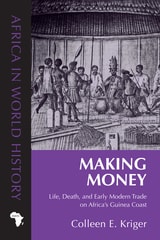
Making Money
Life, Death, and Early Modern Trade on Africa’s Guinea CoastColleen E. Kriger
Ohio University Press, 2017
A new era in world history began when Atlantic maritime trade among Africa, Asia, Europe, and the Americas opened up in the fifteenth century, setting the stage for massive economic and cultural change. In Making Money, Colleen Kriger examines the influence of the global trade on the Upper Guinea Coast two hundred years later—a place and time whose study, in her hands, imparts profound insights into Anglo-African commerce and its wider milieu.
A stunning variety of people lived in this coastal society, struggling to work together across deep cultural divides and in the process creating a dynamic creole culture. Kriger digs further than any previous historian of Africa into the records of England’s Royal African Company to illuminate global trade patterns, the interconnectedness of Asian, African, and European markets, and—most remarkably—the individual lives that give Making Money its human scale.
By inviting readers into the day-to-day workings of early modern trade in the Atlantic basin, Kriger masterfully reveals the rich social relations at its core. Ultimately, this accessible book affirms Africa’s crucial place in world history during a transitional period, the early modern era.
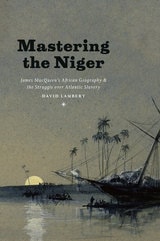
Mastering the Niger
James MacQueen's African Geography and the Struggle over Atlantic SlaveryDavid Lambert
University of Chicago Press, 2013
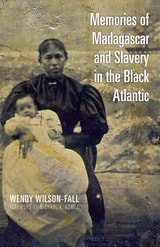
Memories of Madagascar and Slavery in the Black Atlantic
Wendy Wilson-Fall
Ohio University Press, 2015
From the seventeenth century into the nineteenth, thousands of Madagascar’s people were brought to American ports as slaves. In Memories of Madagascar and Slavery in the Black Atlantic, Wendy Wilson-Fall shows that the descendants of these Malagasy slaves in the United States maintained an ethnic identity in ways that those from the areas more commonly feeding the Atlantic slave trade did not. Generations later, hundreds, if not thousands, of African Americans maintain strong identities as Malagasy descendants, yet the histories of Malagasy slaves, sailors, and their descendants have been little explored.
Wilson-Fall examines how and why the stories that underlie this identity have been handed down through families—and what this says about broader issues of ethnicity and meaning-making for those whose family origins, if documented at all, have been willfully obscured by history.
By analyzing contemporary oral histories as well as historical records and examining the conflicts between the two, Wilson-Fall carefully probes the tensions between the official and the personal, the written and the lived. She suggests that historically, the black community has been a melting pot to which generations of immigrants—enslaved and free—have been socially assigned, often in spite of their wish to retain far more complex identities. Innovative in its methodology and poetic in its articulation, this book bridges history and ethnography to take studies of diaspora, ethnicity, and identity into new territory.
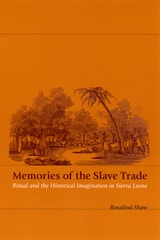
Memories of the Slave Trade
Ritual and the Historical Imagination in Sierra LeoneRosalind Shaw
University of Chicago Press, 2002
Drawing on extensive fieldwork and archival research, Shaw argues that memories of the slave trade have shaped (and been reshaped by) experiences of colonialism, postcolonialism, and the country's ten-year rebel war. Thus money and commodities, for instance, are often linked to an invisible city of witches whose affluence was built on the theft of human lives. These ritual and visionary memories make hitherto invisible realities manifest, forming a prism through which past and present mutually configure each other.
Metaphor and the Slave Trade in West African Literature
Laura T. Murphy
Ohio University Press, 2012
Metaphor and the Slave Trade provides compelling evidence of the hidden but unmistakable traces of the transatlantic slave trade that persist in West African discourse. Through an examination of metaphors that describe the trauma, loss, and suffering associated with the commerce in human lives, this book shows how the horrors of slavery are communicated from generation to generation.
Laura T. Murphy’s insightful new readings of canonical West African fiction, autobiography, drama, and poetry explore the relationship between memory and metaphor and emphasize how repressed or otherwise marginalized memories can be transmitted through images, tropes, rumors, and fears. By analyzing the unique codes through which West Africans have represented the slave trade, this work foregrounds African literary contributions to Black Atlantic discourse and draws attention to the archive that metaphor unlocks for scholars of all disciplines and fields of study.