Results by title
238 books match the query 'Social Classes & Economic Disparity' and 8 start with m
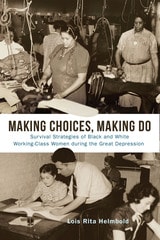
Making Choices, Making Do
Survival Strategies of Black and White Working-Class Women during the Great DepressionLois Rita Helmbold
Rutgers University Press, 2023
Manufacturing Consent
Changes in the Labor Process Under Monopoly CapitalismMichael Burawoy
University of Chicago Press, 1982
Manufacturing Consent, the result of Burawoy's research, combines rich ethnographical description with an original Marxist theory of the capitalist labor process. Manufacturing Consent is unique among studies of this kind because Burawoy has been able to analyze his own experiences in relation to those of Donald Roy, who studied the same factory thirty years earlier. Burawoy traces the technical, political, and ideological changes in factory life to the transformations of the market relations of the plant (it is now part of a multinational corporation) and to broader movements, since World War II, in industrial relations.

Marx
The Alternative to CapitalismKieran Allen
Pluto Press, 2017
If we are serious about finding a different way to run the post-credit crunch society, we must start by introducing alternatives to undergraduates. Kieran Allen begins the task with an accessible and comprehensive look at the ideas of Karl Marx.
Dispensing with the dryness of traditional explanations of Marx, Allen shows how Marx's ideas apply to modern society. The first section briefly outlines Marx's life and the development of his work, then goes on to clearly explain his key theories, including historical materialism and surplus value. The second section examines alternatives to capitalism, the concept of 'anti-capitalism' and provides concrete, contemporary examples of Marx’s theories being put into practice in today's world.
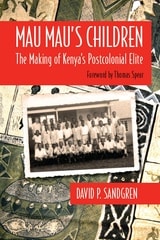
Mau Mau’s Children
The Making of Kenya’s Postcolonial EliteDavid P. Sandgren; Foreword by Thomas Spear
University of Wisconsin Press, 2012
In 1963 David P. Sandgren went to Kenya to teach in a small, rural school for boys, where he remained for the next four years. These were heady times for Kenyans, as the nation gained its independence, approved a new constitution, and held its first elections. In the school where Sandgren taught, the sons of Gikuyu farmers rose to the challenges of this post colonial era and, in time, entered Kenyan society as adults, joining Kenya’s first generation of post colonial elites.
In Mau Mau’s Children, Sandgren has reconnects with these former students. Drawing on more than one hundred interviews, he provides readers with a collective biography of the lives of Kenya’s first postcolonial elite, stretching from their 1940s childhood to the peak of their careers in the 1990s. Through these interviews, Mau Mau’s Children shows the trauma of growing up during the Mau Mau Rebellion, the nature of nationalism in Kenya, the new generational conflicts arising, and the significance of education and Gikuyu ethnicity on his students' path to success.
Measuring Distribution and Mobility of Income and Wealth
Raj Chetty, John N. Friedman, Janet C. Gornick, Barry Johnson, and Arthur Kennickell
University of Chicago Press, 2022
Economic research is increasingly focused on inequality in the distribution of personal resources and outcomes. One aspect of inequality is mobility: are individuals locked into their respective places in this distribution? To what extent do circumstances change, either over the lifecycle or across generations? Research not only measures inequality and mobility, but also analyzes the historical, economic, and social determinants of these outcomes and the effect of public policies. This volume explores the latest developments in the analysis of income and wealth distribution and mobility. The collection of twenty-three studies is divided into five sections. The first examines observed patterns of income inequality and shifts in the distribution of earnings and in other factors that contribute to it. The next examines wealth inequality, including a substantial discussion of the difficulties of defining and measuring wealth. The third section presents new evidence on the intergenerational transmission of inequality and the mechanisms that underlie it. The next section considers the impact of various policy interventions that are directed at reducing inequality. The final section addresses the challenges of combining household-level data, potentially from multiple sources such as surveys and administrative records, and aggregate data to study inequality, and explores ways to make survey data more comparable with national income accounts data.
Memory, Meaning, and Resistance
Reflecting on Oral History and Women at the MarginsFran Leeper Buss
University of Michigan Press, 2017
Middle Class Union
Organizing the ‘Consuming Public’ in Post-World War I AmericaMark W. Robbins
University of Michigan Press, 2017
Combining social history with interdisciplinary approaches to the study of consumption and symbolic space, Middle Class Union illustrates how acts of consumption, representations of the middle class in literary, journalistic, and artistic discourses, and ground-level organizing combined to enable white-collar activists to establish themselves as both the middle class and the backbone of the nation. This book contributes to labor history by examining the nexus of class and consumption to show how many white-collar workers drew on their consumer identity to express an anti-labor politics, later facilitating the struggles of unions throughout the post–World War I years. It also contributes to political history by emphasizing how these middle-class activists laid important groundwork for both 1920s business conservatism and New Deal liberalism. They exerted their political influence well before the post–World War II period, when a self-interested and powerful middle-class consumer identity is more widely acknowledged to have taken hold.
Misconceiving Merit
Paradoxes of Excellence and Devotion in Academic Science and EngineeringMary Blair-Loy and Erin A. Cech
University of Chicago Press, 2022
In Misconceiving Merit, sociologists Mary Blair-Loy and Erin A. Cech uncover the cultural foundations of a paradox. On one hand, academic science, engineering, and math revere meritocracy, a system that recognizes and rewards those with the greatest talent and dedication. At the same time, women and some racial and sexual minorities remain underrepresented and often feel unwelcome and devalued in STEM. How can academic science, which so highly values meritocracy and objectivity, produce these unequal outcomes?
Blair-Loy and Cech studied more than five hundred STEM professors at a top research university to reveal how unequal and unfair outcomes can emerge alongside commitments to objectivity and excellence. The authors find that academic STEM harbors dominant cultural beliefs that not only perpetuate the mistreatment of scientists from underrepresented groups but hinder innovation. Underrepresented groups are often seen as less fully embodying merit compared to equally productive white and Asian heterosexual men, and the negative consequences of this misjudgment persist regardless of professors’ actual academic productivity. Misconceiving Merit is filled with insights for higher education administrators working toward greater equity as well as for scientists and engineers striving to change entrenched patterns of inequality in STEM.