121 books match the query 'Social classes' and 10 start with m

cover of MEN AND VIOLENCE: GENDER, HONOR, AND RITUALS IN MODERN EUROPE AND AMERICA

MEN AND VIOLENCE

GENDER, HONOR, AND RITUALS IN MODERN EUROPE AND AMERICA

Pieter Spierenburg

The Ohio State University Press, 1998

There is growing interest in the history of masculinity and male culture, including violence, as an integral part of a proper understanding of gender. In almost every historical setting, masculinity and violence are closely linked; certainly, violent crime has been overwhelmingly a male enterprise. But violence is not always criminal: in many cultural contexts violence is linked instead to honor and encoded in rituals. We possess only an imperfect understanding of the ways in which aggressive behavior, or the abstention from aggressive behavior, contributes to the construction of masculinity and male honor. In this collection, internationally renowned expert Pieter Spierenburg brings together eight scholars to explore the fascinating interrelationship of masculinity, honor, and the body.
            The essays focus on the United States and western Europe from the seventeenth to the twentieth centuries. The contributors are Ute Frevert, Steven Hughes, Robert Nye, Daniele Boschi, Amy Sophia Greenberg, Martin J. Wiener, Stephen Kantrowitz, and Terence Finnegan. Men and Violence will be welcomed and widely used by a broad range of scholars and students.
[more]
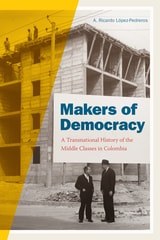
cover of Makers of Democracy: A Transnational History of the Middle Classes in Colombia

Makers of Democracy

A Transnational History of the Middle Classes in Colombia

A. Ricardo López-Pedreros

Duke University Press, 2019

In Makers of Democracy A. Ricardo López-Pedreros traces the ways in which a thriving middle class was understood to be a foundational marker of democracy in Colombia during the second half of the twentieth century. Drawing on a wide array of sources ranging from training manuals and oral histories to school and business archives, López-Pedreros shows how the Colombian middle class created a model of democracy based on free-market ideologies, private property rights, material inequality, and an emphasis on a masculine work culture. This model, which naturalized class and gender hierarchies, provided the groundwork for Colombia's later adoption of neoliberalism and inspired the emergence of alternate models of democracy and social hierarchies in the 1960s and 1970s that helped foment political radicalization. By highlighting the contested relationships between class, gender, economics, and politics, López-Pedreros theorizes democracy as a historically unstable practice that exacerbated multiple forms of domination, thereby prompting a rethinking of the formation of democracies throughout the Americas.
[more]
cover of Managerial Capitalism: Ownership, Management, and the Coming New Mode of Production

Managerial Capitalism

Ownership, Management, and the Coming New Mode of Production

Gérard Duménil and Dominique Lévy

Pluto Press, 2018

Marxist analysis has traditionally been built on a two-class framework: workers and capitalists. With Managerial Capitalism, Gerard Duménil and Dominique Lévy mount a powerful argument that such a framework is outdated—we are in fact amid a transition to a new mode of production, one that is fundamentally shaped by a third, intermediary class: managerialism.
            Drawing examples from the United States and Europe, the authors offer a historically rooted interpretation of major current economic and political trends. Without eschewing Marx’s theory of history and political economy, they update it to take account of the changes underway in class patterns and relationships to production. The result is a robust new Marxism for the present and the future.
[more]
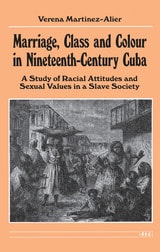
cover of Marriage, Class and Colour in Nineteenth-Century Cuba: A Study of Racial Attitudes and Sexual Values in a Slave Society

Marriage, Class and Colour in Nineteenth-Century Cuba

A Study of Racial Attitudes and Sexual Values in a Slave Society

Verena Martinez-Alier

University of Michigan Press, 1989

Marriage, Class and Colour in Nineteenth-Century Cuba challenges conventional ideas about the roots of Cuban race relations. Verena Martinez-Alier proposes a relational model for the study of sexual values and social inequality. She deals with Cuban notions of honor and virtue while describing complex interconnections between class and perceived racial status that determined the choice of sexual and marriage partners. First published in 1974, Marriage, Class and Colour in Nineteenth-Century Cuba is now a classic, a pathbreaking encounter of anthropology with history that points the way for future investigations. With this edition, the work of this pioneering scholar is made available again, with a new introduction by the author.
[more]
cover of Marx and other Four-Letter Words

Marx and other Four-Letter Words

Edited by Georgina Blakeley and Valerie Bryson

Pluto Press, 2005

Karl Marx's classic definitions of class and society under capitalism are still widely used today. Ideas such as class, revolution, production and oppression are employed across a broad range of academic subjects, reaching beyond politics, economics and sociology.

Yet these concepts, within a specifically Marxist framework, are not always easy to understand. This book is an ideal student introduction that explains, in clear and concise chapters, the precise meaning and implications of each of Marx's key concepts. Furthermore, the contributors show how these ideas continue to be relevant, and how they relate to modern society.

The contributors include leading academics in the field of politicial science. Outlining clearly what each concept means, they move on to situate it within cutting-edge contemporary political theory.

Concepts include historical materialism, capitalism, class, the state, imperialism, the division of labour, oppression, production and reproduction, revolution, working class internationalism, equality and democracy.
[more]
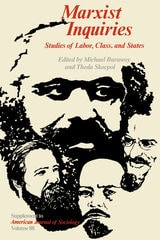
cover of Marxist Inquiries: Studies of Labor, Class, and States

Marxist Inquiries

Studies of Labor, Class, and States

Edited by Michael Burawoy and Theda Skocpol

University of Chicago Press, 1983

This collection exemplifies the resurgence of Marxist ideas in contemporary social research. Its purpose is neither to cover all the areas of Marxist research nor to survey alternative Marxist perspectives or schools. Rather the volume assembles nine examples of the most interesting work being done today by younger sociologists who are seriously pursuing the rich and provocative arguments to be found in the ongoing Marxist tradition. All contributions build upon or react to Marxist theoretical perspectives. They employ such diverse research techniques as participant observation, statistical analysis, interviewing, and the examination of archives of public documents. Among the topics covered:

– the economic bases of state policies and their determination by social and political struggles;
–  the politcal reshaping of international economic order;
– industrial work in relation to other institutions (such as education, patriarchy, and citizenship);
– the transformation of class structures in capitalist and state-socialist societies.

Published as a supplement to American Journal of Sociology, these studies constitute essential reading both for those sociologists who see Marxism as a powerful framework for understanding capitalist societies and for those who may not be committed to working within the Marxist tradition but nevertheless want to see Marxist hypotheses fully researched and debated.

[more]
[more]
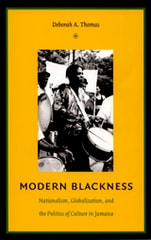
cover of Modern Blackness: Nationalism, Globalization, and the Politics of Culture in Jamaica

Modern Blackness

Nationalism, Globalization, and the Politics of Culture in Jamaica

Deborah A. Thomas

Duke University Press, 2004

Modern Blackness is a rich ethnographic exploration of Jamaican identity in the late twentieth century and early twenty-first. Analyzing nationalism, popular culture, and political economy in relation to one another, Deborah A. Thomas illuminates an ongoing struggle in Jamaica between the values associated with the postcolonial state and those generated in and through popular culture. Following independence in 1962, cultural and political policies in Jamaica were geared toward the development of a multiracial creole nationalism reflected in the country’s motto: “Out of many, one people.” As Thomas shows, by the late 1990s, creole nationalism was superseded by “modern blackness”—an urban blackness rooted in youth culture and influenced by African American popular culture. Expressions of blackness that had been marginalized in national cultural policy became paramount in contemporary understandings of what it was to be Jamaican.

Thomas combines historical research with fieldwork she conducted in Jamaica between 1993 and 2003. Drawing on her research in a rural hillside community just outside Kingston, she looks at how Jamaicans interpreted and reproduced or transformed on the local level nationalist policies and popular ideologies about progress. With detailed descriptions of daily life in Jamaica set against a backdrop of postcolonial nation-building and neoliberal globalization, Modern Blackness is an important examination of the competing identities that mobilize Jamaicans locally and represent them internationally.
[more]
cover of Modern Hungarian Society in the Making

Modern Hungarian Society in the Making

András Gero

Central European University Press, 1995

Illuminates the problems connected with Hungary's transition to a civil society while providing insights into the development of political culture and the rise of civil and national consequences.
[more]
cover of Myths about the Powerless: Contesting Social Inequalities

Myths about the Powerless

Contesting Social Inequalities

M. Brinton Lykes

Temple University Press, 1996

[more]