Results by title
231 books match the query 'Society' and 13 start with m
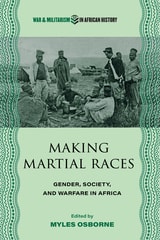
Making Martial Races
Gender, Society, and Warfare in AfricaMyles Osborne
Ohio University Press, 2024
Media, Technology, and Society
Theories of Media EvolutionW. Russell Neuman
University of Michigan Press, 2010
"This book is the perfect primer for understanding media in the digital age. We are in an era when newspaper, radio, and television are fast becoming archeological concepts. Herein are the reasons why."
---Nicholas Negroponte, founder and chairman of One Laptop per Child and cofounder of the MIT Media Laboratory
"Congratulations to Neuman and colleagues for a fascinating exploration of how previous new media were constructed, whether things could have been otherwise, and what can be learned for future media."
---Sonia Livingstone, Department of Media and Communications, the London School of Economics and Political Science
In Media, Technology, and Society, some of the most prominent figures in media studies explore the issue of media evolution. Focusing on a variety of compelling examples in media history, ranging from the telephone to the television, the radio to the Internet, these essays collectively address a series of notoriously vexing questions about the nature of technological change. Is it possible to make general claims about the conditions that enable or inhibit innovation? Does government regulation tend to protect or thwart incumbent interests? What kinds of concepts are needed to address the relationship between technology and society in a nonreductive and nondeterministic manner? To what extent can media history help us to understand and to influence the future of media in constructive ways? The contributors' historically grounded responses to these questions will be relevant to numerous fields, including history, media and communication studies, management, sociology, and information studies.
W. Russell Neuman is John Derby Evans Professor of Media Technology and Research Professor, Center for Political Studies, Institute for Social Research, at the University of Michigan.
DIGITALCULTUREBOOKS: a collaborative imprint of the University of Michigan Press and the University of Michigan Library
Melodramatic Formations
American Theatre and Society, 1820-1870Bruce A. Mcconachie
University of Iowa Press, 1992

Mexico's Merchant Elite, 1590-1660
Silver, State, and SocietyLouisa Schell Hoberman
Duke University Press, 1991
Through extensive archival research, Hoberman brings to light new data that illuminate the formation, behavior, and power of the merchant class in New Spain. She documents sources and uses of merchant wealth, tracing the relative importance of mining, agriculture, trade, and public office. By delving into biographical information on prominent families, Hoberman also reveals much about the longevity of the first generation’s social and economic achievements.
The author’s broad analysis situates her study in the overall environment in which the merchants thrived. Among the topics discussed are the mining and operation of the mint, Mexico’s political position vis-a-vis Spain, and the question of an economic depression in the seventeenth century.
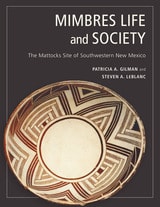
Mimbres Life and Society
The Mattocks Site of Southwestern New MexicoPatricia A. Gilman and Steven A. LeBlanc
University of Arizona Press, 2017
Mimbres pueblos, as early examples of people using surface room blocks, are ideal for investigating questions about how and why people moved from earlier subterranean pit structures to aboveground room blocks. The authors consider the number of households living at the site before and after the transition, as well as the lack of evidence for subsistence intensification and population growth as causes of this transition. These analyses suggest that each room block on the site housed a single family as opposed to multiple families, the more common interpretation. There were not necessarily more households on the site during the Classic period than earlier.
Patricia A. Gilman and Steven A. LeBlanc spent five seasons excavating at the Mattocks site and many more analyzing and writing about Mattocks site data. They note that subtle social differences among people were at play, and they emphasize that the Mattocks site may be unique among Mimbres pueblos in many aspects. Mimbres Life and Society reveals broad-ranging implications for southwestern archaeologists and anyone interested in understanding the ancient Southwest and early village societies.
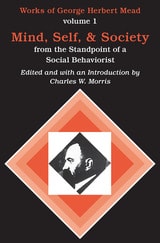
Mind, Self, and Society
From the Standpoint of a Social BehavioristGeorge Herbert Mead
University of Chicago Press, 1967
"If philosophical eminence be measured by the extent to which a man's writings anticipate the focal problems of a later day and contain a point of view which suggests persuasive solutions to many of them, then George Herbert Mead has justly earned the high praise bestowed upon him by Dewey and Whitehead as a 'seminal mind of the very first order.'"—Sidney Hook, The Nation
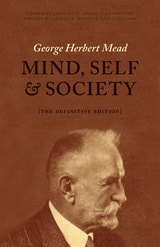
Mind, Self, and Society
The Definitive EditionGeorge Herbert Mead
University of Chicago Press, 2015
This collection gets to the heart of Mead’s meditations on social psychology and social philosophy. Its penetrating, conversational tone transports the reader directly into Mead’s classroom as he teases out the genesis of the self and the nature of the mind. The book captures his wry humor and shrewd reasoning, showing a man comfortable quoting Aristotle alongside Alice in Wonderland.
Included in this edition are an insightful foreword from leading Mead scholar Hans Joas, a revealing set of textual notes by Dan Huebner that detail the text’s origins, and a comprehensive bibliography of Mead’s other published writings. While Mead’s lectures inspired hundreds of students, much of his brilliance has been lost to time. This new edition ensures that Mead’s ideas will carry on, inspiring a new generation of thinkers.
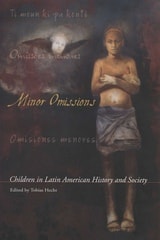
Minor Omissions
Children in Latin American History and SocietyEdited by Tobias Hecht
University of Wisconsin Press, 2002
Latin American history—the stuff of wars, elections, conquests, inventions, colonization, and all those other events and processes attributed to adults—has also been lived and partially forged by children. Taking a fresh look at Latin American and Caribbean society over the course of more than half a millennium, this book explores how the omission of children from the region's historiography may in fact be no small matter.
Children currently make up one-third of the population of Latin America and the Caribbean, and over the centuries they have worked, played, worshipped, committed crimes, and fought and suffered in wars. Regarded as more promising converts to the Christian faith than adults, children were vital in European efforts to invent loyal subjects during the colonial era. In the contemporary economies of Latin America and the Caribbean—where 23 percent of people live on a dollar per day or less—the labor of children may spell the difference between survival and starvation for millions of households.
Minor Omissions brings together scholars of history, anthropology, religion, and art history as well as a talented young author who has lived in the streets of a Brazilian city since the age of nine. The book closes with the prophetic dystopian tale "The Children's Rebellion" by the noted Uruguayan writer Cristina Peri Rossi.

Money and Society
A Critical CompanionAxel T. Paul
Pluto Press, 2021
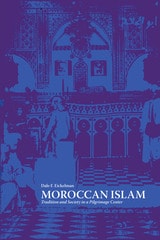
Moroccan Islam
Tradition and Society in a Pilgrimage CenterBy Dale F. Eickelman
University of Texas Press, 1976
This book is one of the first comprehensive studies of Islam as locally understood in the Middle East. Specifically, it is concerned with the prevalent North African belief that certain men, called marabouts, have a special relation to God that enables them to serve as intermediaries and to influence the well-being of their clients and kin. Dale F. Eickelman examines the Moroccan pilgrimage center of Boujad and unpublished Moroccan and French archival materials related to it to show how popular Islam has been modified by its adherents to accommodate new social and economic realities. In the course of his analysis he demonstrates the necessary interrelationship between social history and the anthropological study of symbolism.
Eickelman begins with an outline of the early development of Islam in Morocco, emphasizing the "maraboutic crisis" of the fourteenth through sixteenth centuries. He also examines the history and social characteristics of the Sherqawi religious lodge, on which the study focuses, in preprotectorate Morocco. In the central portion of the book, he analyzes the economic activities and social institutions of Boujad and its rural hinterland, as well as some basic assumptions the townspeople and tribesmen make about the social order. Finally, there is an intensive discussion of maraboutism as a phenomenon and the changing local character of Islam in Morocco.
In focusing on the "folk" level of Islam, rather than on "high culture" tradition, the author has made possible a more general interpretation of Moroccan society that is in contrast with earlier accounts that postulated a marked discontinuity between tribe and town, past and present.

Music, Disability, and Society
Authored by Alex Lubet
Temple University Press, 2010
Musical talent in Western culture is regarded as an extraordinary combination of technical proficiency and interpretative sensitivity. In Music, Disability, and Society, Alex Lubet challenges the rigid view of technical skill and writes about music in relation to disability studies. He addresses the ways in which people with disabilities are denied the opportunity to participate in music.
Elaborating on the theory of "social confluence," Lubet provides a variety of encounters between disability and music to observe radical transformations of identity. Considering hand-injured and one-handed pianists; the impairments of jazz luminaries Django Reinhardt, Horace Parlan, and "Little" Jimmy Scott; and the "Blind Orchestra" of Cairo, he shows how the cultural world of classical music contrasts sharply with that of jazz and how musicality itself is regarded a disability in some religious contexts. Music, Disability, and Society also explains how language difference can become a disability for Asian students in American schools of music, limiting their education and careers.
Lubet offers pungent criticism of the biases in music education and the music profession, going so far as to say that culture disables some performers by adhering to rigid notions of what a musician must look like, how music must be played, who may play it, and what (if any) is the legitimate place of music in society. In Music, Disability, and Society, he convincingly argues that where music is concerned, disability is a matter of culture, not physical impairment.
Musical Improvisation
Art, Education, and SocietyEdited by Gabriel Solis and Bruno Nettl
University of Illinois Press, 2008
Contributors are Stephen Blum, Patricia Shehan Campbell, Sabine M. Feisst, Lawrence Gushee, Robert S. Hatten, William Kinderman, Natalie Kononenko, Robert Levin, Charlotte Mattax Moersch, Ingrid Monson, John P. Murphy, Bruno Nettl, A. Jihad Racy, Anne K. Rasmussen, Stephen Slawek, Gabriel Solis, Nicholas Temperley, John Toenjes, and Thomas Turino.

Mythical Pasts, Elusive Futures
History and Society in an Anxious AgeFrank Furedi
Pluto Press, 1992