Results by title
141 books match the query 'Space Science' and 9 start with m
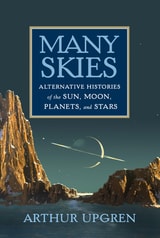
Many Skies
Alternative Histories of the Sun, Moon, Planets, and StarsUpgren, Arthur
Rutgers University Press, 2012
What if Earth had several moons or massive rings like Saturn? What if the Sun were but one star in a double-star or triple-star system? What if Earth were the only planet circling the Sun?
These and other imaginative scenarios are the subject of Arthur Upgren's inventive book Many Skies: Alternative Histories of the Sun, Moon, Planets, and Stars. Although the night sky as we know it seems eternal and inevitable, Upgren reminds us that, just as easily, it could have been very different.
Had the solar sytem happened to be in the midst of a star cluster, we might have many more bright stars in the sky. Yet had it been located beyond the edge of the Milky Way galaxy, we might have no stars at all. If Venus or Mars had a moon as large as ours, we would be able to view it easily with the unaided eye. Given these or other alternative skies, what might Ptolemy or Copernicus have concluded about the center of the solar sytem and the Sun?
This book not only examines the changes in science that these alternative solar, stellar, and galactic arrangements would have brought, it also explores the different theologies, astrologies, and methods of tracking time that would have developed to reflect them. Our perception of our surroundings, the number of gods we worship, the symbols we use in art and literature, even the way we form nations and empires are all closely tied to our particular (and accidental) placement in the universe.
Many Skies, however, is not merely a fanciful play on what might have been. Upgren also explores the actual ways that human interferences such as light pollution are changing the night sky. Our atmosphere, he warns, will appear very different if we have belt of debris circling the globe and blotting out the stars, as will happen if advertisers one day pollute space with brilliant satellites displaying their products.
From fanciful to foreboding, the scenarios in Many Skies will both delight and inspire reflection, reminding us that ours is but one of many worldviews based on our experience of a universe that is as much a product of accident as it is of intention.
[more]
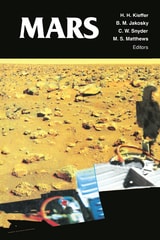
Mars
Edited by H. H. Kieffer, B. M. Jakosky, C. W. Snyder, and M. S. Matthews
University of Arizona Press, 1992
The planet Mars has been a subject of wonder for millennia, as attested by its place in mythology, by later speculation about its canals, and by the scientific and public excitement over the Viking mission. Although the scientific literature about the planet is voluminous, no comprehensive treatment of the results of modern spacecraft exploration has yet been made available. This volume fills that gap by providing a summary of what is presently known about Mars and identifying many puzzles such as polar cap variance, occurrence of dust storms, and the possible location of water. The introductory chapter cites questions, controversies, and milestones in the study of Mars, and also includes an annotated book list, basic data about the planet, and a guide to Martian seasons. A chapter on telescopic observation credits the contributions made by many amateurs that have advanced our knowledge of variations observed on Mars. A chapter on spacecraft exploration, by an American and a Russian author who have participated in all Mars missions, includes a revelation of an additional Soviet attempt. Twenty-nine technical articles cover geophysics; bedrock geology; surface; atmosphere; exosphere and magnetic field; and climate history. Two chapters address the search for life on Mars; three concluding chapters consider the Martian satellites. An indispensable reference for scientists, Mars will also serve as a complete sourcebook for serious amateur astronomers.
[more]
Mars
The Pristine Beauty of the Red PlanetAlfred S. McEwen, Candice Hansen-Koharcheck, and Ari Espinoza
University of Arizona Press, 2017
HiRISE is the most powerful camera ever sent to another planet, showing us Mars in astonishing detail. Featuring an outstanding and never-before-published collection of HiRISE high-resolution color images with explanatory captions in twenty-four languages, this book offers a unique volume produced from an active NASA mission.
Mars enthusiasts will appreciate these perfect snapshots of our current understanding of Mars, with soon-to-be classic pictures that have come to define our vision of the Red Planet. These images and their interpretations will be held as a yardstick for future exploration as we learn more about the surface and geologic processes of the fourth planet from the Sun.
With tantalizing and artistic glimpses at actively eroding slopes, impact craters, strange polar landscapes, avalanches, and even spectacular descent pictures of probes like the Phoenix Lander and the Mars Science Laboratory, we see what researchers are seeing.
Through vivid and beautiful images, this book underscores the need for such a camera on future orbiters, especially as more landing missions are planned. Mars: The Pristine Beauty of the Red Planet provides a stunning keepsake of one of humanity’s greatest accomplishments in space travel.
[more]
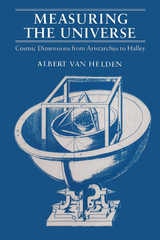
Measuring the Universe
Cosmic Dimensions from Aristarchus to HalleyAlbert Van Helden
University of Chicago Press, 1986
Measuring the Universe is the first history of the evolution of cosmic dimensions, from the work of Eratosthenes and Aristarchus in the third century B.C. to the efforts of Edmond Halley (1656—1742).
"Van Helden's authoritative treatment is concise and informative; he refers to numerous sources of information, draws on the discoveries of modern scholarship, and presents the first book-length treatment of this exceedingly important branch of science."—Edward Harrison, American Journal of Physics
"Van Helden writes well, with a flair for clear explanation. I warmly recommend this book."—Colin A. Ronan, Journal of the British Astronomical Association
[more]
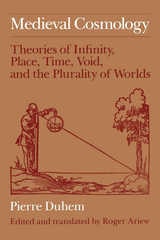
Medieval Cosmology
Theories of Infinity, Place, Time, Void, and the Plurality of WorldsPierre Duhem
University of Chicago Press, 1987
These selections from Le système du monde, the classic ten-volume history of the physical sciences written by the great French physicist Pierre Duhem (1861-1916), focus on cosmology, Duhem's greatest interest. By reconsidering the work of such Arab and Christian scholars as Averroes, Avicenna, Gregory of Rimini, Albert of Saxony, Nicole Oresme, Duns Scotus, and William of Occam, Duhem demonstrated the sophistication of medieval science and cosmology.
[more]
Mercury
Edited by Faith Vilas, Clark R. Chapman, and Mildred Shapley Matthews
University of Arizona Press, 1989
"At its best in synthesizing [current available] information to derive theories about the geological and tectonic histories of the planet ."—Science Books & Films
"This book is another in the excellent University of Arizona Space Science Series, each of which is based on a conference. . . .but goes far beyond a conference proceedings to present a comprehensive summary of current knowledge. . . .I recommend this book as a valuable compendium of current knowledge."—Pageoph
"This collection will be a most valuable addition to any research library."—Choice
[more]
Meteorites and the Early Solar System
John F. Kerridge
University of Arizona Press, 1988
First published in November 1988, this work provided a coherent narrative about the known understandings of meteorites and the early solar system.
From the original publication:
From the original publication:
Although the Earth was formed, together with the other planets, at the birth of the solar system, geological activity has since erased all but a hint of the processes that accompanied its formation. If we wish to explore the processes that occurred in the earliest solar system, and the nature of the environment in which they took place, we must turn to the record contained in more primitive material. Many meteorites appear to satisfy that criterion, and much effort has been applied in identifying those meteorites, or their constituents, that have retained a reliable record of the early solar system. This book provides a synthesis of what has been learned so far about the earliest stages of solar system history through the study of meteorites, and what, given our current level of understanding, remains to be learned.
Contents 1. Introduction 2. Source Regions 3. Secondary Processing 4. Irradiation Effects 5. Solar System Chronology 6. Chondrites and the Early Solar System 7. Elemental Composition of Chondrites 8. Magnetic Fields in the Early Solar System 9. Chondrules10. Primitive Material Surviving in chondrites11. Micrometeorites12. Inhomogencity of the Nebula13. Survival of Presolar Material in Meteorites14. Nucleosynthesis15. Nucleocosmochronology16. Summary
Contents 1. Introduction 2. Source Regions 3. Secondary Processing 4. Irradiation Effects 5. Solar System Chronology 6. Chondrites and the Early Solar System 7. Elemental Composition of Chondrites 8. Magnetic Fields in the Early Solar System 9. Chondrules10. Primitive Material Surviving in chondrites11. Micrometeorites12. Inhomogencity of the Nebula13. Survival of Presolar Material in Meteorites14. Nucleosynthesis15. Nucleocosmochronology16. Summary
[more]
Meteorites and the Early Solar System II
Edited by Dante S. Lauretta and Harry Y. McSween
University of Arizona Press, 2006
They range in size from microscopic particles to masses of many tons. The geologic diversity of asteroids and other rocky bodies of the solar system are displayed in the enormous variety of textures and mineralogies observed in meteorites. The composition, chemistry, and mineralogy of primitive meteorites collectively provide evidence for a wide variety of chemical and physical processes. This book synthesizes our current understanding of the early solar system, summarizing information about processes that occurred before its formation. It will be valuable as a textbook for graduate education in planetary science and as a reference for meteoriticists and researchers in allied fields worldwide.
[more]
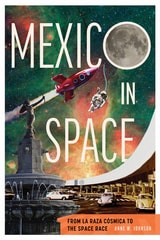
Mexico in Space
From la Raza Cósmica to the Space RaceAnne W. Johnson
University of Arizona Press, 2026
An insightful look at how Mexico's rich cosmic heritage and modern space-age aspirations intersect
From Aztec sun stones to satellite launches, from muralist visions to dark sky parks, Mexico’s engagement with outer space is fundamental to its identity. Mexico in Space offers a groundbreaking look at how the country has navigated the tensions between technological dependence and sovereign dreams.
Anthropologist Anne W. Johnson reveals Mexico’s unique relationship with outer space, describing Indigenous knowledge, nationalist projects, artistic visions, and community practices. Through rich ethnographic detail and historical insight, Johnson challenges the notion that space is for everyone and shows whose voices truly shape the world’s cosmic futures. Johnson introduces us to satellite engineers, community astronomers, space generation youth, and artists imagining Mars, each crafting alternative cosmic futures.
As space exploration increasingly becomes the domain of billionaires and superpowers, this book offers a compelling counternarrative, demonstrating how Mexican cosmic engagements suggest more just, inclusive ways of inhabiting Earth and beyond and providing vital lessons for reimagining humanity’s place in the cosmos.
[more]