Results by title
70 books match the query 'Spanish' and 3 start with m
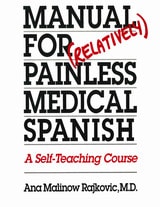
Manual for (Relatively) Painless Medical Spanish
A Self-Teaching CourseBy Ana Malinow Rajkovic
University of Texas Press, 1992
Spanish-speaking patients are no rarity in United States hospitals and clinics, as many English-speaking health care providers have discovered. To help these providers better communicate with the patients they serve, Ana Malinow Rajkovic has prepared the Manual for (Relatively) Painless Medical Spanish, a lively and innovative self-teaching guide to the grammar, pronunciation, and medical vocabulary of Spanish.
Presented in a systematic and highly entertaining fashion, twelve lessons cover some of the most commonly encountered situations. These include the family clinic, the emergency room, appendicitis, the social chat, pregnancy, family planning, pelvic inflammatory disease and urinary tract infection, depression, children with asthma, patients with angina, explaining a venipuncture and a spinal tap, and patients with shortness of breath. Each lesson closes with a bilingual interview that includes vocabulary and grammar introduced in that lesson. A guide to the medical history and physical examination appears in English and Spanish in the appendix.
Excellent in the classroom or for independent learning, the Manual will enable health care providers better to understand and supply the needs of Spanish-speaking patients.
Modality in Spanish and Combinations of Modal Meanings
Dana Kratochvílová
Karolinum Press, 2019
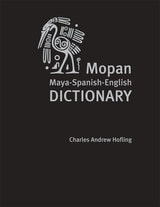
Mopan Maya-Spanish-English Dictionary
Charles A Hofling
University of Utah Press, 2011
Charles Andrew Hofling
Smithsonian-Utah Publications in American Indian Languages
Lyle Campbell and Ives Goddard
Linguistics
This is highly valuable dictionary of the Mopan (Mayan) language. In addition to its many entries, it also provides an introductory grammatical description, as well as general dictionary features such as parts of speech, examples, cross-references, variant forms, homophones, and indexes. The book also contains special sections on orthography and pronunciation unique to this important Mayan language, as well as translations into English and Spanish.
The dictionary has the merits well known from other dictionaries of indigenous languages of the Americas, preserving knowledge systems as they are encoded in vocabulary and providing valuable information for numerous fields, including Mayanists, Mesoamericanists, American Indian scholars, anthropologists, historians, linguists, students of Mayan hieroglyphic writing, and members of modern Mayan communities, among others.
This is the second book in the new Smithsonian-Utah Publications in American Indian Languages (SUPAIL) series, a joint venture of the University of Utah Press and the Smithsonian Institution.