112 books match the query 'Spirituality' and 7 start with m
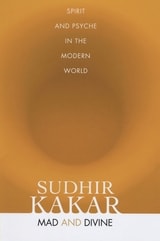
cover of Mad and Divine: Spirit and Psyche in the Modern World

Mad and Divine

Spirit and Psyche in the Modern World

Sudhir Kakar

University of Chicago Press, 2009

Sudhir Kakar, India’s foremost practitioner of psychoanalysis, has focused his career on infusing this preeminently Western discipline with ideas and views from the East. In Mad and Divine, he takes on the separation of the spirit and the body favored by psychoanalysts, cautioning that a single-minded focus on the physical denies a person’s wholeness. Similarly, Kakar argues, to focus on the spirit alone is to hold in contempt the body that makes us human.

Mad and Divine looks at the interplay between spirit and psyche and the moments of creativity and transformation that occur when the spirit overcomes desire and narcissism. Kakar examines this relationship in religious rituals and healing traditions— both Eastern and Western—as well as in the lives of some extraordinary men: the mystic and guru Rajneesh, Gandhi, and the Buddhist saint Drukpa Kunley.

Enriched with a novelist’s felicity of language and an analyst’s piercing insights and startling interpretations, Mad and Divine is a valuable addition to the literature on the integration of the spirit and psyche in the evolving psychology of the individual.
[more]
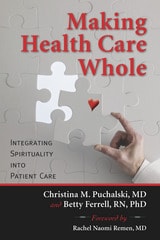
cover of Making Health Care Whole: Integrating Spirituality into Patient Care

Making Health Care Whole

Integrating Spirituality into Patient Care

Christina Puchalski

Templeton Press, 2021

In the last fifteen years, the field of palliative care has experienced a surge in interest in spirituality as an important aspect of caring for seriously ill and dying patients. While spirituality has been generally recognized as an essential dimension of palliative care, uniformity of spiritual care practice has been lacking across health care settings due to factors like varying understandings and definitions of spirituality, lack of resources and practical tools, and limited professional education and training in spiritual care.
In order to address these shortcomings, more than forty spiritual and palliative care experts gathered for a national conference to discuss guidelines for incorporating spirituality into palliative care. Their consensus findings form the basis of Making Health Care Whole. This important new resource provides much-needed definitions and charts a common language for addressing spiritual care across the disciplines of medicine, nursing, social work, chaplaincy, psychology, and other groups. It presents models of spiritual care that are broad and inclusive, and provides tools for screening, assessment, care planning, and interventions. This book also advocates a team approach to spiritual care, and specifies the roles of each professional on the team.
 
Serving as both a scholarly review of the field as well as a practical resource with specific recommendations to improve spiritual care in clinical practice, Making Health Care Whole will benefit hospices and palliative care programs in hospitals, home care services, and long-term care services. It will also be a valuable addition to the curriculum at seminaries, schools of theology, and medical and nursing schools.
[more]
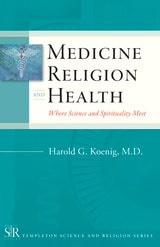
cover of Medicine, Religion, and Health: Where Science and Spirituality Meet

Medicine, Religion, and Health

Where Science and Spirituality Meet

Harold G Koenig

Templeton Press, 2008

Medicine, Religion, and Health: Where Science and Spirituality Meet will be the first title published in the new Templeton Science and Religion Series, in which scientists from a wide range of fields distill their experience and knowledge into brief tours of their respective specialties. In this, the series' maiden volume, Dr. Harold G. Koenig, provides an overview of the relationship between health care and religion that manages to be comprehensive yet concise, factual yet inspirational, and technical yet easily accessible to nonspecialists and general readers.
Focusing on the scientific basis for integrating spirituality into medicine, Koenig carefully summarizes major trends, controversies, and the latest research from various disciplines and provides plausible and compelling theoretical explanations for what has thus far emerged in this relatively young field of study. Medicine, Religion, and Health begins by defining the principal terms and then moves on to a brief history of religion's role in medicine before delving into the current state of research. Koenig devotes several chapters to exploring the outcomes of specific studies in fields such as mental health, cardiovascular disease, and mortality. The book concludes with a review of the clinical applications derived from the research. Koenig also supplies several detailed appendices to aid readers of all levels looking for further information.
 
Medicine, Religion, and Health will shed new light on critical contemporary issues. They will whet readers' appetites for more information on this fascinating, complex, and controversial area of research, clinical activity, and widespread discussion. It will find a welcome home on the bookshelves of students, researchers, clinicians, and other health professionals in a variety of disciplines.
[more]
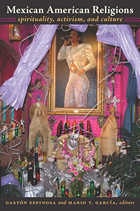
cover of Mexican American Religions: Spirituality, Activism, and Culture

Mexican American Religions

Spirituality, Activism, and Culture

Gastón Espinosa and Mario T. García, eds.

Duke University Press, 2008

This collection presents a rich, multidisciplinary inquiry into the role of religion in the Mexican American community. Breaking new ground by analyzing the influence of religion on Mexican American literature, art, activism, and popular culture, it makes the case for the establishment of Mexican American religious studies as a distinct, recognized field of scholarly inquiry. Scholars of religion, Latin American, and Chicano/a studies as well as of sociology, anthropology, and literary and performance studies, address several broad themes. Taking on questions of history and interpretation, they examine the origins of Mexican American religious studies and Mario Barrera’s theory of internal colonialism. In discussions of the utopian community founded by the preacher and activist Reies López Tijerina, César Chávez’s faith-based activism, and the Los Angeles-based Católicos Por La Raza movement of the late 1960s, other contributors focus on mystics and prophets. Still others illuminate popular Catholicism by looking at Our Lady of Guadalupe, home altars, and Los Pastores dramas (nativity plays) as vehicles for personal, social, and political empowerment.

Turning to literature, contributors consider Gloria Anzaldúa’s view of the borderlands as a mystic vision and the ways that Chicana writers invoke religious symbols and rhetoric to articulate a moral vision highlighting social injustice. They investigate the role of healing, looking at it in relation to both the Latino Pentecostal movement and the practice of the curanderismo tradition in East Los Angeles. Delving into to popular culture, they reflect on Luis Valdez’s video drama La Pastorela: “The Shepherds’ Play,” the spirituality of Chicana art, and the religious overtones of the reverence for the slain Tejana music star Selena. This volume signals the vibrancy and diversity of the practices, arts, traditions, and spiritualities that reflect and inform Mexican American religion.

Contributors: Rudy V. Busto, Davíd Carrasco, Socorro Castañeda-Liles, Gastón Espinosa, Richard R. Flores, Mario T. García, María Herrera-Sobek, Luís D. León, Ellen McCracken, Stephen R. Lloyd-Moffett, Laura E. Pérez, Roberto Lint Saragena, Anthony M. Stevens-Arroyo, Kay Turner
[more]
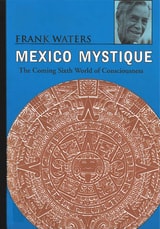
cover of Mexico Mystique: The Coming Sixth World of Consciousness

Mexico Mystique

The Coming Sixth World of Consciousness

Frank Waters

Ohio University Press, 1989

In Mexico Mystique Frank Waters draws us deeply into the ancient but still-living myths of Mexico. To reveal their hidden meanings and their powerful symbolism, he brings to bear his gift for intuitive imagination as well as a broad knowledge of anthropology, Jungian psychology, astrology, and Eastern and esoteric religions. He offers a startling interpretation of the Mayan Great Cycle — our present Fifth World — whose beginning has been projected to 3113 B.C., and whose cataclysmic end has been predicted by 2011 A.D.
[more]
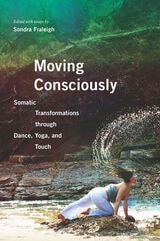
cover of Moving Consciously: Somatic Transformations through Dance, Yoga, and Touch

Moving Consciously

Somatic Transformations through Dance, Yoga, and Touch

Edited by Sondra Fraleigh

University of Illinois Press, 2015

The popularity of yoga and Zen meditation has heightened awareness of somatic practices. Individuals develop the conscious embodiment central to somatics work via movement and dance, or through touch from a skilled teacher or therapist often called a somatic bodyworker. Methods of touch and movement foster generative processes of consciousness in order to create a fluid interconnection between sensation, thought, movement, and expression. In Moving Consciously , Sondra Fraleigh gathers essays that probe ideas surrounding embodied knowledge and the conscious embodiment of movement and dance. Using a variety of perspectives on movement and dance somatics, Fraleigh and other contributors draw on scholarship and personal practice to participate in a multifaceted investigation of a thriving worldwide phenomenon. Their goal: to present the mental and physical health benefits of experiencing one's inner world through sensory awareness and movement integration. A stimulating addition to a burgeoning field, Moving Consciously incorporates concepts from East and West into a timely look at life-changing, intertwined practices that involve dance, movement, performance studies, and education. Contributors: Richard Biehl, Robert Bingham, Hillel Braude, Alison East, Sondra Fraleigh, Kelly Ferris Lester, Karin Rugman, Catherine Schaeffer, Jeanne Schul, and Ruth Way.
[more]
cover of Myriad Intimacies

Myriad Intimacies

Lata Mani

Duke University Press, 2022

In Myriad Intimacies postcolonial theorist, spiritual practitioner, and filmmaker Lata Mani oscillates between text and video, poetry and prose, genre and form, register and voice, and secular and sacred to offer a transmedia exploration of the interrelatedness of lives, concepts, frameworks, and aspects of self. She draws on concepts from tantra—a philosophy that celebrates matter as alive, embodiment as sacred, and the senses as a form of intelligence—alongside feminist, critical race, and cultural theory to meditate on the ways in which everyone and everything exists in mutually constitutive interrelations. Addressing issues ranging from desire, the body, nature, and love, to otherness, identity politics, social justice, #MeToo, and the COVID-19 pandemic, Mani foregrounds the power and necessity of recognizing relationality as foundational. Throughout, she offers a way of reframing what we think we know and how we come to know it, demonstrating that it is only by acknowledging and embracing the indivisible and interdependent nature of existence that we restore our true intimacy with each other and the world.
[more]