Results by title
828 books match the query 'Study and teaching' and 30 start with m
Machine Scoring of Student Essays
Truth and Consequencesedited by Patricia Freitag Ericsson & Rich Haswell
Utah State University Press, 2006
The current trend toward machine-scoring of student work, Ericsson and Haswell argue, has created an emerging issue with implications for higher education across the disciplines, but with particular importance for those in English departments and in administration. The academic community has been silent on the issue—some would say excluded from it—while the commercial entities who develop essay-scoring software have been very active.
Machine Scoring of Student Essays is the first volume to seriously consider the educational mechanisms and consequences of this trend, and it offers important discussions from some of the leading scholars in writing assessment.
Reading and evaluating student writing is a time-consuming process, yet it is a vital part of both student placement and coursework at post-secondary institutions. In recent years, commercial computer-evaluation programs have been developed to score student essays in both of these contexts. Two-year colleges have been especially drawn to these programs, but four-year institutions are moving to them as well, because of the cost-savings they promise. Unfortunately, to a large extent, the programs have been written, and institutions are installing them, without attention to their instructional validity or adequacy.
Since the education software companies are moving so rapidly into what they perceive as a promising new market, a wider discussion of machine-scoring is vital if scholars hope to influence development and/or implementation of the programs being created. What is needed, then, is a critical resource to help teachers and administrators evaluate programs they might be considering, and to more fully envision the instructional consequences of adopting them. And this is the resource that Ericsson and Haswell are providing here.

Maimonides' Empire of Light
Popular Enlightenment in an Age of BeliefRalph Lerner
University of Chicago Press, 2000
Lerner describes the brilliant and sometimes wily ways in which Maimonides sought to break through the despair and superstition that gripped the Jewish people's minds, without sacrificing the dignity and core of his message. These writings—presented here in uncommonly accurate, mostly new translations—also reveal that Maimonides was willing to risk the scorn of his contemporaries to enlighten both his own and future generations. By addressing the writings of Maimonides' disciples, including Shem Tov ben Joseph Ibn Falaquera in the mid-thirteenth century and Joseph Albo in the fifteenth century, Lerner shows how this technique was passed on.
In striking contrast to the Enlightenment of the eighteenth century, Maimonides' enlightenment is premised on the inequality of understandings and other differences between the elite and the common people. Instead of scorning the past, Lerner shows, Maimonides' enlightenment invests it with a new and ennobling dignity. A valuable reference for students of political philosophy and Jewish studies, Lerner's elegantly written book also brings to life the richness and relevance of medieval Jewish thought for all those interested in the Jewish tradition.
Making Mark Twain Work in the Classroom
James S. Leonard, ed.
Duke University Press, 1999
The essays in Making Mark Twain Work in the Classroom reaffirm the importance of Twain in the American literature curriculum from high school through graduate study. Addressing slavery and race, gender, class, religion, language and ebonics, Americanism, and textual issues of interest to instructors and their students, the contributors offer guidance derived from their own demographically diverse classroom experiences. Although some essays focus on such works as A Connecticut Yankee in King Arthur’s Court and The Innocents Abroad, most discuss the hotly debated Adventures of Huckleberry Finn, viewed alternately in this volume as a comic masterpiece or as evidence of Twain’s growing pessimism—but always as an effective teaching tool.
By placing Twain’s work within the context of nineteenth-century American literature and culture, Making Mark Twain Work in the Classroom will interest all instructors of American literature. It will also provoke debate among Americanists and those concerned with issues of race, class, and gender as they are represented in literature.
Contributors. Joseph A. Alvarez, Lawrence I. Berkove, Anthony J. Berret, S.J., Wesley Britton, Louis J. Budd, James E. Caron, Everett Carter, Jocelyn Chadwick-Joshua, Pascal Covici Jr., Beverly R. David, Victor Doyno, Dennis W. Eddings, Shelley Fisher Fishkin, S. D. Kapoor, Michael J. Kiskis, James S. Leonard, Victoria Thorpe Miller, Stan Poole, Tom Reigstad, David E. E. Sloane, David Tomlinson
Manifesto for the Humanities
Transforming Doctoral Education in Good Enough TimesSidonie Smith
University of Michigan Press, 2015
Grounding this manifesto in background factors contributing to current “crises” in the humanities, Smith advocates for a 21st century doctoral education responsive to the changing ecology of humanistic scholarship and teaching. She elaborates a more expansive conceptualization of coursework and dissertation, a more robust, engaged public humanities, and a more diverse, collaborative, and networked sociality.
Manly Writing
Gender, Rhetoric and the Rise of CompostionMiriam Brody
Southern Illinois University Press, 1993
In this critical history of the gendered politics of rhetoric and the rise of composition, Miriam Brody argues that nothing about words or their arrangement is innately gendered. Yet since the English Enlightenment, teachers have encouraged their students to admire and imitate "manly" writing, writing that is plain, forceful, cogent, and true. Similarly, students have been enjoined to avoid so-called effeminate or feminine writing—writing characterized as vague, unorganized, ornate, and deceitful.
Such advice, part of what Brody terms the hidden curriculum, has served the interests of discourse communities as various as the early Enlightenment Royal Society in seventeenth-century London (by urging a clear and masculine style for the work of science) and the land-grant universities of nineteenth-century America (by claiming that the work of writing was similar to clearing the land and pushing back the frontier). Brody’s discussion in fact becomes a social history of canonical rhetorical essays and important late Enlightenment, nineteenth-century, and early modern school texts. She points out that in their advice to writers even the Strunks and Whites and Peter Elbows of more recent times have extolled masculine virtues and urged control over invasive and problematic feminine qualities.
Brody’s book not only clarifies rhetoric’s inheritance and transformation of the classical ideal of manliness, it also is the first critical work to explore the ideological significance of gendered imagery and to interpret in light of this imagery rhetorical essays and hard-to-locate early composition texts against a background of previously unpublished archival materials.

Map is not Territory
Studies in the History of ReligionsJonathan Z. Smith
University of Chicago Press, 1992
Mapping Wisconsin History
Teacher's Guide and Student MaterialsWisconsin Historical Society Press, 2000
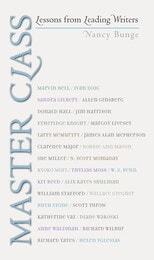
Master Class
Lessons from Leading WritersNancy Bunge
University of Iowa Press, 2005
Master Class: Lessons from Leading Writers gathers more than two decades of wisdom from twenty-nine accomplished authors. It offers previously unpublished interviews along with freshly edited versions of ten interviews from Nancy Bunge's well-received previous collection, Finding the Words. The first section, Theory, incorporates interviews which document the golden age of writing programs in which authors with a strong sense of social and cultural responsibility taught as seriously as they wrote. These conversations delve into the writers' philosophies and teaching methods. The second section, Practice, presents interviews with authors who discuss how they've approached the writing of particular works. Altogether the interviews introduce authors as inspirational models and provide insightful techniques for other writers to try. One piece of advice recurs with striking consistency: to produce fresh, interesting work, aspiring writers must develop a passionate self-trust. This rule has an essential corollary: improving as a writer means constantly stretching oneself with new information and skills. Sure to interest writing and literature teachers as well as writers at every stage of development, Master Class is highly recommended for undergraduate and graduate writing courses.
Interviews with Marvin Bell, Ivan Doig, Sandra Gilbert, Allen Ginsberg, Donald Hall, Jim Harrison, Etheridge Knight, Margot Livesey, Larry McMurtry, James Alan McPherson, Clarence Major, Bobbie Ann Mason, Sue Miller, N. Scott Momaday, Kyoko Mori, Thylias Moss, W. S. Penn, Kit Reed, Alix Kates Shulman, William Stafford, Wallace Stegner, Ruth Stone, Scott Turow, Katherine Vaz, Diane Wakoski, Anne Waldman, Richard Wilbur, Richard Yates, and Helen Yglesias.

Master Teachers of Theatre
Observations on Teaching Theatre by Nine American MastersEdited by Burnet M. Hobgood
Southern Illinois University Press, 1988
Claribel Baird reviews the interpretation of classical texts for theatrical performance. Howard Bay interrupted his stage design career of more than 150 Broadway productions to help students. BernardBeckerman asks if there are approaches to the teaching of dramatic literature that particularly suit drama-as-theatre. Robert Benedetti offers suggestions on the teaching of acting. OscarBrockett treats the problems of the theatre teacher and the processes of learning.
AgnesHaaga shows that the essential quality in heading up child drama programs is a sense of joyous delight. Wallace Smith discusses methods for teaching secondary schooltheatre. Jewel Walker offers a rare written statement about his work as a theatre teacher. Carl Weber conveys the principles and methodology of his mentor, Bertolt Brecht, to beginning directors.
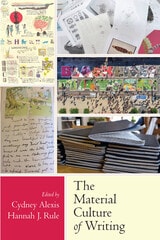
Material Culture of Writing
edited by Cydney Alexis and Hannah J. Rule
University Press of Colorado, 2022
The collection features scholars across the disciplines—such as art, art history, English, museum studies, and writing studies—who work as teachers, historians, museum curators/conservators, and faculty. Each chapter features methods and questions from contributors’ own disciplines while at the same time speaking to writing studies’ interest in writers, writing identity, and writing practice. The authors in this volume also work with a variety of methodologies, including literary analysis, archival research, and qualitative research, providing models for the types of research possible using a material culture studies framework. The collection is organized into three sections—Writing Identity, Writing Work, Writing Genre—each with a contextualizing introduction from the editors that introduces the chapters themselves and imagines possible directions for writing studies research facilitated by material culture studies.
The Material Culture of Writing serves as an accessible introduction to work in material culture studies for writing studies scholars, graduate students, and undergraduates, especially as it makes a distinctive contribution to writing studies in its material culture studies approach. Because of the interdisciplinarity of material culture studies and this volume’s contributors, this collection will appeal to a wide range of scholars and readers, including those interested in writing studies, the history of the book, print culture, genre studies, archival methods, and authorship studies.
Contributors: Cydney Alexis, Debby Andrews, Diane Ehrenpreis, Keri Epps, Desirée Henderson, Kevin James, Jenny Krichevsky, Anne Mackay, Emilie Merrigan, Laura R. Micciche, Hannah J. Rule, Kate Smith
Meaningful Writing Project
Learning, Teaching and Writing in Higher EducationMichele Eodice
Utah State University Press, 2017
In the face of the continuing discourse of crisis in US education, The Meaningful Writing Project offers readers an affirming story of writing in higher education that shares students’ experiences in their own voices. In presenting the results of a three-year study consisting of surveys and interviews of university seniors and their faculty across three diverse institutions, authors Michele Eodice, Anne Ellen Geller, and Neal Lerner consider students’ perceptions of their meaningful writing experiences, the qualities of those experiences, and instructors’ perspectives on assignment design and delivery.
This study confirms that meaningful assignments offer students opportunities to engage with instructors, peers, and texts and are relevant to past experiences and passions as well as to future aspirations and identities. Meaningful writing occurs across majors, in both required and elective courses, and beyond students’ years at college. Additionally, the study makes clear that faculty across the curriculum devote significant care and attention to creating writing assignments that support student learning, as they understand writing performance to be a developmental process connected to overall cognitive and social development, student engagement with learning, and success in a wide variety of disciplines and professions.
The Meaningful Writing Project provides writing center directors, WPAs, other composition scholars, and all faculty interested in teaching and learning with writing an unprecedented look into the writing projects students find meaningful.
Media Literacy for Justice
Lessons for Changing the WorldBelinha S. De Abreu
American Library Association, 2022
Foreword by Yohuru Williams, Racial Justice Initiative, Dean of the College of Arts and Sciences. St. Thomas University, Minneapolis; Preface by Asha Rangappa, former FBI agent and Senior Lecturer, Yale University’s Jackson Institute for Global Affairs
Providing context, reflection points, and ready-to-use lesson plans, this powerful book illuminates the intersections of social justice and media literacy for educators, school and public librarians, teachers of history and civics, information literacy instructors, and community leaders.The corrosive effects of today’s relentless tide of media are pernicious. We are conditioned in many ways by our media environments to accept and not question, making it crucial that young people master the skills necessary to access, analyze, evaluate, and create media. De Abreu and her fellow contributors propose that a key solution to our society’s crisis of misinformation, misrepresentation, and misunderstanding lies in melding social justice aims with media literacy concepts and skills. Featuring reflective activities and lesson ideas that can be adapted for educational settings from higher education to the K-12 spectrum, community centers, and libraries, this resource
- spotlights the work of school library media specialists, classroom teachers, academic educators, and representatives of non-profits from around the world;
- presents ten chapters which explore such timely issues as how to deal with controversial topics in the classroom, the effects of misinformation/disinformation on civics in society, why the media underrepresents certain people in their programming, the digital divide and where libraries fit in, how injustice exacerbates public health issues, and global conceptions of social justice and media literacy examined through various world events; and
- provides information about additional resources like social action/advocacy organizations, classroom resources, and films that will assist readers as they reflect upon, teach, and discuss media literacy and social justice.
Medical Anthropology at the Intersections
Histories, Activisms, and FuturesMarcia C. Inhorn and Emily A. Wentzell, eds.
Duke University Press, 2012
Contributors. Lawrence Cohen, Didier Fassin, Faye Ginsburg, Marcia C. Inhorn, Arthur Kleinman, Margaret Lock, Emily Martin, Lynn M. Morgan, Richard Parker, Rayna Rapp, Merrill Singer, Emily A. Wentzell
Medieval Identity Machines
Jeffrey J. Cohen
University of Minnesota Press, 2003
A provocative new approach to medieval culture
In Medieval Identity Machines, Jeffrey J. Cohen examines the messiness, permeability, and perversity of medieval bodies, arguing that human identity always exceeds the limits of the flesh. Combining critical theory with a rigorous reading of medieval texts, Cohen asks if the category “human” isn’t too small to contain the multiplicity of identities. As such, this book is the first to argue for a “posthuman” Middle Ages and to make extensive use of the philosophical writings of Gilles Deleuze to rethink the medieval.
Among the topics that Cohen covers are the passionate bond between men and horses in chivalric training; the interrelation of demons, celibacy, and colonialism in an Anglo-Saxon saint’s life; Lancelot’s masochism as envisioned by Chrétien de Troyes; the voice of thunder echoing from Margery Kempe; and the fantasies that sustained some dominant conceptions of race. This tour of identity—in all its fragility and diffusion—illustrates the centrality of the Middle Ages to theory as it enhances our understanding of self, embodiment, and temporality in the medieval world.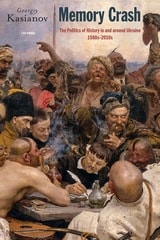
Memory Crash
Politics of History in and around Ukraine, 1980s–2010sGeorgiy Kasianov
Central European University Press, 2022
This account of historical politics in Ukraine, framed in a broader European context, shows how social, political, and cultural groups have used and misused the past from the final years of the Soviet Union to 2020. Georgiy Kasianov details practices relating to history and memory by a variety of actors, including state institutions, non-governmental organizations, political parties, historians, and local governments. He identifies the main political purposes of these practices in the construction of nation and identity, struggles for power, warfare, and international relations.
Kasianov considers the Ukrainian case in the context of a global increase in the politics of history and memory, with particular emphasis on a distinctive East-European variety. He pays special attention to the use and abuse of history in relations between Ukraine, Russia, and Poland.
Messy Beginnings
Postcoloniality and Early American StudiesEdited by Malini Johar Schueller and Edward Watts
Rutgers University Press, 2003
When exploring the links between America and postcolonialism, scholars tend to think either in terms of contemporary multiculturalism, or of imperialism since 1898. This narrow view has left more than the two prior centuries of colonizing literary and political culture unexamined.
Messy Beginnings challenges the idea of early America’s immunity from issues of imperialism, that its history is not as “clean” as European colonialism. By addressing the literature ranging from the diaries of American women missionaries in the Middle East to the work of Benjamin Franklin and Nathaniel Hawthorne, and through appraisals of key postcolonial theorists such as Edward Said, Gayatri Spivak, and Homi Bhabha, the contributors to this volume explore the applicability of their models to early American culture.
Messy Beginnings argues against the simple concept that the colonization of what became the United States was a confrontation between European culture and the “other.” Contributors examine the formation of America through the messy or unstable negotiations of the idea of “nation.”
The essays forcefully show that the development of “Americanness” was a raced and classed phenomenon, achieved through a complex series of violent encounters, legal maneuvers, and political compromises. The complexity of early American colonization, where there was not one coherent “nation” to conquer, contradicts the simple label of imperialism used in other lands. The unique approach of Messy Beginnings will reshape both pre-conceived notions of postcolonialism, and how postcolonialists think about the development of the American nation.
Metabolizing Capital
Writing, Information, and the Biophysical EnvironmentChristian J. Pulver
Utah State University Press, 2020
The rise of the global cloud and the internet-of-things have ushered in a new stage of the internet that marks a transition from the celebrated user-generated content of Web 2.0 to the data-driven networks of Web 3.0. As social media networks have expanded, so has the amount of writing and communication we do online. This has created several valuable sub-layers of data and metadata about consumer-citizens that corporations and governments now routinely collect, store, and monetize. This frenzy to collect more data is contributing to several problematic social and environmental concerns as flows of information and capital dangerously accelerate how energy and matter move through ecosystems at every scale.
This book explores the planetary consequences of Web 3.0 and the vital role that writing and data production play in accelerating capital circulation, from concerns raised by the growing energy demands of the information industries, to growing streams of electronic waste, to the growing socioeconomic tensions arising as a result of information monopolies.
A posthuman, Marxist analysis of digital culture and writing, Metabolizing Capital contributes to and challenges current understandings of rhetorical agency and actor networks. Combining scholarship from writing studies, rhetoric, and composition with research in metabolic ecology, information theory, media studies, cognitive psychology, history, and new materialism, this book should be of interest to scholars in writing studies as well as others who study digital culture, ecological literacies, the history of writing and information, big data, and environmental concerns related to electronics and the information industries.
Metaliteracy
Reinventing Information Literacy to Empower LearnersThomas P. Mackey
American Library Association, 2014
Michigan Salvage
The Fiction of Bonnie Jo CampbellLisa DuRose
Michigan State University Press, 2023
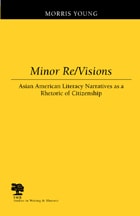
Minor Re/Visions
Asian American Literacy Narratives as a Rhetoric of CitizenshipMorris Young
Southern Illinois University Press, 2004
Through a blend of personal narrative, cultural and literary analysis, and discussions about teaching, Minor Re/Visions: Asian American Literacy Narratives as a Rhetoric of Citizenship shows how people of color use reading and writing to develop and articulate notions of citizenship. Morris Young begins with a narration of his own literacy experiences to illustrate the complicated relationship among literacy, race, and citizenship and to reveal the tensions that exist between competing beliefs and uses of literacy among those who are part of dominant American culture and those who are positioned as minorities.
Influenced by the literacy narratives of other writers of color, Young theorizes an Asian American rhetoric by examining the rhetorical construction of American citizenship in works such as Richard Rodriguez’s Hunger of Memory, Victor Villanueva’s Bootstraps: From an American Academic of Color, Carlos Bulosan’s America Is in the Heart, and Maxine Hong Kingston’s “Song for a Barbarian Reed Pipe” from Woman Warrior. These narratives, Young shows, tell stories of transformation through education, the acquisition of literacy, and cultural assimilation and resistance. They also offer an important revision to the American story by inserting the minor and creating a tension amid dominant discourses about literacy, race, and citizenship. Through a consideration of the literacy narratives of Hawai`i, Young also provides a context for reading literacy narratives as responses to racism, linguistic discrimination, and attempts at “othering” in a particular region.
As we are faced with dominant discourses that construct race and citizenship in problematic ways and as official institutions become even more powerful and prevalent in silencing minor voices, Minor Re/Visions reveals the critical need for revising minority and dominant discourses. Young’s observations and conclusions have important implications for the ways rhetoricians and compositionists read, teach, and assign literacy narratives.
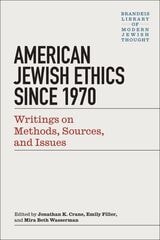
Modern Jewish Ethics since 1970
Writings on Methods, Sources, and IssuesEdited by Jonathan K. Crane, Emily A. Filler, and Mira Beth Wasserman
Brandeis University Press, 2025
These deliberate juxtapositions are to encourage scholars and students to develop similar meta-ethical analyses on Jewish ethics, broadly construed. Jewish ethics is not just a set of propositions or principles; nor can it be reduced to a single trajectory of thought or abstracted as an elaborate system of ideas. Jewish ethics is the field of study that engages Jewish texts, ideas, history, and experience in conversations about values and virtues, justice and good judgment, human relations and responsibilities. This volume presents some of those conversations to spark many more.
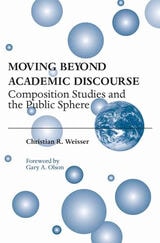
Moving Beyond Academic Discourse
Composition Studies and the Public SphereChristian R. Weisser. Foreword by Gary A. Olson
Southern Illinois University Press, 2002
Moving student writing beyond academic discourse and into larger public spheres is a difficult task, but Christian R. Weisser’s study challenges composition instructors to do just that. This highly accessible book does what no other study has attempted to do: place the most current, cutting-edge theories and pedagogies in rhetoric and composition in their intellectual and historical contexts, while at the same time offering a unique, practical theory and pedagogy of public writing for use both inside and outside of the classroom.
By positing a theory of the public for composition studies, one which envisions the public sphere as a highly contested, historically textured, multilayered, and sometimes contradictory site, Weisser offers a new approach to the roles that compositionists might assume in their attempts to initiate progressive political and social change.
After first providing a historical context that situates composition’s recent interest in public writing, Weisser next examines recent theories in composition studies that consider writing an act of social engagement before outlining a more complex theory of the public based on the work of Jürgen Habermas. The resulting re-envisioning of the public sphere expands current conversations in rhetoric and composition concerning the public.
Weisser concludes with a holistic vision that places greater political and social import on addressing public issues and conversations in the composition classroom and that elucidates the role of the public intellectual as it relates specifically to compositionists in postmodern society.
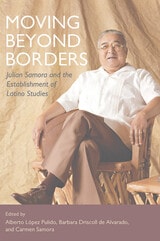
Moving Beyond Borders
Julian Samora and the Establishment of Latino StudiesEdited by Alberto Lopez Pulido, Barbara Driscoll de Alvarado, and Carmen Samora
University of Illinois Press, 2008
Moving Beyond Borders examines the life and accomplishments of Julian Samora, the first Mexican American sociologist in the United States and the founding father of the discipline of Latino studies. Detailing his distinguished career at the University of Notre Dame from 1959 to 1984, the book documents the history of the Mexican American Graduate Studies program that Samora established at Notre Dame and traces his influence on the evolution of border studies, Chicano studies, and Mexican American studies.
Samora's groundbreaking ideas opened the way for Latinos to understand and study themselves intellectually and politically, to analyze the complex relationships between Mexicans and Mexican Americans, to study Mexican immigration, and to ready the United States for the reality of Latinos as the fastest growing minority in the nation. In addition to his scholarly and pedagogical impact, his leadership in the struggle for civil rights was a testament to the power of community action and perseverance. Focusing on Samora's teaching, mentoring, research, and institution-building strategies, Moving Beyond Borders explores the legacies, challenges, and future of ethnic studies in United States higher education.
Contributors are Teresita E. Aguilar, Jorge A. Bustamante, Gilberto Cárdenas, Miguel A. Carranza, Frank M. Castillo, Anthony J. Cortese, Lydia Espinosa Crafton, Barbara Driscoll de Alvarado, Herman Gallegos, Phillip Gallegos, José R. Hinojosa, Delfina Landeros, Paul López, Sergio X. Madrigal, Ken Martínez, Vilma Martínez, Alberto Mata, Amelia M. Muñoz, Richard A. Navarro, Jesus "Chuy" Negrete, Alberto López Pulido, Julie Leininger Pycior, Olga Villa Parra, Ricardo Parra, Victor Rios, Marcos Ronquillo, Rene Rosenbaum, Carmen Samora, Rudy Sandoval, Alfredo Rodriguez Santos, and Ciro Sepulveda.
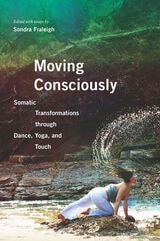
Moving Consciously
Somatic Transformations through Dance, Yoga, and TouchEdited by Sondra Fraleigh
University of Illinois Press, 2015

Mu, 49 Marks of Abolition
Sora Y. Han
Duke University Press, 2024
Multilingual Writers and Writing Centers
Ben Rafoth
Utah State University Press, 2015
Multilingual writers—often graduate students with more content knowledge and broader cultural experience than a monolingual tuto—unbalance the typical tutor/client relationship and pose a unique challenge for the writing center. Multilingual Writers and Writing Centers explores how directors and tutors can better prepare for the growing number of one-to-one conferences with these multilingual writers they will increasingly encounter in the future.
This much-needed addition of second language acquisition (SLA) research and teaching to the literature of writing center pedagogy draws from SLA literature; a body of interviews Rafoth conducted with writing center directors, students, and tutors, and his own decades of experience. Well-grounded in daily writing center practice, the author addresses which concepts and practices directors can borrow from the field of SLA to help tutors respond to the needs of multilingual writers, what directors need to know about these concepts and practices, and how tutoring might change in response to changes in student populations.
Multilingual Writers and Writing Centers is a call to invigorate the preparation of tutors and directors for the negotiation of the complexities of multilingual and multicultural communication.
Multiliteracies for a Digital Age
Stuart A. Selber
Southern Illinois University Press, 2004
Just as the majority of books about computer literacy deal more with technological issues than with literacy issues, most computer literacy programs overemphasize technical skills and fail to adequately prepare students for the writing and communications tasks in a technology-driven era. Multiliteracies for a Digital Age serves as a guide for composition teachers to develop effective, full-scale computer literacy programs that are also professionally responsible by emphasizing different kinds of literacies and proposing methods for helping students move among them in strategic ways.
Defining computer literacy as a domain of writing and communication, Stuart A. Selber addresses the questions that few other computer literacy texts consider: What should a computer literate student be able to do? What is required of literacy teachers to educate such a student? How can functional computer literacy fit within the values of teaching writing and communication as a profession? Reimagining functional literacy in ways that speak to teachers of writing and communication, he builds a framework for computer literacy instruction that blends functional, critical, and rhetorical concerns in the interest of social action and change.
Multiliteracies for a Digital Age reviews the extensive literature on computer literacy and critiques it from a humanistic perspective. This approach, which will remain useful as new versions of computer hardware and software inevitably replace old versions, helps to usher students into an understanding of the biases, belief systems, and politics inherent in technological contexts. Selber redefines rhetoric at the nexus of technology and literacy and argues that students should be prepared as authors of twenty-first-century texts that defy the established purview of English departments. The result is a rich portrait of the ideal multiliterate student in a digital age and a social approach to computer literacy envisioned with the requirements for systemic change in mind.
Mutuality in the Rhetoric and Composition Classroom
David L. Wallace and Helen Rothschild Ewald
Southern Illinois University Press, 2000
In Mutuality in the Rhetoric and Composition Classroom, David L. Wallace and Helen Rothschild Ewald point out the centrality of rhetoric in the academy, asserting the intimate connection between language and knowledge making. They also stress the need for a change in the roles of teachers and students in today’s classroom. Their goal is mutuality, a sharing of authority among teachers and students in the classroom that would allow everyone an equal voice in the communication of ideas.
Arguing that the impetus to empower students by engaging them in liberatory and emancipatory pedagogies is simply not enough, Wallace and Ewald seek to “help readers identify, theorize, and work through problems faced by teachers who already value alternative approaches but who are struggling to implement them in the classroom." It is not the teacher’s job merely to convey a received body of knowledge, nor is knowledge a prepackaged commodity to be delivered by the teacher. It is “constituted in the classroom through the dialogic interaction between teachers and students alike.”
Wallace and Ewald see mutuality as potentially transformative, but they “do not believe that the nature or that transformation can be designated in advance.” Rather it is located in the interaction between teachers and students. Wallace and Ewald look at how the transformative notion of mutuality can be effected in classrooms in three important ways: reconstituting classroom speech genres, redesigning the architecture of rhetoric and writing courses, and valuing students’ interpretive agency in classroom discourse. Mutuality in alternative pedagogy, they assert, is neither a single approach nor a specific set of valued practices; it is a continuous collaboration between teachers and students.
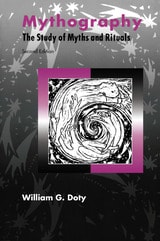
Mythography
The Study of Myths and RitualsWilliam G. Doty
University of Alabama Press, 2000
This new edition of William Doty's critically acclaimed study provides a comprehensive guidebook to the many schools of interpretation in this burgeoning field
William Doty's popular text has been hailed as the most comprehensive work of its kind. Extensively rewritten and completely restructured, the new edition provides further depth and perspective and is even more accessible to students of myth. It includes expanded coverage of postmodern and poststructuralist perspectives, the Gernet Center, mythic iconography, neo-Jungian approaches, and cultural studies, and it summarizes what is new in the study of Greek myth, iconography, French classical scholarship, and ritual studies. It also features a comprehensive index of names and topics, a glossary, an up-to-date annotated bibliography, and a guide to myth on the Internet.
Presenting all major myth theorists from antiquity to the present, Mythography is an encyclopedic work that offers a cross-disciplinary approach to the study of myth. By reflecting the dramatic increase in interest in myth among both scholars and general readers since publication of the first edition, it remains a key study of modern approaches to myth and
an essential guide to the wealth of mythographic research available today.
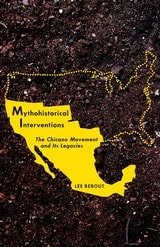
Mythohistorical Interventions
The Chicano Movement and Its LegaciesLee Bebout
University of Minnesota Press, 2010
Examining the deployment of the Aztec eagle by the United Farm Workers union, the poem Yo Soy Joaquín, the document El Plan de Santa Barbara, and icons like La Malinche and La Virgen de Guadalupe, Bebout reveals the centrality of culture to the Chicano movement. For Bebout, the active implementation of cultural narrative was strategically significant in several ways. First, it allowed disparate movement participants to imagine themselves as part of a national, and nationalist, community of resistance. Second, Chicano use of these narratives contested the images that fostered Anglo-American hegemony.
Bringing his analysis up to the present, Bebout delineates how demographic changes have, on the one hand, encouraged the possibility of a panethnic Latino community, while, on the other hand, anti-Mexican nativists attempt to resurrect Chicano myths as a foil to restrict immigration from Mexico.