Results by title
94 books match the query 'Techniques' and 3 start with m
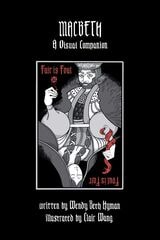
Macbeth
A Visual CompanionWendy Beth Hyman
Arizona Center for Medieval and Renaissance Studies, 2026
A collaboration between experienced Shakespeare scholar-educator Wendy Beth Hyman and her former student, emerging queer illustrator and animator Clair Wang, that seeks to visualize the literary language of Macbeth.
Macbeth: A Visual Companion offers a unique resource to readers, teachers, and performers of Shakespeare: an illustrated guide to those literary features of Shakespeare’s texts that can’t be represented on stage. How do you unravel a complex metaphor, an antiquated pun, an embedded allegory? What if allusions and images and similes could appear before the reader’s eyes? What if we could learn to read as Renaissance readers did: with fewer footnotes, but greater capacity to “see” literary language like chiasmus or equivocation? This is the aim of this creative collaboration.
Designed to be read alongside the free online editions provided by the Folger Shakespeare Library, Macbeth: A Visual Companion illuminates the most obscure features of a very complex play, empowering readers to unpack Shakespeare without reliance on watered-down modernizations or even staged productions. Hyman and Wang present a two-part strategy. One, illustrations that, rather than counterfeiting the action of drama, provide a visual representation of the inner worlds of language. And two, scholarly commentary that, rather than inertly explain or obtusely theorize difficulty, shows how literary devices themselves generate meaning. They thus model for readers how to access metaphors, allusions, and images in real time—just like Shakespeare’s original audience did. In the process, they aim to empower students and non-specialist teachers not only to understand Macbeth or Shakespeare more generally, but also to showcase a model for more confidently grappling with challenging literary texts of all kinds.

Materials & Techniques in the Decorative Arts
An Illustrated DictionaryEdited by Lucy Trench
University of Chicago Press, 2000
Compiled by a team of experts, each with an intimate knowledge of his or her subject, the entries are written in clear, accessible language and supplemented by numerous photographs and drawings. Each core material (glass, ceramics, textiles, paper, plastics, leather, metal, stone, wood, and paint) is covered from its raw state through any processing or preparation to various craft stages and finally, to any surface finishing.
Traditionally, the kind of information found in these pages has been passed on from craftsman to craftsman or confined to highly specialized books, and even common terms are often misunderstood. This dictionary makes the subject accessible to all—from art and architectural historians, curators, collectors, restoration specialists, artists, and museum staff to decorators, aficionados, and those who enjoy watching Antiques Roadshow. In short, this book is for all those who are intrigued by the materials and techniques used to create the beautiful objects that surround us.
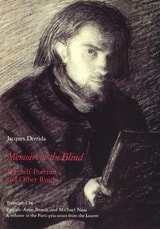
Memoirs of the Blind
The Self-Portrait and Other RuinsJacques Derrida
University of Chicago Press, 1993
vision, blindness, self-representation, and their relation to
drawing, while offering detailed readings of an extraordinary
collection of images. Selected by Derrida from the prints
and drawings department of the Louvre, the works depict
blindness—fictional, historical, and biblical. From Old
and New Testament scenes to the myth of Perseus and the
Gorgon and the blinding of Polyphemus, Derrida uncovers in
these images rich, provocative layers of interpretation.
For Derrida drawing is itself blind; as an act rooted in
memory and anticipation, drawing necessarily replaces one
kind of seeing (direct) with another (mediated). Ultimately,
he explains, the very lines which compose any drawing are
themselves never fully visible to the viewer since they exist
only in a tenuous state of multiple identities: as marks on
a page, as indicators of a contour. Lacking a "pure"
identity, the lines of a drawing summon the supplement of the
word, of verbal discourse, and, in doing so, obscure the
visual experience. Consequently, Derrida demonstrates, the
very act of depicting a blind person undertakes multiple
enactments and statements of blindness and sight.
Memoirs of the Blind is both a sophisticated
philosophical argument and a series of detailed readings.
Derrida provides compelling insights into famous and lesser
known works, interweaving analyses of texts—including
Diderot's Lettres sur les aveugles, the notion of
mnemonic art in Baudelaire's The Painter of Modern
Life, and Merleau-Ponty's The Visible and the
Invisible. Along with engaging meditations on the history
and philosophy of art, Derrida reveals the ways viewers
approach philosophical ideas through art, and the ways art
enriches philosophical reflection.
An exploration of sight, representation, and art,
Memoirs of the Blind extends and deepens the
meditation on vision and painting presented in Truth and
Painting. Readers of Derrida, both new and familiar, will
profit from this powerful contribution to the study of the
visual arts.