Results by title
71 books match the query 'Textbooks for foreign speakers' and 4 start with m
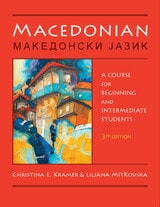
Macedonian
A Course for Beginning and Intermediate StudentsChristina E. Kramer
University of Wisconsin Press, 2011
Macedonian, the official language of the Republic of Macedonia, is spoken by two and a half million people in the Balkans, North America, Australia, and other émigré communities around the world. Christina E. Kramer’s award-winning textbook provides a basic introduction to the language. Students will learn to speak, read, write, and understand Macedonian while discussing family, work, recreation, music, food, health, housing, travel, and other topics.
Intended to cover one year of intensive study, this third edition updates the vocabulary, adds material to help students appreciate the underlying structure of the language, and offers a wide variety of new, proficiency-based readings and exercises to boost knowledge of Macedonian history, culture, literature, folklore, and traditions.
Winner, Best Contribution to Language Pedagogy, American Association of Teachers of Slavic and Eastern European Languages
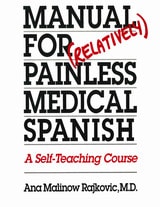
Manual for (Relatively) Painless Medical Spanish
A Self-Teaching CourseBy Ana Malinow Rajkovic
University of Texas Press, 1992
Spanish-speaking patients are no rarity in United States hospitals and clinics, as many English-speaking health care providers have discovered. To help these providers better communicate with the patients they serve, Ana Malinow Rajkovic has prepared the Manual for (Relatively) Painless Medical Spanish, a lively and innovative self-teaching guide to the grammar, pronunciation, and medical vocabulary of Spanish.
Presented in a systematic and highly entertaining fashion, twelve lessons cover some of the most commonly encountered situations. These include the family clinic, the emergency room, appendicitis, the social chat, pregnancy, family planning, pelvic inflammatory disease and urinary tract infection, depression, children with asthma, patients with angina, explaining a venipuncture and a spinal tap, and patients with shortness of breath. Each lesson closes with a bilingual interview that includes vocabulary and grammar introduced in that lesson. A guide to the medical history and physical examination appears in English and Spanish in the appendix.
Excellent in the classroom or for independent learning, the Manual will enable health care providers better to understand and supply the needs of Spanish-speaking patients.
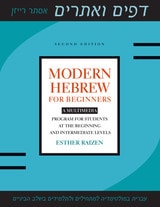
Modern Hebrew for Beginners
A Multimedia Program for Students at the Beginning and Intermediate LevelsBy Esther Raizen
University of Texas Press, 2016
Modern Hebrew for Beginners—which is now revised and updated—and Modern Hebrew for Intermediate Students are the core of a multimedia program for the college-level Hebrew classroom developed at the University of Texas at Austin in the early 2000s. Within an intensive framework of instruction that assumes six weekly hours in the classroom, the program provides for two semesters of instruction, at the end of which most successful students will reach the intermediate-mid or intermediate-high levels of proficiency in speaking and reading, and some will reach advanced-low proficiency, as defined by the American Council on the Teaching of Foreign Languages (ACTFL).
In addition to a variety of written exercises, the workbook includes vocabulary lists, reading selections, discussions of cultural topics, illustrations of grammar points, notes on registers, suggestions for class and individual activities, and glossaries. The workbook is complemented by a website (http://www.laits.utexas.edu/hebrew) that provides short video segments originally scripted and filmed in Israel and the United States, vocabulary flashcards with sound, interactive exercises on topics included in the workbook, sound files parallel to the reading selections in the workbook, and additional materials that enhance the learning experience. The stability of the workbook, combined with the dynamic nature of the website and the internet searches the students are directed to conduct, allows language instructors to reshape the curriculum and adapt it to the needs of their students and the goals of their programs.
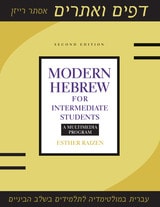
Modern Hebrew for Intermediate Students
A Multimedia ProgramBy Esther Raizen
University of Texas Press, 2016
Modern Hebrew for Intermediate Students—which is now revised and updated—and Modern Hebrew for Beginners are the core of a multimedia program for the college-level Hebrew classroom developed at the University of Texas at Austin in the early 2000s. Within an intensive framework of instruction that assumes six weekly hours in the classroom, the program provides for two semesters of instruction, at the end of which most successful students will reach the intermediate-mid or intermediate-high levels of proficiency in speaking and reading, and some will reach advanced-low proficiency, as defined by the American Council on the Teaching of Foreign Languages (ACTFL).
In addition to a variety of written exercises, the workbook includes vocabulary lists, reading selections, discussions of cultural topics, illustrations of grammar points, notes on registers, suggestions for class and individual activities, and glossaries. The workbook is complemented by a website (http://www.laits.utexas.edu/hebrew) that provides short video segments originally scripted and filmed in Israel and the United States, vocabulary flashcards with sound, interactive exercises on topics included in the workbook, sound files parallel to the reading selections in the workbook, and additional materials that enhance the learning experience. The stability of the workbook, combined with the dynamic nature of the website and the internet searches the students are directed to conduct, allows language instructors to reshape the curriculum and adapt it to the needs of their students and the goals of their programs.