Results by title
91 books match the query 'Theater and society' and 5 start with m
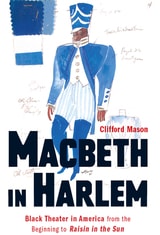
Macbeth in Harlem
Black Theater in America from the Beginning to Raisin in the SunClifford Mason
Rutgers University Press, 2020
2020 George Freedley Memorial Award Special Jury Prize from the Theatre Library Association
2021 PROSE Awards Finalist, Music & the Performing Arts
In 1936 Orson Welles directed a celebrated all-black production of Macbeth that was hailed as a breakthrough for African Americans in the theater. For over a century, black performers had fought for the right to perform on the American stage, going all the way back to an 1820s Shakespearean troupe that performed Richard III, Othello, and Macbeth, without relying on white patronage.
"Macbeth" in Harlem tells the story of these actors and their fellow black theatrical artists, from the early nineteenth century to the dawn of the civil rights era. For the first time we see how African American performers fought to carve out a space for authentic black voices onstage, at a time when blockbuster plays like Uncle Tom’s Cabin and The Octoroon trafficked in cheap stereotypes. Though the Harlem Renaissance brought an influx of talented black writers and directors to the forefront of the American stage, they still struggled to gain recognition from an indifferent critical press.
Above all, "Macbeth" in Harlem is a testament to black artistry thriving in the face of adversity. It chronicles how even as the endemic racism in American society and its theatrical establishment forced black performers to abase themselves for white audiences’ amusement, African Americans overcame those obstacles to enrich the nation’s theater in countless ways.
[more]
Makeshift Chicago Stages
A Century of Theater and PerformanceEdited by Megan E. Geigner, Stuart J. Hecht, and Jasmine Jamillah Mahmoud
Northwestern University Press, 2021
Since Chicago’s founding, theater has blossomed in the city’s makeshift spaces, from taverns to parks, living rooms to storefronts. Makeshift Chicago Stages brings together leading historians to share the history of theater and performance in the Second City. The essays collected here theorize a regional theater history and aesthetic that are inherently improvisational, rough-and-tumble, and marginal, reflecting the realities of a hypersegregated city and its neighborhoods. Space and place have contributed to Chicago’s reputation for gritty, ensemble-led work, part of a makeshift ethos that exposes the policies of the city and the transgressive possibilities of performance.
This book examines the rise and proliferation of Chicago’s performance spaces, which have rooted the city’s dynamic, thriving theater community. Chapters cover well‑known, groundbreaking, and understudied theatrical sites, ensembles, and artists, including the 1893 Columbian Exposition Midway Plaisance, the 57th Street Artist Colony, the Fine Arts Building, the Goodman Theatre, the Federal Theatre Project, the Kingston Mines and Body Politic Theaters, ImprovOlympics (later iO), Teatro Vista, Theaster Gates, and the Chicago Home Theater Festival. By putting space at the center of the city’s theater history, the authors in Makeshift Chicago Stages spotlight the roles of neighborhoods, racial dynamics, atypical venues, and borders as integral to understanding the work and aesthetics of Chicago’s artists, ensembles, and repertoires, which have influenced theater practices worldwide. Featuring rich archival work and oral histories, this anthology will prove a valuable resource for theater historians, as well as anyone interested in Chicago’s cultural heritage.
This book examines the rise and proliferation of Chicago’s performance spaces, which have rooted the city’s dynamic, thriving theater community. Chapters cover well‑known, groundbreaking, and understudied theatrical sites, ensembles, and artists, including the 1893 Columbian Exposition Midway Plaisance, the 57th Street Artist Colony, the Fine Arts Building, the Goodman Theatre, the Federal Theatre Project, the Kingston Mines and Body Politic Theaters, ImprovOlympics (later iO), Teatro Vista, Theaster Gates, and the Chicago Home Theater Festival. By putting space at the center of the city’s theater history, the authors in Makeshift Chicago Stages spotlight the roles of neighborhoods, racial dynamics, atypical venues, and borders as integral to understanding the work and aesthetics of Chicago’s artists, ensembles, and repertoires, which have influenced theater practices worldwide. Featuring rich archival work and oral histories, this anthology will prove a valuable resource for theater historians, as well as anyone interested in Chicago’s cultural heritage.
[more]
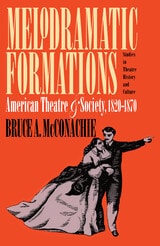
Melodramatic Formations
American Theatre and Society, 1820-1870Bruce A. Mcconachie
University of Iowa Press, 1992
The middle years of the nineteenth century were a time of dynamic artistic and social changes in America. Now, Melodramatic Formations is the first study to trace these changes in popular stage melodrama's production, dramatic form, and audience reception. Bruce McConachie shows how the theatrical mutability that characterized the years 1820 to 1870 is inextricably tied to the decline of elite paternalism and republicanism and the rise of bourgeois rationalism and respectability.
Taking a rigorous interdisciplinary approach, McConachie examines several historical regularities of production, genre, and audience. Here theatre (and its drama) has at long last been returned to its general culture, rather than being treated as an isolated phenomenon. Ultimately, he develops a new notion of a theatrical formation—a construct where groups of spectators and theatre performers produce each other as artists-to-be-experienced and audiences-to-be-entertained.
Throughout Melodramatic Formations McConachie illustrates how theatre both maintains and produces various ideologies; he convincingly shows that theatre is a major player in our social and cultural history. This book will be of interest to all in American studies, theatre history, and American cultural history.
[more]
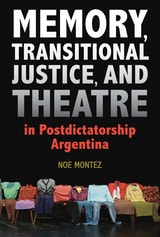
Memory, Transitional Justice, and Theatre in Postdictatorship Argentina
Noe Montez
Southern Illinois University Press, 2018
Author Noe Montez considers how theatre, as a site of activism, produces memory narratives that change public reception to a government’s transitional justice policies. Drawing on contemporary research in memory studies and transitional justice, Montez examines the Argentine theatre’s responses to the country’s transitional justice policies—truth and reconciliation hearings, trials, amnesties and pardons, and memorial events and spaces—that have taken place in the last decade of the twentieth century and the first two decades of the twenty-first century.
Montez explores how the sociohistorical phenomenon of the Teatroxlaidentidad—an annual showcase staged with the support of Argentina’s Grandmothers of the Plaza de Mayo—acted as a vehicle for drawing attention to the hundreds of children kidnapped from their families during the dictatorship and looks at why the memory narratives regarding the Malvinas Islands (also known as the Falklands) range from ideological appropriations of the islands, to absurdist commentaries about the failed war that signaled the dictatorship’s end, to the islands’ heavily contested status today.
Memory, Transitional Justice, and Theatre in Postdictatorship Argentina explores the vibrant role of theatrical engagement in postdictatorship Argentina, analyzes plays by artists long neglected in English-language articles and books, and explores the practicalities of staging performances in Latin America.
[more]
Movable Londons
Performance and the Modern CityJulia H Fawcett
University of Michigan Press, 2025
In September 1666, a fire sparked in a bakery on Pudding Lane grew until it had destroyed four-fifths of central London. The rebuilding efforts that followed not only launched the careers of some of London’s most famous architects, but also transformed Londoners’ relationship to their city by underscoring the ways that people could shape a city’s spaces—and the ways that a city’s spaces could shape its people. Movable Londons looks to the Restoration theater to understand how the dispossessed made London into a modern city after the Great Fire of 1666 and how the introduction of changeable scenery in theaters altered how Londoners conceptualized the city. Fawcett makes a claim for the centrality of unplanned spaces and the role of the Restoration theater in articulating those spaces as the modern city emerged and argues that movable scenery revolutionized London’s public theaters, inviting audiences to observe how the performers—many of them hailing from the same communities as their characters—navigated the stage.
[more]