Results by title
303 books match the query 'Time' and 14 start with m
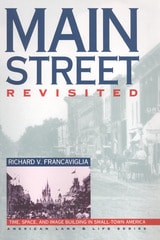
Main Street Revisited
Time, Space, and Image Building in Small-Town AmericaRichard V. Francaviglia
University of Iowa Press, 1996
As an archetype for an entire class of places, Main Street has become one of America's most popular and idealized images. In Main Street Revisited, the first book to place the design of small downtowns in spatial and chronological context, Richard Francaviglia finds the sources of romanticized images of this archetype, including Walt Disney's Main Street USA, in towns as diverse as Marceline, Missouri, and Fort Collins, Colorado.
Francaviglia interprets Main Street both as a real place and as an expression of collective assumptions, designs, and myths; his Main Streets are treasure troves of historic patterns. Using many historical and contemporary photographs and maps for his extensive fieldwork and research, he reveals a rich regional pattern of small-town development that serves as the basis for American community design. He underscores the significance of time in the development of Main Street's distinctive personality, focuses on the importance of space in the creation of place, and concentrates on popular images that have enshrined Main Street in the collective American consciousness.
Mashairi ya Vita vya Kuduhu
War Poetry in Kiswahili Exchanged at the Time of the Battle of KuduhuAnn Biersteker
Michigan State University Press, 1995
Mashairi Ya Vita Vya Kuduhu is a presentation and discussion of both manuscript and published versions of poems written by Lamu poets around the time of the Battle of Kuduhu. The poetic dialogue studied in this volume has played a significant role in the history of Swahili poetry, and its primary concern is to inform continued work in this area. The poems contained in this work were transmitted and preserved by speakers of Kiswahili and later collected and preserved by scholars. Chapter One contains the edited poems; Chapter Two consists of the translations. Subsequent chapters include accounts of the Battle of Kuduhu, editing and translating practices, and annotated poems and source versions. This work is presented as an example of the importance of research, fieldwork, and the consideration of available versions and alternative styles of presentation in the study of Swahili poetry.
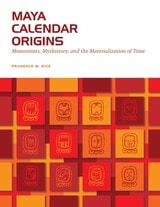
Maya Calendar Origins
Monuments, Mythistory, and the Materialization of TimeBy Prudence M. Rice
University of Texas Press, 2007
In Maya Political Science: Time, Astronomy, and the Cosmos, Prudence M. Rice proposed a new model of Maya political organization in which geopolitical seats of power rotated according to a 256-year calendar cycle known as the May. This fundamental connection between timekeeping and Maya political organization sparked Rice's interest in the origins of the two major calendars used by the ancient lowland Maya, one 260 days long, and the other having 365 days. In Maya Calendar Origins, she presents a provocative new thesis about the origins and development of the calendrical system.
Integrating data from anthropology, archaeology, art history, astronomy, ethnohistory, myth, and linguistics, Rice argues that the Maya calendars developed about a millennium earlier than commonly thought, around 1200 BC, as an outgrowth of observations of the natural phenomena that scheduled the movements of late Archaic hunter-gatherer-collectors throughout what became Mesoamerica. She asserts that an understanding of the cycles of weather and celestial movements became the basis of power for early rulers, who could thereby claim "control" over supernatural cosmic forces. Rice shows how time became materialized—transformed into status objects such as monuments that encoded calendrical or temporal concerns—as well as politicized, becoming the foundation for societal order, political legitimization, and wealth. Rice's research also sheds new light on the origins of the Popol Vuh, which, Rice believes, encodes the history of the development of the Mesoamerican calendars. She also explores the connections between the Maya and early Olmec and Izapan cultures in the Isthmian region, who shared with the Maya the cosmovision and ideology incorporated into the calendrical systems.
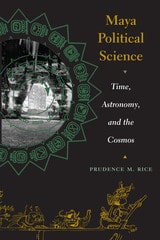
Maya Political Science
Time, Astronomy, and the CosmosBy Prudence M. Rice
University of Texas Press, 2004
How did the ancient Maya rule their world? Despite more than a century of archaeological investigation and glyphic decipherment, the nature of Maya political organization and political geography has remained an open question. Many debates have raged over models of centralization versus decentralization, superordinate and subordinate status—with far-flung analogies to emerging states in Europe, Asia, and Africa. But Prudence Rice asserts that neither the model of two giant "superpowers" nor that which postulates scores of small, weakly independent polities fits the accumulating body of material and cultural evidence.
In this groundbreaking book, Rice builds a new model of Classic lowland Maya (AD 179-948) political organization and political geography. Using the method of direct historical analogy, she integrates ethnohistoric and ethnographic knowledge of the Colonial-period and modern Maya with archaeological, epigraphic, and iconographic data from the ancient Maya. On this basis of cultural continuity, she constructs a convincing case that the fundamental ordering principles of Classic Maya geopolitical organization were the calendar (specifically a 256-year cycle of time known as the may) and the concept of quadripartition, or the division of the cosmos into four cardinal directions. Rice also examines this new model of geopolitical organization in the Preclassic and Postclassic periods and demonstrates that it offers fresh insights into the nature of rulership, ballgame ritual, and warfare among the Classic lowland Maya.
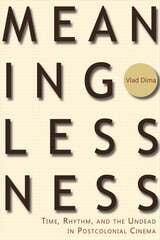
Meaninglessness
Time, Rhythm, and the Undead in Postcolonial CinemaVlad Dima
Michigan State University Press, 2023
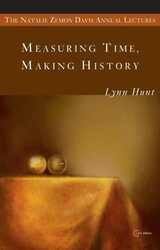
Measuring Time, Making History
Lynn Hunt
Central European University Press, 2008
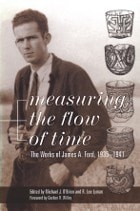
Measuring the Flow of Time
The Works of James A. Ford, 1935-1941James A. Ford, edited by R. Lee Lyman and Michael J. O'Brien
University of Alabama Press, 1999
This collection of Ford's works focuses on the development of ceramic chronology—a key tool in Americanist archaeology.
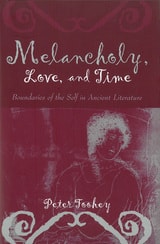
Melancholy, Love, and Time
Boundaries of the Self in Ancient LiteraturePeter Toohey
University of Michigan Press, 2004
Memory Construction and the Politics of Time in Neoliberal South Korea
Namhee Lee
Duke University Press, 2022
Memory, Myth, and Time in Mexico
From the Aztecs to IndependenceBy Enrique Florescano
University of Texas Press, 1994
In Memory, Myth, and Time in Mexico, noted Mexican scholar Enrique Florescano’s Memoria mexicana becomes available for the first time in English. A collection of essays tracing the many memories of the past created by different individuals and groups in Mexico, the book addresses the problem of memory and changing ideas of time in the way Mexicans conceive of their history. Original in perspective and broad in scope, ranging from the Aztec concept of the world and history to the ideas of independence, this book should appeal to a wide readership.
Metropolitan Resilience in a Time of Economic Turmoil
Edited by Michael A. Pagano
University of Illinois Press, 2013
Cities, counties, school districts and other local governments have suffered a long-lasting period of fiscal challenges since the beginning of the Great Recession. Metropolitan governments continue to adjust to the "new normal" of sharply lower property values, consumer sales, and personal income. Contributors to this volume include elected officials, academics, key people in city administrations, and other nationally recognized experts who discuss solutions to the urban problems created by the Great Recession.
Metropolitan Resilience in a Time of Economic Turmoil looks at the capacity of local governments to mobilize resources efficiently and effectively, as well as the overall effects of the long-term economic downturn on quality of life. Introducing the reader to the fiscal effects of the Great Recession on cities, the book examines the initial fraying and subsequent mending of the social safety net, the opportunities for pursuing economic development strategies, the challenges of inter-jurisdictional cooperation, and the legacy costs of pension liabilities and infrastructure decay.
Contributors are Phil Ashton, Raphael Bostic, Richard Feiock, Rachel A. Gordon, Rebecca Hendrick, Geoffrey J.D. Hewings, David Merriman, Richard Nathan, Michael A. Pagano, Breeze Richardson, Annette Steinacker, Nik Theodore, Rachel Weber, and Margaret Weir.
Microdramas
Crucibles for Theater and TimeJohn H. Muse
University of Michigan Press, 2017
Subjecting short plays to extended scrutiny upends assumptions about brief or minimal art, and about theatrical experience. The book shows that short performances often demand greater attention from audiences than plays that unfold more predictably. Microdramas put pressure on preconceptions about which aspects of theater might be fundamental and about what might qualify as an event. In the process, they suggest answers to crucial questions about time, spectatorship, and significance.
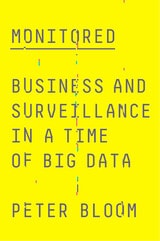
Monitored
Business and Surveillance in a Time of Big DataPeter Bloom
Pluto Press, 2019
What does this technocratic ideology and surveillance-heavy culture reveal about the deeper reality of modern society? Monitored investigates the history and implications of this modern accountability paradox. Peter Bloom reveals pervasive monitoring practices which mask how at its heart, the elite remains socially and ethically out of control.
Challenging their exploitive 'accounting power', Bloom demands that the systems that administer our lives are oriented to social liberation and new ways of being in the world.

Mothering in the Time of Coronavirus
Amy Lutz, Sujung (Crystal) Lee, and Baurzhan Bokayev
University of Massachusetts Press, 2025
When stay-at-home orders during the COVID-19 pandemic erased the division between home and school, many parents in the United States were suddenly expected to become their children’s teachers. Despite this new arrangement, older gender norms largely remained in place, and these extra child rearing responsibilities fell disproportionately on mothers. Mothering in the Time of Coronavirus explores how they juggled working, supervising at-home learning, and protecting their children’s emotional and physical health during the outbreak.
Focusing on both remote and essential workers in central New York, Amy Lutz, Sujung (Crystal) Lee, and Baurzhan Bokayev argue that the pandemic transformed an already intensive style of contemporary American child rearing, in which mothers are expected to be constantly available to meet their children’s needs even when they are working outside the home, into extremely intensive mothering. The authors investigate the consequences of this shift, and how it is influenced by issues such as class and race. They also bring attention to how and why current public policies are not conducive to the de-intensification of motherhood. Locating their study within larger intersections of gender, family, and education, they contend that to fully appreciate the broader social consequences of COVID-19, we must understand the experiences of mothers.