155 books match the query 'Toward' and 10 start with m
cover of Machado de Assis: Toward a Poetics of Emulation

Machado de Assis

Toward a Poetics of Emulation

João Cezar de Castro Rocha

Michigan State University Press, 2015

This book offers an alternative explanation for one of the core dilemmas of Brazilian literary criticism: the “midlife crisis” Machado de Assis underwent from 1878 to 1880, the result of which was the writing of The Posthumous Memoirs of Brás Cubas, as well as the remarkable production of his mature years—with an emphasis on his masterpiece, Dom Casmurro.

At the center of this alternative explanation, Castro Rocha situates the fallout from the success enjoyed by Eça de Queirós with the publication of Cousin Basílio and Machado’s two long texts condemning the author and his work. Literary and aesthetic rivalries come to the fore, allowing for a new theoretical framework based on a literary appropriation of “thick description,” the method proposed by anthropologist Clifford Geertz. From this method, Castro Rocha derives his key hypothesis: an unforeseen consequence of Machado’s reaction to Eça’s novel was a return to the classical notion of aemulatio, which led Machado to develop a “poetics of emulation.”
[more]
cover of Making Senses of the Past: Toward a Sensory Archaeology

Making Senses of the Past

Toward a Sensory Archaeology

Edited by Jo Day

Southern Illinois University Press, 2013

Since the nineteenth century, museums have kept their artifacts in glass cases to better preserve them, and drawings and photographs have become standard ways of presenting the past. These practices have led to an archaeology dominated by visual description, even though human interaction with the surrounding world involves the whole body and all of its senses. In the past few years, sensory archaeology has become more prominent, and Making Senses of the Past is one of the first collected volumes on this subject. This book presents cutting-edge research on new theoretical issues. The essays presented here take readers on a multisensory journey around the world and across time.

In ancient Peru, a site provides sensory surprises as voices resound beneath the ground and hidden carvings slowly reveal their secrets. In Canada and New Zealand, the flicker of reflected light from a lake dances on the faces of painted rocks and may have influenced when and why the pigment was applied. In Mesopotamia, vessels for foodstuffs build a picture of a past cuisine that encompasses taste and social activity in the building of communities. While perfume and flowers are examined in various cultures, in the chamber tombs of ancient Roman Palestine, we are reminded that not all smells are pleasant. Making Senses of the Past explores alternative ways to perceive past societies and offers a new way of wiring archaeology that incorporates the senses.
[more]
cover of Materializing Democracy: Toward a Revitalized Cultural Politics

Materializing Democracy

Toward a Revitalized Cultural Politics

Russ Castronovo and Dana D. Nelson, eds.

Duke University Press, 2002

For the most part, democracy is simply presumed to exist in the United States. It is viewed as a completed project rather than as a goal to be achieved. Fifteen leading scholars challenge that stasis in Materializing Democracy. They aim to reinvigorate the idea of democracy by placing it in the midst of a contentious political and cultural fray, which, the volume’s editors argue, is exactly where it belongs. Drawing on literary criticism, cultural studies, history, legal studies, and political theory, the essays collected here highlight competing definitions and practices of democracy—in politics, society, and, indeed, academia.

Covering topics ranging from rights discourse to Native American performance, from identity politics to gay marriage, and from rituals of public mourning to the Clinton-Lewinsky affair, the contributors seek to understand the practices, ideas, and material conditions that enable or foreclose democracy’s possibilities. Through readings of subjects as diverse as Will Rogers, Alexis de Tocqueville, slave narratives, interactions along the Texas-Mexico border, and liberal arts education, the contributors also explore ways of making democracy available for analysis. Materializing Democracy suggests that attention to disparate narratives is integral to the development of more complex, vibrant versions of democracy.

Contributors. Lauren Berlant, Wendy Brown, Chris Castiglia, Russ Castronovo, Joan Dayan, Wai Chee Dimock, Lisa Duggan, Richard R. Flores, Kevin Gaines, Jeffrey C. Goldfarb, Michael Moon, Dana D. Nelson, Christopher Newfield, Donald E. Pease
[more]
cover of Media Travels: Toward an Atlas of Global Media

Media Travels

Toward an Atlas of Global Media

Juan Llamas-Rodriguez

Amherst College Press, 2025

Media Travels: Toward An Atlas of Global Media fills a significant gap in global media scholarship by offering short, readable articles covering different types of media from around the world. Through careful and informed analysis, these eleven accessibly written chapters illustrate the particularities of different media practices and situate them within social, historical, and geographical contexts. Examples range from South African video games to Korean TV series popular in Latin America to Indigenous film and media from the US and Canada.

Media studies courses, particularly introductory courses, are often narrowly focused on US and Western European canons. Instructors for introductory media studies courses wishing to expand the offerings in their curricula will find in these essays new ways of approaching foundational concepts and issues in the field, including globalization, social difference, and diverse media cultures. Scholars wishing to expand their research into specific media forms or representational issues can also turn to these case studies for approaches from beyond the US. By including a variety of media and several geographical areas, the collection introduces readers to the formal, technological, and cultural diversity of global media studies.

Edited by Juan Llamas-Rodriguez with contributions from Anthony Adah and Añulika Agina, Maria Corrigan, Benjamin Han, Anna Shah Hoque, Meryem Kamil, Angelica Marie Lawson, Lilia Adriana Perez Limon, Sonia Robles, Kuhu Tanvir, David Tenorio, and Rachel van der Merwe.

[more]
cover of Mercy without End: Toward a More Inclusive Church

Mercy without End

Toward a More Inclusive Church

Lavina Fielding Anderson

Signature Books, 2020

These eighteen essays span more than thirty years of Lavina Fielding Anderson’s concerns about and reflections on issues of inclusiveness in the Church of Jesus Christ of Latter-day Saints, including her own excommunication for “apostasy” in 1993, followed by twenty-five years of continued attendance at weekly LDS ward meetings. Written with a taste for irony and an eye for documentation, the essays are timeless snapshots of sometimes controversial issues, beginning with official resistance to professionally researched Mormon history in the 1980s. They underscore unanswered questions about gender equality and repeatedly call attention to areas in which the church does not live up to its better self. Compassionately and responsibly, it calls Anderson’s beloved religion back to its holiest nature.
[more]
cover of Metawritings: Toward a Theory of Nonfiction

Metawritings

Toward a Theory of Nonfiction

Jill Talbot

University of Iowa Press, 2012

Metawriting—the writing about writing or writing that calls attention to itself as writing—has been around since Don Quixote and Tristram Shandy, but Jill Talbot makes that case that now more than ever the act of metawriting is performed on a daily basis by anyone with a Facebook profile, a Twitter account, or a webpage. Metawritings: Toward a Theory of Nonfiction is the first collection to combine metawriting in both fiction and nonfiction.
 
In this daring volume, metawriting refers to writing about writing, veracity in writing, the I of writing and, ultimately, the construction of writing. With a prologue by Pam Houston, the anthology of personal essays, short stories, and one film script excerpt also includes illuminating and engaging interviews with each contributor. Showcasing how writers perform a meta-awareness of self via the art of the story, the craft of the essay, the writings and interviews in this collection serve to create an engaging, provocative discussion of the fiction-versus-nonfiction debate, truth in writing, and how metawriting works (and when it doesn’t).
 
Metawritings provides a context for the presence of metawriting in contemporary literature within the framework of the digital age’s obsessively self-conscious modes of communication: status updates, Tweets, YouTube clips, and blogs (whose anonymity creates opportunities for outright deception) capture our meta-lives in 140 characters and video uploads, while we watch self-referential, self-conscious television (The Simpsons, The Daily Show with Jon Stewart, The Office). Speaking to the moment and to the writing that is capturing it, Talbot addresses a significant and current conversation in contemporary writing and literature, the teaching of writing, and the craft of writing. It is a sharp, entertaining collection of two genres, enhanced by a conversation about how we write and how we live in and through our writing.
 
Contributors
Sarah Blackman
Bernard Cooper
Cathy Day
Lena Dunham
Robin Hemley
Pam Houston
Kristen Iversen
David Lazar
E. J. Levy
Brenda Miller
Ander Monson
Brian Oliu
Jill Talbot
Ryan Van Meter

[more]
cover of Militarized Currents: Toward a Decolonized Future in Asia and the Pacific

Militarized Currents

Toward a Decolonized Future in Asia and the Pacific

Setsu Shigematsu

University of Minnesota Press, 2010
Foregrounding indigenous and feminist scholarship, this collection analyzes militarization as an extension of colonialism from the late twentieth to the twenty-first century in Asia and the Pacific. The contributors theorize the effects of militarization across former and current territories of Japan and the United States, such as Guam, Okinawa, the Marshall Islands, the Philippines, and Korea, demonstrating that the relationship between militarization and colonial subordination—and their gendered and racialized processes—shapes and produces bodies of memory, knowledge, and resistance.
 
Contributors: Walden Bello, U of the Philippines; Michael Lujan Bevacqua, U of Guam; Patti Duncan, Oregon State U; Vernadette Vicuña Gonzalez, U of Hawai‘i, M noa; Insook Kwon, Myongji U; Laurel A. Monnig, U of Illinois, Urbana–Champaign; Katharine H. S. Moon, Wellesley College; Jon Kamakawiwo‘ole Osorio, U of Hawai‘i, M noa; Naoki Sakai, Cornell U; Fumika Sato, Hitotsubashi U; Theresa Cenidoza Suarez, California State U, San Marcos; Teresia K. Teaiwa, Victoria U, Wellington; Wesley Iwao Ueunten, San Francisco State U.
[more]
cover of Multiculturalism and the Politics of Guilt: Toward a Secular Theocracy

Multiculturalism and the Politics of Guilt

Toward a Secular Theocracy

Paul Edward Gottfried

University of Missouri Press, 2003
Multiculturalism and the Politics of Guilt extends Paul Gottfried’s examination of Western managerial government’s growth in the last third of the twentieth century. Linking multiculturalism to a distinctive political and religious context, the book argues that welfare-state democracy, unlike bourgeois liberalism, has rejected the once conventional distinction between government and civil society.
            Gottfried argues that the West’s relentless celebrations of diversity have resulted in the downgrading of the once dominant Western culture. The moral rationale of government has become the consciousness-raising of a presumed majority population. While welfare states continue to provide entitlements and fulfill the other material programs of older welfare regimes, they have ceased to make qualitative leaps in the direction of social democracy. For the new political elite, nationalization and income redistributions have become less significant than controlling the speech and thought of democratic citizens. An escalating hostility toward the bourgeois Christian past, explicit or at least implicit in the policies undertaken by the West and urged by the media, is characteristic of what Gottfried labels an emerging “therapeutic” state.        
For Gottfried, acceptance of an intrusive political correctness has transformed the religious consciousness of Western, particularly Protestant, society. The casting of “true” Christianity as a religion of sensitivity only toward victims has created a precondition for extensive social engineering. Gottfried examines late-twentieth-century liberal Christianity as the promoter of the politics of guilt. Metaphysical guilt has been transformed into self-abasement in relation to the “suffering just” identified with racial, cultural, and lifestyle minorities. Unlike earlier proponents of religious liberalism, the therapeutic statists oppose anything, including empirical knowledge, that impedes the expression of social and cultural guilt in an effort to raise the self-esteem of designated victims.
            Equally troubling to Gottfried is the growth of an American empire that is influencing European values and fashions. Europeans have begun, he says, to embrace the multicultural movement that originated with American liberal Protestantism’s emphasis on diversity as essential for democracy. He sees Europeans bringing authoritarian zeal to enforcing ideas and behavior imported from the United States.
            Multiculturalism and the Politics of Guilt extends the arguments of the author’s earlier After Liberalism. Whether one challenges or supports Gottfried’s conclusions, all will profit from a careful reading of this latest diagnosis of the American condition.
[more]
cover of Museums, Monuments, and National Parks: Toward a New Genealogy of Public History

Museums, Monuments, and National Parks

Toward a New Genealogy of Public History

Denise D. Meringolo

University of Massachusetts Press, 2012

The rapid expansion of the field of public history since the 1970s has led many to believe that it is a relatively new profession. In this book, Denise D. Meringolo shows that the roots of public history actually reach back to the nineteenth century, when the federal government entered into the work of collecting and preserving the nation's natural and cultural resources. Scientists conducting research and gathering specimens became key figures in a broader effort to protect and interpret the nation's landscape. Their collaboration with entrepreneurs, academics, curators, and bureaucrats alike helped pave the way for other governmental initiatives, from the Smithsonian Institution to the parks and monuments today managed by the National Park Service.

All of these developments included interpretive activities that shaped public understanding of the past. Yet it was not until the emergence of the education-oriented National Park Service history program in the 1920s and 1930s that public history found an institutional home that grounded professional practice simultaneously in the values of the emerging discipline and in government service. Even thereafter, tensions between administrators in Washington and practitioners on the ground at National Parks, monuments, and museums continued to define and redefine the scope and substance of the field. The process of definition persists to this day, according to Meringolo, as public historians establish a growing presence in major universities throughout the United States and abroad.
[more]
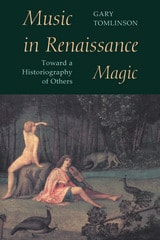
cover of Music in Renaissance Magic: Toward a Historiography of Others

Music in Renaissance Magic

Toward a Historiography of Others

Gary Tomlinson

University of Chicago Press, 1994

Magic enjoyed a vigorous revival in sixteenth-century Europe, attaining a prestige lost for over a millennium and becoming, for some, a kind of universal philosophy. Renaissance music also suggested a form of universal knowledge through renewed interest in two ancient themes: the Pythagorean and Platonic "harmony of the celestial spheres" and the legendary effects of the music of bards like Orpheus, Arion, and David. In this climate, Renaissance philosophers drew many new and provocative connections between music and the occult sciences.

In Music in Renaissance Magic, Gary Tomlinson describes some of these connections and offers a fresh view of the development of early modern thought in Italy. Raising issues essential to postmodern historiography—issues of cultural distance and our relationship to the others who inhabit our constructions of the past —Tomlinson provides a rich store of ideas for students of early modern culture, for musicologists, and for historians of philosophy, science, and religion.

"A scholarly step toward a goal that many composers have aimed for: to rescue the idea of New Age Music—that music can promote spiritual well-being—from the New Ageists who have reduced it to a level of sonic wallpaper."—Kyle Gann, Village Voice

"An exemplary piece of musical and intellectual history, of interest to all students of the Renaissance as well as musicologists. . . . The author deserves congratulations for introducing this new approach to the study of Renaissance music."—Peter Burke, NOTES

"Gary Tomlinson's Music in Renaissance Magic: Toward a Historiography of Others examines the 'otherness' of magical cosmology. . . . [A] passionate, eloquently melancholy, and important book."—Anne Lake Prescott, Studies in English Literature
[more]