Results by title
94 books match the query 'Transnationalism' and 8 start with m

Mangos, Chiles, and Truckers
The Business of TransnationalismRobert Alvarez Jr.
University of Minnesota Press, 2005
Contrary to common perceptions in postnational studies, Alvarez shows how the nation-state enacts and connects with the transnational, crossing borders in ways that underwrite new technology and trade. Emphasizing the importance and control of the nation-state in the global process, Mangos, Chiles, and Truckers demonstrates how people make meaning as they struggle with the economic circumstances of their lives, creating cultural traditions and giving new value to old customs and practices.
Robert R. Alvarez Jr. is professor of ethnic studies at the University of California, San Diego.
George Lipsitz is professor of American studies at the University of California, Santa Cruz.
Mexican Hometown Associations in Chicagoacán
From Local to Transnational Civic EngagementBada, Xóchitl
Rutgers University Press, 0
Hometown associations (HTAs) consist of immigrants from the same town in Mexico and often begin quite informally, as soccer clubs or prayer groups. As Bada’s work shows, however, HTAs have become a powerful force for change, advocating for Mexican immigrants in the United States while also working to improve living conditions in their communities of origin. Focusing on a group of HTAs founded by immigrants from the state of Michoacán, the book shows how their activism has bridged public and private spheres, mobilizing social reforms in both inner-city Chicago and rural Mexico.
Bringing together ethnography, political theory, and archival research, Bada excavates the surprisingly long history of Chicago’s HTAs, dating back to the 1920s, then traces the emergence of new models of community activism in the twenty-first century. Filled with vivid observations and original interviews, Mexican Hometown Associations in Chicagoacán gives voice to an underrepresented community and sheds light on an underexplored form of global activism.
Mexican Women and the Other Side of Immigration
Engendering Transnational TiesBy Luz María Gordillo
University of Texas Press, 2010
Weaving narratives with gendered analysis and historiography of Mexicans in the Midwest, Mexican Women and the Other Side of Immigration examines the unique transnational community created between San Ignacio Cerro Gordo, Jalisco, and Detroit, Michigan, in the last three decades of the twentieth century, asserting that both the community of origin and the receiving community are integral to an immigrant's everyday life, though the manifestations of this are rife with contradictions.
Exploring the challenges faced by this population since the inception of the Bracero Program in 1942 in constantly re-creating, adapting, accommodating, shaping, and creating new meanings of their environments, Luz María Gordillo emphasizes the gender-specific aspects of these situations. While other studies of Mexican transnational identity focus on social institutions, Gordillo's work introduces the concept of transnational sexualities, particularly the social construction of working-class sexuality. Her findings indicate that many female San Ignacians shattered stereotypes, transgressing traditionally male roles while their husbands lived abroad. When the women themselves immigrated as well, these transgressions facilitated their adaptation in Detroit. Placed within the larger context of globalization, Mexican Women and the Other Side of Immigration is a timely excavation of oral histories, archival documents, and the remnants of three decades of memory.

Mieres Reborn
The Reinvention of a Catalan CommunityA. F. Robertson
University of Alabama Press, 2012
Mieres Reborn reveals how patient observation and an analysis of one small community have much to tell us about human progress more generally.
Not long ago Mieres, a village in the eastern foothills of the Pyrenees, seemed destined to die. As in countless thousands of rural communities around the world, young people in Mieres over the years have moved to the towns and cities, leaving behind abandoned fields and meadows, derelict houses, and their aging and disconsolate parents and grandparents.
Close observation of this social microcosm over two decades reveals the capacity of ordinary people in a locality to reinvent themselves, reconstruct relationships with the wider world, and confront new threats to their collective survival. A. F. Robertson describes how the determination that Mieres should survive is most evident in a vigorous round of fiestas, fairs, and other public events in which natives, exiles, and newcomers work to create a lively sense of belonging. Since the 1980s, Mieres has been enlivened by a reverse flow of migrants from the cities, new settlers who have brought an infusion of youth to the community, devised new livelihoods, revitalized the village school, energized the native ”Mierencs,” and provided the impetus for a rediscovery of historical roots and political identity.
The regeneration of life in the countryside, in part a reaction to urban expansion and decay, is a global phenomenon of increasing political, economic, and social significance.
Migrant World Making
Sergio F Juárez
Michigan State University Press, 2023
Migration, Class and Transnational Identities
Croations in Australia and AmericaVal Colic-Pelsker
University of Illinois Press, 2007
Val Colic-Peisker harnesses concepts and theories from sociology, anthropology, and political science to compare the vastly different experiences of two Croatian immigrant cohorts in the city of Perth, Western Australia. The populations explored represent an earlier group of working-class migrants arriving from communist Yugoslavia from the 1950s to 1970s and a later group of urban professionals arriving in the 1980s and 1990s as 'independent' or skills-based migrants. This latter group integrated into professional ranks but also used their Australian experience as a stepping stone in becoming part of a highly mobile global professional middle class.
Employing a refined theoretical analysis, this rich ethnography challenges the domination of the ethnic perspective in migration studies and the idea of ethnic community itself. It emphasizes the importance of class, focusing on the intersection of class, ethnicity, and gender in the process of migration, migrant incorporation, and transnationalism. In theorizing the connection of the two migrant cohorts with their native Croatia, the study introduces concepts of "ethnic" and "cosmopolitan" transnationalism as two distinctive experiences mediated by class.

Minor Transnationalism
Françoise Lionnet and Shu-mei Shih, eds.
Duke University Press, 2005
Based in a broad range of fields—including literature, history, African studies, Asian American studies, Asian studies, French and francophone studies, and Latin American studies—the contributors complicate ideas of minority cultural formations and challenge the notion that transnationalism is necessarily a homogenizing force. They cover topics as diverse as competing versions of Chinese womanhood; American rockabilly music in Japan; the trope of mestizaje in Chicano art and culture; dub poetry radio broadcasts in Jamaica; creole theater in Mauritius; and race relations in Salvador, Brazil. Together, they point toward a new theoretical vocabulary, one capacious enough to capture the almost infinitely complex experiences of minority groups and positions in a transnational world.
Contributors. Moradewun Adejunmobi, Ali Behdad, Michael Bourdaghs, Suzanne Gearhart, Susan Koshy, Françoise Lionnet, Seiji M. Lippit, Elizabeth Marchant, Kathleen McHugh, David Palumbo-Liu, Rafael Pérez-Torres, Jenny Sharpe, Shu-mei Shih , Tyler Stovall
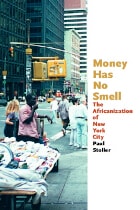
Money Has No Smell
The Africanization of New York CityPaul Stoller
University of Chicago Press, 2002
Blending fascinating ethnographic description with incisive social analysis, Stoller shows how these savvy West African entrepreneurs have built cohesive and effective multinational trading networks, in part through selling a simulated Africa to African Americans. These and other networks set up by the traders, along with their faith as devout Muslims, help them cope with the formidable state regulations and personal challenges they face in America. As Stoller demonstrates, the stories of these West African traders illustrate and illuminate ongoing debates about globalization, the informal economy, and the changing nature of American communities.